KimStanleyRobinson.info

The reference site for Kim Stanley Robinson

Author: Kimon K

  • More NY2140 interviews & reviews

    More NY2140 interviews & reviews

    KSR’s latest, New York 2140, has been out for over a month now, and has been gathering quite a few readers!


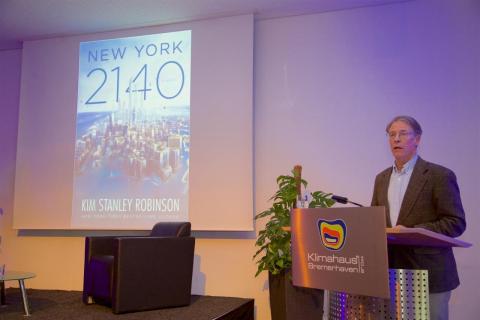
    To promote the book, KSR was on tour in Europe, with events in Barcelona, in Germany and in London. Top photo from an event at Klimahaus in Bremerhaven, Germany — photo by Fritz Heidorn/Oldenburg, Germany. More photos from KSR’s stay in Bremerhaven and Berlin as well as a couple of short videos can be found here.


    In London, an event united 3 excellent writers, KSR, Adam “Yellow Blue Tibia” Roberts and Francis “Red Plenty” Spufford (whose latest novel Golden Hill also takes place in Manhattan, but in the 18th century!). A report on that discussion over here.


    This interview for NYMag covers many NYC topics as one would expect, especially the detailed research on-site, i.e. walking around the city and getting to know its history.

    I thought of the book eventually as a comedy of coping, and to do that I picked a time, or perhaps 40 years after the disaster itself. […] science fiction has to imagine the people who come after, when the situation will be natural, whatever it is. […] I was invoking a somewhat nostalgic, more romantic New York of the imagination that’s more human scale, more neighborhood-focused, more localized, and more kind of hand-crafted, you might call it. 

    I wanted a finance novel that was heavily based on what lessons we learned — or did not learn — from the crash of 2008 and 2009. All science-fiction novels are about the future and about the present at the same time.

    [On Franklin the trader being a sympathetic character] I did that on purpose. People who succeed by using the currently shifting rules of capitalism are not villainous, nor have they broken the law or cheated. […] That point needed to be raised because, as Orson Welles once pointed out, everybody has their reasons. […] I must admit, in the first draft he was more of a jerk, but he began to step on the toes of the citizens. So with the changing of frighteningly few sentences I made him more of a geek. Not that different than my scientist characters who are funny because they try to evaluate social life as if we’re nothing but a theoretical problem in physics or sociobiology. I like my finance guy.

    Can you legislate fundamental change? Essentially we need fundamental change, we have to hope the answer is yes. Because the alternatives to legislation are all terrible. Legislation is by far the best method for big social change. Get the right congress in and the right World Trade Organization technocrats in and you change.


    In this interview with Inverse, “The Man who put Science in Science Fiction”, KSR talks about his writing, his method for world-building, these “infodumps” he’s well known for (and criticized (and praised) for), his characters in NY2140, his impressive use of epigraphs and quotes in this novel.

    Beyond the depiction of the future, what is this novel about?

    It’s about finance, and climate change, and New York as a place, and those particular characters, and what we could do now to influence events to make a better future for the people yet to come. Utopian climate change fiction: the obvious next hot genre.


    In the Science Friday podcast, KSR describes daily life in his future drowned New York. A “citizen” chapter of the novel can also be read at Science Friday.


    NY2140 as well as climate science, urban planning, urban agriculture and environmental humanities were discussed in a panel discussion at Rutgers University with KSR and Rutgers researchers. Here’s a report from that with quotes from faculty members.


    A surprising pairing took place in an event hosted by the Arthur C. Clarke Center for Human Imagination at UCSD — although not so surprising when one considers they are both fan favorites of the SF&F genre: George “A Song of Ice and Fire” R. R. “Game of Thrones” Martin and Kim Stanley Robinson! Here’s a summary of what was uttered at the event, along with some tease from both authors on what’s next: 

    Robinson teased the audience early on with the prospect of a film or television adaptation of his Mars Trilogy at some point in the future. […] As to whom [Martin] would like to see assume the Iron Throne, Martin left the audience with a message that could perhaps serve both to sum up the entirety of the event and to annoy any avid fans in attendance: “Keep reading.”


    Also: plenty of reviews of NY2140 are out!

    John Clute for Strange Horizons: “New York 2140 reads almost like a game. It is a scherzo, something happening all the time […] astonishingly full of joy: the joy of telling; the joy of sharing the reasoning behind events; the joy of inducing good people to cohabit.”

    Niall Alexander for Tor.com: “At six hundred plus pages, New York 2140 is somewhat short on plot for such a long novel, but it’s absolutely, positively packed with characters rife with life […] characters little and large cross paths, and as the narrative threads we’d thought independent—inconsequential, even—gather into something greater because they’re suddenly something shared.”

    Cory Doctorow for BoingBoing: “with New York 2140, Robinson starts to connect the dots between these different futures [2312, Aurora] with a bold, exhilarating story of life in a permanent climate crisis, where most people come together in adversity, but where a small rump of greedy, powerful people get in their way.”

    Gary K. Wolfe for Locus: “As such colorful and eccentric characters might suggest, a good portion of New York 2140 has an oddly Dickensian feel to it […] there have been more than a few environmental catastrophe tales set in a future New York, but possibly none of them have been this interesting.” (also for the Chicago Tribune)

    And some others:

    The usual linkstorm ends here. More will follow. In the meantime, you can start your own petition for a Mutt and Jeff vignette spinoff!
  • New York 2140 is out: interviews & reviews

    New York 2140 is out: interviews & reviews

    New York 2140, Kim Stanley Robinson’s latest, his 18th novel, just came out!

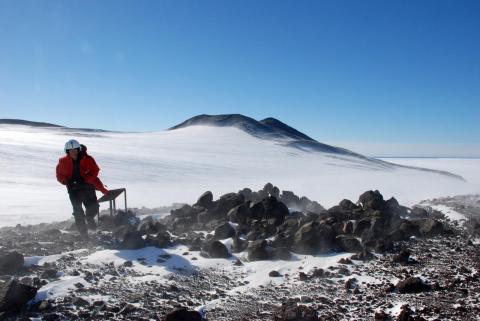
    Pictured above: KSR in Antarctica, from his second NSF-sponsored trip in 2016 (the first one in 1995 gave birth to the novel Antarctica). This is him reaching the Wilson rock hut on Igloo Spur, at Cape Crozier on Ross Island. It was built in 1911 to shelter Wilson, Cherry-Garrard and Bowers during the so-called “Worst Journey in the World“, one painful episode that is part of the ultimately failed British expedition led by Scott to reach the South Pole. KSR’s own account of his journey and reflections on the 1911 journey are upcoming.


    First, KSR interviews on and around NY2140. Some generic setting and characters spoilers.

    In this very quotable interview for Scientific American, KSR summarizes what the new novel is about thusly:

    It’s about climate change and sea level rise, but it’s also about the way that our economic system doesn’t allow us to afford a decent future. As one of the characters says early in the book, “We’ve got good tech, we’ve got a nice planet, but we’re fucking it up by way of stupid laws.”

    Finance, globalization—this current moment of capitalism—has a stranglehold on the world by way of all our treaties and laws, but it adds up to a multigenerational Ponzi scheme, an agreement on the part of everybody to screw the future generations for the sake of present profits. By the logic of our current system we have to mess up the Earth, and that is crazy. My new novel explores this problem and how we might get out of it.

    KSR goes on about the climate science, the fact that he hasn’t actually lived in New York, about post-2008 leftist thinking and the meetings he’s had that have shaped his thinking on economics and political economics.

    Life is robust. Everything is robust—except the current economic system. So let’s reform that, revise it to something more intelligent and generous. That’s my hope—and it doesn’t hurt that it lets me tell a lot of fun and interesting stories.

    KSR reminisces on his two Antarctica trips, tells us how he sank Manhattan and muses on life in Davis, California, in this profile and interview for Sacramento Town Magazine: “The Man Who Feel For Earth” — complete with drawn portraits! (Also included an interview with Mario Biagioli, advisor on this novel but also in Galileo’s Dream; Karen Joy Fowler, fellow SF writer, they were writing sitting in the same café for years; and novelist Jonathan Lethem) One gets a very good sense of how Robinson plans and executes his writing and who he is as a thinker and human being, an excellent resource. Picked bits:

    “It’s the same structure that Dickens uses in Bleak House,”

    “I spent a night in the old MetLife building,” he says, speaking of what is now the Edition hotel, “and one of the customer relations people showed me everything from the very top of the steeple to the bottom of the basement. I felt like I knew the building.”

    he has only engaged in politics actively once. “I tried to [fight] UC Davis when they were trying to turn some of their agricultural research fields into their own private faculty suburb [in 2004],” he recounts. “That was painful and made me late on my books. I’ve decided that really I’m best off writing my books and making them be political activism.”

    The apocalyptic vibe in the climate change movement is because people are so scared by what looks pretty damn bad, but so many good things are happening, too. I have been fighting this fight as a public intellectual, as a novelist and someone giving talk after talk after talk, since about 2002. I’ve seen huge changes in public acceptance. The speed at which clean technologies are being taken up is doubling, and that quickly makes huge differences.

    Given the financial and Wall Street connections of New York 2140, Bloomberg took an interest in KSR (!) and published this article on him, a mix of career profile, interview, novel presentation and a nice illustrated visualisation of the novel’s setting.

    More NY2140 (read: Terra2017) musings in this interview for the Chicago Review of Books:

    I think it is a hopeful novel. The future we’re headed into will include climate change to one degree or another (ha ha), and it’s also going to include finance, which in a complex society is just one aspect of everyone getting along. Finance is never truly unfettered, in that it’s always regulated, but the regulations can and do privilege certain stakeholders over others. The other stakeholders include other living creatures on the planet. They keep us alive, but can’t exactly speak for themselves in our legal decisions and law-making. We have to figure out how to create justice and sustainability for them as well as us, as they’re part of us. We all together need sustainable justice.

    I often start with ideas that are global or historical or scientific that don’t have any characters in them at first, and then as I write, the characters appear and become more distinct, and do things—it’s a strange process, and I don’t feel in control of it. So that’s very interesting. It keeps me writing.

    In this interview for Singularity Hub, KSR talks about his trip in Antarctica and writing NY2140 as a novel of realism:

    “Optimism is a political position, to be wielded like a club. It’s not naïve and it’s not innocent. … [O]ptimism is a moral and political position. It’s a choice made to insist that things could be better if we worked at it. [Italian neo-Marxist theorist Antonio] Gramsci suggested this with his motto, ‘Pessimism of the intellect, optimism of the will.’ “This is just one moment in a long battle between science and capitalism. That’s the story of our time, and the story won’t end in our lifetime, but we can pitch in and make a contribution toward the good, and I trust many people will. Is that optimism? I think it’s just a description of the project at hand.”

    Another interview for iDigitalTimes on NY2140. Some quotes:

    Capitalism and the profit motive are in some kind of competition with science and utopian thinking, in determining what happens to us both technologically and socially. So there again it’s an interaction, maybe a struggle for control. Ultimately we decide what we want in a big amorphous process we call history.

    [Wealthy industrialists] want to perpetuate their power, and as a class they’re therefore dangerous and need to be legislated into harmlessness. I’d like to see individual income taxed as progressively as in the Eisenhower administration, and then also see corporate assets taxed in a similar fashion, as suggested by Thomas Piketty. Then the wealthy would have enough to be comfortable, but not enough to try to buy the political system.

    My feeling is that evolution is more likely than revolution, so what we need to conceptualize is very rapid evolution. […] I think it’s better to go immediately to work on all possible reforms and evolutionary changes, than it would be to declare the situation so bad that we need a revolution if we’re going to succeed.

    The book was mostly written in 2015 and the first three months of 2016, so for the most part its thinking predates the current situation.

    New York pizza is like the shark or the cockroach, and having achieved perfection in its ecological niche it will persist in its current form for the next 350 million years.

    Also of interest: IDT fellow site International Business Times also published a separate interview with KSR on Aurora.

    Further details on how NY2140 came about in this interview for the Sierra Club:

    I went to my editor, Tim Holman, and said, “I want to write about global finance.” He said, “Oh God, never say that again. Horrible idea.” And I said, “But I want to do it.” So he thought for a while and said, “Well, remember that drowned Manhattan from your [science fiction novel] 2312? If you want to do finance, New York is the logical place to do it. Could you put the book in that drowned Manhattan?” In terms of picking the time, it was just a matter of making it far enough off that the sea level rise could be justified but close enough that we still have the current set of problems. You will the optimism as a political weapon to keep yourself active. It’s not easy, and it’s definitely not automatic. It’s more like, “Goddammit! I’m gonna stay optimistic!”


    Reviews for NY2140 have started pouring in. Again, mild spoilers warning.

    Gerry Canavan for the Los Angeles Review of Books, with the bold title “Utopia in the Time of Trump”. A heartfelt review from somebody very knowledgeable in Robinson’s entire body of work.

    It is undeniably clear that Robinson’s project has become the construction of a huge metatextual history of the future […] each new Robinson book comments on and complicates the vision of the future espoused by earlier ones, typically by refocusing our attention on some heretofore overlooked component of the problem. […] New York 2140 remixes many of Robinson’s key futurological themes, once again with a significantly more pessimistic orientation. […] I felt for a bit reading New York 2140 that perhaps it was no longer right to call Robinson our last great utopian visionary, as he is so often described; maybe even Stan has finally wised up and realized we’re all doomed.

    Adam Roberts for The Guardian:

    This is a large-scale novel, not only in terms of its 624 pages, but also the number of characters and storylines Robinson deploys, the sheer range of themes and topics. […] This range and variety make summarising the plot a tricky business. Lots goes on. Robinson is not a writer who does villains; none of his characters here is evil, although some are grubbier and more compromised than others. The villain in this novel is capitalism itself. […] New York 2140 is a towering novel about a genuinely grave threat to civilisation. Impressively ambitious, it bears comparison with other visionaries’ attempts to squeeze the sprawl and energy of the US between two covers: John Dos Passos’s USA trilogy and Don DeLillo’s Underworld.

    Others:

    • Climate scientist Robert Kopp for The Conversation talks about the novel and the science of predicting sea level rise.
    • Everdeen Mason for The Washington Post

    More interviews and reviews are coming, as could be expected!

  • Utopia Against Finance And Other Stories

    Some interviews to get you warmed up for the new novel coming out next week.

    Utopia Against Finance, Cli-Fi, Green Earth and New York 2140 

    This will be the focus of NY2140. The theme: a socialist realist history of a potential transition to post-capitalism.

    This keynote for “Climate Futures: This Changes Everything” for the Environmental Humanities Center in UC Santa Barbara, recorded in his house, sums it up:

    Another very interesting discussion is that of the future of cities and ways of living when the sea level rises due to climate change. Kim Stanley Robinson and architect Usman Haque get us to Rising Sea Levels: London in 2080 in this transatlantic videoconference / thought experiment! — organized by the Arthur C. Clarke Center for Human Imagination and The Bartlett School of Architecture and moderated by Sheldon Brown and David Kirsch (May 2016). The video of the event is online (don’t get discouraged by the bad audio quality in the first minutes). La Jolla Light reports:

    Robinson warned those gathered that sea levels are rising even faster than scientists thought they would. “This is one of the greatest problems that humanity faces,” he said, noting America might end up with some of its major cities — like New York and Miami — halfway under water, becoming a “Super Venice, Italy.” Robinson explained that the problem stems from melting ice in western Antarctica and Greenland, an unstoppable process once it gets going […] Robinson mentioned one possible solution; building 60 huge pumping stations that would pump the melting ice water back up onto the Antarctic bedrock for refreezing.

    By necessity, people will be changing their definition of personal space and will be living in closer proximity, in what [Haque] calls a “Liquid Democracy.” Things will get done, not by the government, but by liquid groups of people who form their own organizations as needed. The Internet will no longer exist, Haque reasons. Instead, people will communicate by posting messages on giant electronic billboards, which he calls “light walls.” The main food staple will be algae that people grow at home. There will be no live pets, but instead people will have virtual pets, like holographic cats and dogs. They will sleep in converted, driver-less cars from the company Uber, which they will drive into their homes.

    Also of interest:

    • A similar keynote to the one above and Q&A: “Power and the Space of the Planet“, at the Temple Hoyne Buell Center for the Study of American Architecture (April 2015), with response by Phillip Wegner and discussion moderated by Reinhold Martin, Director, Temple Hoyne Buell Center for the Study of American Architecture
    • “Toward A Plausible Utopia“, a discussion between KSR and Bjarke Ingels, architect, at the New York City Museum (May 2015)

    Mars, the solar system, 2312 & Aurora

    KSR spoke to “Voices from Lagrange 5“, a podcast examining the social, political and anthropological aspects of space settlements. A very interesting discussion on the (lack of) profit-making opportunities of space exploration, Space X and space socialism.

    In this interview for Public Books, “Earth First, Then Mars“, KSR talks about how his ideas have evolved and matured over his career.

    Earth is the only place we can really thrive. Terraforming Mars, if possible at all, might take thousands of years rather than hundreds; this is the explicit commentary that Aurora makes on my Mars Trilogy’s timeline. I still think terraforming Mars is a great long-term project, just very long. So it will not serve to help us as any kind of “second home” while we get through the long emergency we are facing with the ecological problems here on Earth.

    Health, broadly regarded, means keeping the whole biosphere healthy, because we’re so interpenetrated with it. Something like the Leopoldian land ethic seems to emerge: what’s good is what’s good for the land. You’re happy when you’re healthy, and you’re only healthy when the biosphere is healthy.

    I sense that in asserting that humanity can’t inhabit the galaxy, much less the universe, and may only ever be healthy here on Earth, I’ve suggested a limitation that rubs some people the wrong way. They like to think of humans as transcendent, and once a religious afterlife is removed from consideration, the species going cosmic is the secular replacement for that religious yearning.

    As a comparison, here is a two-part interview with KSR from 2012 for John Tibbetts’ AboutSF podcast, on writing the Mars trilogy and writing science fiction in general: Part 1, Part 2.

    In this article for Scientific American, “What Will It Take for Humans to Colonize the Milky Way?” (which reads like a condensed version of his seminal essay for BoingBoing), KSR argues about thedifficulties of manned interstellar travel.

    And in this interview in Spanish for El Confidencial, conducted to coincide with the release of the translation of Aurora in Spanish, KSR discusses the ideas behind Aurora, the Singularity and the Mondragón cooperatives.

    La secuencia debería ser la siguiente: antiausteridad, keynesianismo, social democracia (tal vez aquí se encuentre Mondragón), socialismo democrático y poscapitalismo. Las necesidades deberían ser socializadas, los riesgos deberían ser socializados y no privatizados (considerando que muchos de estos riesgos no son voluntarios, como la vejez y la enfermedad).

    Climate One hosted the event “Remaking the Planet” on the issue of climate change and geoengineering, with Oliver Morton (The Economist), Ken Caldeira (climate scientist at Stanford University) and KSR (January 2016). The audio recording and transcript are online (also at PRX). Some KSR bits:

    If we change if we plant a lot of forests, if we give all the women on the planet their full legal rights, we’ve changed the climate of the earth in a radical way so that’s geoengineering too. […] we’re talking about humanity’s relationship to the biosphere and the planet as a complex system that we can’t hack, that’s not the right word, but we might be able to finesse it in ways that will keep us from causing a mass extinction event.

    If you didn’t subsidize the carbon industry massively by taxpayer money, you already have the crossover power where clean energy could be quickly put in by government supported projects and it would be full employment, it would be a thing to do and you could have clean energy so much faster than we thought even 10 years ago.

    Ten years ago we couldn’t have had this conversation but the 10 hottest years that we have on record took place in this century. So global warming is happening and everybody knows it.

    Space science is an earth science and the solar system is our neighborhood. And when we talk about Mars, we are thinking about planets, and when we think about planets we’re realizing we’re on a planet and so it’s all good in that regard. And we, this is the only planet we can live on and stay healthy and I think that will be true for tens of thousands of years. So there is no Planet B and that moral hazard is taken away as soon as you understand that.

    Shaman and odds & ends

    Two podcast interviews on Shaman and related themes:

    …and KSR reading from Shaman at the San Antonio LoneStarCon3 in 2013.

    Here are also two videos:

    • From Future in Review 2012 (FiRe 2012) “Looking Ahead: The World in 20 Years” where KSR and David Brin exchange ideas on science fiction and writing.
    • A panel from last year’s Balticon (May 2016), “Frontiers of Science and Science Fiction“, where Larry Niven, Kim Stanley Robinson, Connie Willis, Charlie Stross, Joe Haldeman and Harry Turtledove and a panel of the scientists and engineers of the Hubble and Webb space telescopes as they explore the places where their worlds collide.

    Finally, in an interview for Islam and Science Fiction, KSR talks about writing The Years of Rice and Salt and the role of SF in imagining the future.

    The Dalai Lama has declared that if science ever shows something in Buddhism is wrong, then Buddhism should change. I don’t see the Middle Eastern monotheisms making that kind of declaration. We are now in a scientific civilization, but it’s been coming for centuries and during those centuries, some religions have regarded science as a particular form of worship or devotion. I think that might be the best angle for them to take, to make a reconciliation of fact and value, etc.

    […] there needs to be a lot of Muslim science fiction of all kinds, exploring and displaying all kinds of futures. It would be helpful to the imaginations of everyone alive, and a real service to humanity. We all need futures in our heads to work toward or against, and the more there are, and the thicker their texture (to add to their believability and impact) the better. It’s a huge opportunity for young writers.

    Now that we are caught up, we are ready for the release of New York 2140 on March 14!

  • The Hard Problem: An Audio Voyage

    The Hard Problem: An Audio Voyage

    As we await for the release of New York 2140 in barely one week — here are some other KSR-related bits:

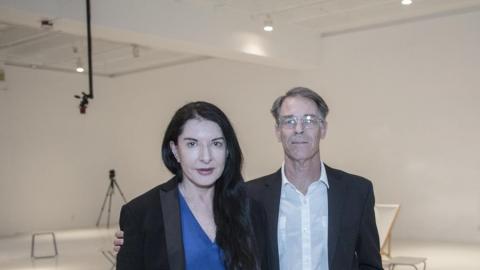
    In 2312, Kim Stanley Robinson makes references to performance artist Marina Abramovic several times, through the activities of the main character, Swan. After 2312‘s release, in 2015 Robinson and Abramovic got together and created a collaborative work, along with the help of composer/sound mixer Adam Tinkle and the Arthur C. Clarke Centre for Human Imagination.

    Today, the end result is the audio performance “The Hard Problem: An Audio Voyage“, and you can download it here!

    An introductory video, “3015 Prologue” was also produced:

    The Center for Human Imagination describes the process like this:

    In winter of 2015, the Clarke Center produced a collaborative project with the performance artist Marina Abramović and the science fiction author Kim Stanley Robinson. The multi-day workshop cultivated a series of interactions between a story that Stan was writing about a multi-generational spaceship heading to another star, and the performance art gestures of Marina’s that are a journey into our inner self. We improvised readings and performance actions to find the ways in which these seemingly diametric experiences touched on the common idea of how we extend our sense of time and space from the moment to the eternal. Out of this, we created an installation with multiple audio tracks, which was then further developed for the Venice Biennale. We also made a short film, which you can find a link to on the podcast webpage, and the audio tracks were mixed and choreographed by Adam Tinkle into the podcast we are featuring today: The Hard Problem: An Audio Voyage, by Kim Stanley Robinson, Adam Tinkle, Marina Abramović and the Arthur C. Clarke Center for Human Imagination.

    Additional photos from the workshop that served as a basis for the final work can be found at Boing Boing:

    The audio elements were produced during a day-long workshop with Abramović and Robinson at the Clarke Center, which subsequently appeared at the Venice Bienalle. The audioscape is rich and haunting, and has moments of goosepimple-raising eeriness as the narration invites us to put ourselves in the mind of an AI plying the spaces between the stars.

    See also this La Jolla Light article from 2015. Back then the work was called “3015: Work In Progress“.

    Also available at the Marina Abramovic Institute.

    The whole audio voyage was performed by Robinson alone during his visit to Iceland in September 2015. The full video is online, and you can experience it with dim lights here:

    In that same link from the Reykjavik International Literary Festival there is also a recording of a panel on “The Environment, the Future and the Future of Writing“, with Robinson and Andri Snær Magnason (both Friday September 11).