KimStanleyRobinson.info

The reference site for Kim Stanley Robinson

Author: Kimon K

  • “Shaman” meets “2312” and more

    Kim Stanley Robinson’s latest novel, Shaman, has now been released in paperback by Orbit!

    What’s it about? In just three paragraphs, you have it from Stan himself in this little piece for Kindle Amazon.

    “When a five thousand year-old body emerged from a glacier in the Alps in 1991, it immediately became one of the greatest finds in archeological history, because all the dead man’s gear had been frozen and preserved with him. […] I thought  He was just like me.”

    Stan and Ursula K Le Guin (do I need to introduce her?) finally did a first event together after knowing each other for nearly 40 years! In February, the Spring Creek Project sponsored a symposium entitled “Transformation Without Apocalypse: How to Live Well on an Altered Planet”, at Oregon State University. Stan and Ursula read from their own work and from each other’s work, with passages from 2312, Shaman and poems. This is a historic appearance, very heartwarming, although the atmosphere in the room can’t be felt through that video alone I suppose.

    More videos of older events have surfaced too. Stan participated in the Arizona State University Origins project, with the Great Debate Transcending Our Origins: Violence, Humanity, and the Future. He was on the panel “The Future: From Medicine and Synthetic Biology to Machine Intelligence” along with scientists and notable experts Richard Dawkins, Craig Venter, Esther Dyson, Eric Horvitz, George Poste and Randolph Nesse discussing the future of new biomedical and robotic technologies and their impact on humanity. The whole panel video was posted on the internet, you can watch it here: Part 1 & Part 2. Stan’s 7-min pitch of how we could live fuller liveshas been posted separately, it’s a concentration of many of the ideas he has been putting forward in recent years:

    So: Laws and “software” of how we run our societies as technologies. Constitutions as science fiction concepts. “Government of the people, by the people, for the people, shall not perish from the earth” as a science fiction short story (future tense). Those are some ideas! In a related interview for Decode DC, “What can Mars teach us about politics on Earth?” (direct audio), Robinson discusses these ideas and others that he has developed throughout his career — for example the citizens’ duma in Blue Mars.

    In October 2013, Stan and social media professor McKenzie Wark did a discussion at Eugene Lang College in New York. Stan read from Shaman and they discussed in depth the thoughts behind the book, how we used to live, what technologies we developed, Neanderthals, and of course taking it from there and on to 2312 and our future, and also on writing SF and “speculative realism” and on readers of SF and fantasy. Part 1 here; Part 2 is audience Q&A. The sound on the video is not that good.

    Additionally, McKenzie Wark interviewed Stan for the Los Angeles Review of Books: “A Functional Form Has Its Own Beauty“. A great interview, some selected parts:

    Finally, somebody asks the sex question! — an aspect of 2312 I felt was not discussed enough:

    I feel I’ve been taught a lot about gender by science fiction, including books by Joanna Russ, Samuel Delany, Ursula Le Guin, and others, and also by the science-fiction community, which has a flourishing LGBT component, pretty well integrated with the rest of it. Also I was very struck by my own experiences as a “Mr. Mom” when I did the home parenting for our two children, especially when they were infants and toddlers. I wanted to write about that again, as I did in the Science In the Capital trilogy, but from a different angle, to express the feeling that grew in me that gender as feeling is labile and not related to bodies per se.

    A great description of how essentially all of his novels work:

    I’ve been much influenced by Bahktin’s image of the novel as polyvocal, what he calls a heteroglossia (another great word!), so that it isn’t so much the novelist as a single visionary but rather something more like an old-time telephone switchboard operator, plugging in different voices and then orchestrating the flow of that chorus, so to speak. So you get chances for different points of view to speak or argue in dialogues or larger discussions, and the plots themselves also express these arguments in actions.   

    On writing a lot about everyday habits:

    As for changing one’s habits, that is so mysterious. Again from Proust; there is the moment when you are cast into a new situation and have to change habits, and I think it was Beckett in his slim book on Proust who spoke of these moments as the true existential exposure, the naked times when you are alive without the protection of your habits, and have to think what to do moment by moment, actually decide, until you settle into (I think Beckett called it exfoliating) into a new set of habits and are somewhat protected again from that existential nakedness. This seems right to me, this is how it has felt for me, and I am very interested to try to write these moments, and present these moments as central to a plot.

    On the scientific “vs” the religious world views:

    Not only in Shaman but in the rest of my science fiction, I’ve been interested to cross all these ways of knowing, to think about  science as a kind of religious activity, and definitely as a secretly hegemonic culture within our other various cultures, while at the same time thinking about Buddhism or art as versions of scientific thinking, or some other permanently valid way of looking at things. The permanent necessity of philosophy and art, basically, so that we can decide what to do — that isn’t a question science takes on or wants to take on.

    Often in my novels all these aspects are mashed together in the characters’ lives, and in the plots.

    On using words like Coriolis and katabatic a lot (I love how McKenzie Wark has spotted this!):

    I like to use words out of the sciences that particularize physical processes (or generalize them) in ways ordinary language doesn’t usually. In fact many of these words are simply Greek or Latin, or mash-ups of the two languages, but they suggest a scientific precision that strikes me as both writerly (like, say, Joyce) and also comic, in the sense of Mr. Spock explaining his Spocklike thinking. Hippocampus, de-intensification, hierarchicalization, etc., etc., it goes on and on and is both funny and sharp, and musical too, in ways I like.

    Finally, the calendar on the left has been updated with summer and fall events, including a European tour for the Worldcon in August and more! There’s also a 2015 event — more on that later.
  • Shaping the Future with Science Fiction and Climate Fiction

    Over May 16-18, the Smithsonian Magazine organized “The Future Is Here: Science meets Science Fiction | Imagination, Inspiration and Invention” – an event with many panelists, from scientists and engineers and astronauts to inventors and actors and writers – and Kim Stanley Robinson was among them, for a panel on “Humanity in the Solar System”.

    The event resulted in an article in the Smithsonian Magazine, on “How America’s Leading Science Fiction Authors Are Shaping Your Future”, with interviews of SF authors Kim Stanley Robinson, Cory Doctorow, William Gibson, Ursula Le Guin, Ted Chiang or Neal Stephenson, on the relationship between science, technology and SF, the utopian and dystopian strands of SF and on how SF shapes our imagination on the future. As Delany says,

    “The variety of worlds science fiction accustoms us to, through imagination, is training for thinking about the actual changes—sometimes catastrophic, often confusing—that the real world funnels at us year after year. It helps us avoid feeling quite so gob-smacked.”

    According to Robinson:

    “Science fiction represents how people in the present feel about the future,” Robinson says. “That’s why ‘big ideas’ were prevalent in the 1930s, ’40s and partly in the ’50s. People felt the future would be better, one way or another. Now it doesn’t feel that way. Rich people take nine-tenths of everything and force the rest of us to fight over the remaining tenth, and if we object to that, we are told we are espousing class warfare and are crushed. They toy with us for their entertainment, and they live in ridiculous luxury while we starve and fight each other. This is what The Hunger Games embodies in a narrative, and so the response to it has been tremendous, as it should be.”

    (Picture on top by Mehreen Murtaza)

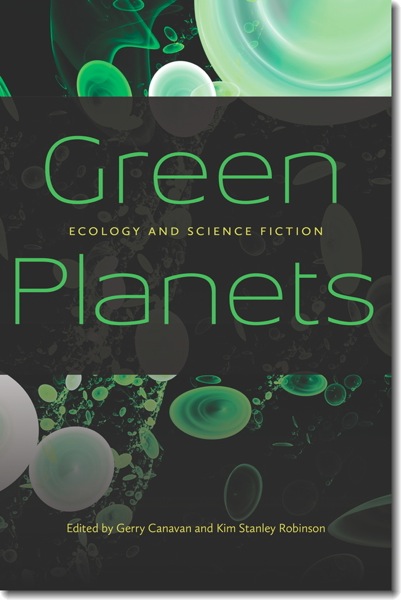
    Robinson along with Gerry Canavan (assistant professor of English at Marquette University) recently edited together a book of “essays exploring the relationship between environmental disaster and visions of apocalypse through the lens of science fiction”, Green Planets. Synopsis:

    Contemporary visions of the future have been shaped by hopes and fears about the effects of human technology and global capitalism on the natural world. In an era of climate change, mass extinction, and oil shortage, such visions have become increasingly catastrophic, even apocalyptic. Exploring the close relationship between science fiction, ecology, and environmentalism, the essays in Green Planets consider how science fiction writers have been working through this crisis. Beginning with H. G. Wells and passing through major twentieth-century writers like Ursula K. Le Guin, Stanislaw Lem, and Thomas Disch to contemporary authors like Margaret Atwood, China Miéville, and Paolo Bacigalupi—as well as recent blockbuster films like Avatar and District 9—the essays in Green Planets consider the important place for science fiction in a culture that now seems to have a very uncertain future. The book includes an extended interview with Kim Stanley Robinson and an annotated list for further exploration of “ecological SF” and related works of fiction, nonfiction, films, television, comics, children’s cartoons, anime, video games, music, and more.
    Contributors include Christina Alt, Brent Bellamy, Sabine Höhler, Adeline Johns-Putra, Melody Jue, Rob Latham, Andrew Milner, Timothy Morton, Eric C. Otto, Michael Page, Christopher Palmer, Gib Prettyman, Elzette Steenkamp, Imre Szeman.

    Gerry Canavan describes the book thusly:

    The essays in Green Planets are predicated on the proposition that two hundred years of SF can help us collectively “think” this leap into futurity in the context of the epochal mass-extinction event called the Anthropocene (which the literary theorists more simply call “modernity”). SF is our culture’s vast, shared, polyvocal archive of the possible; from techno-utopias to apocalypses to ecotopian fortunate falls, it is thetransmedia genre of SF that has first attempted to articulate the sorts of systemic global changes that are imminent, or already happening, and begins to imagine what our transformed planet might eventually be like for those who will come to live on it. Especially taken in the context of escalating ecological catastrophe, in which each new season seems to bring with it some new and heretofore-unseen spectacular disaster, my coeditor’s well-known declaration that in the contemporary moment “the world has become a science fiction novel” has never seemed more true or more frightening. Indeed, such a notion suggests both politics and “realism” are now always “inside” science fiction, insofar as the world, as we experience its vertiginous technological and ecological flux, now more closely resembles SF than it does any historical realism…

    A kind-of-excerpt of the book by Canavan, an essay on “Dystopia, Anti-Utopia, and the End of the World”, is up at SF Signal!

    Staying on the topic of sci-fi, “cli-fi” and scientific news, writer Tony White links all these on the occasion of the publication of the UN’s Intergovernmental Panel on Climate Change Fifth Assessment Report – a big event that happens about every seven years, and with each report raising the level of certainty that climate change is happening, that it is man-made, and that the situation is more and more urgent for us to move towards adapting our energy system, infrastructures, ways of life, to emit less. In discussing the publication, White discusses the Climate Outreach Information Network and references Robinson’s talks and their role in informing and inspiring change (specifically, Stan’s talk at MOMA/PS1 in New York last year).

    The Long View of climate change is also the focus of this New York Times article, where Andrew C. Revkin interviews to paleoclimatologist Curt Stager, Robinson, and astrobiologist David Grinspoon on how humans will deal with climate change impacts – our paleolithic roots (Shaman) and the Venice-like New York (2312) are of course referenced!

    Coming soon: Some more panels with Stan. There will be videos!

  • Stan the Californian

    Boom – A Journal of California met Kim Stanley Robinson at his home and writing spot in Davis, California, for an extensive interview. His childhood, writing, science fiction, science, capitalism, utopia, his Three Californias trilogy, John Muir, and the history and landscape of California were addressed. Some excerpts:

    Boom: Is there a special brand of California science fiction?

    Robinson: I think so. It began with people like Jack London and Upton Sinclair, and then the Los Angeles Science Fiction Society in the 1940s. This included Ray Bradbury, who moved with his parents to Los Angeles when he was young, like I did, both of us from Waukegan, Illinois, but him maybe twenty years earlier. Bradbury was always focused on what modernization was doing to human beings, to the nontechnological aspects of humanity. There was also Robert Heinlein, who was living in Los Angeles in the forties. Crazy Bob they called him when he was young. He was always a strange amalgam. And then there was Philip K. Dick in northern California, also Poul Anderson and Jack Vance, Frank Herbert, and in her childhood, Ursula Le Guin. It turns out that many of the most interesting science fiction writers were in California. There’s something strange and powerful about California, as a landscape and an idea, so the place may have inspired the literature.

    Boom: Your Three Californias trilogy lays out very different visions for California’s future. Which of the three Californias would you want to live in?

    Robinson: Pacific Edge without a doubt. Pacific Edge was my first attempt to think about what would it be like if we reconfigured the landscape, the infrastructure, the social systems of California. I think eventually that’s where we’ll end up. It may be a five hundred year project. I thought of it as my utopian novel. But the famous problem of utopian novels as a genre is that they are cut off from history. They always somehow get a fresh start. I thought the interesting game to play would be to try to graft my utopia onto history and presume that we could trace the line from our current moment to the moment in the book. I don’t think I succeeded. I wish I had had the forethought to add about twenty pages of expository material on how they got to that society. Later I had a lot of dissatisfactions with Pacific Edge. You can’t have this gap in the history where the old man says, well, we did it, but never explains how. But every time I tried to think of the details it was like—well, Ernest Callenbach wrote Ecotopia, and then explained how they got to it in Ecotopia Emerging. And there’s not a single sentence in that prequel that you can believe. So, Pacific Edge was my attempt, a first attempt, and I think it’s still a nice vision of what Southern California could be. That coastal plain is so nice. From Santa Barbara to San Diego is the most gorgeous Mediterranean environment. And we’ve completely screwed it. To me now, it’s kind of a nightmare. When I go down there it creeps me out. I hope to spend more of my life in San Diego, which is one of my favorite places. But I’ll probably stick to west of the coast highway and stay on the beach as much as I can. I’ll deal, but we can do so much better.

    Boom: In The Gold Coast, your dystopian novel in the California trilogy, and in your other dystopian novels, are you issuing a warning about where we’re headed?

    Robinson: I am issuing a warning, yes. That’s one thing science fiction does. There are two sides of that coin, utopian and dystopian. The dystopian side is, if we continue, we will end up at this bad destination and we won’t like it. That’s worth doing sometimes. But I won’t do the apocalypse. That is not realist. It is more of a religious statement. I like disaster without apocalypse. Gold Coast is dystopian. And a lot of it has come true since it came out in 1988.

    Boom: Do you think there is something special California can contribute to this utopian project?

    Robinson: I do. I think we’re a working utopian project in progress, between the landscape and the fact that California has an international culture, with all our many languages. It’s got the UC system and the Cal State system, the whole master plan, all the colleges together, and Silicon Valley, and Hollywood. It’s some kind of miraculous conjunction. But conjunctions don’t last for long. And history may pass us by eventually, but for now it’s a miraculous conjunction of all of these forces. So I love California. Often when I go abroad and I’m asked where I’m from, I say California rather than America. California is an integral space that I admire. And we’re doing amazing things politically. I like the way the state is trending more left than the rest of America. And San Francisco is the great city of the world. I love San Francisco. I think of myself as living in its provinces—and provincials, of course, are often the ones who are proudest of the capital. And many of my San Francisco friends exhibit a civic pride that is intense, and I think justified. So there’s something going on here in California. I do think it’s somewhat accidental; so to an extent, it’s pride in an accident, or maybe you could say in a collective, in our particular history. So there’s no one thing or one person or group that can say, ah, we did it! It just kind of happened to us, in that several generations kept bashing away, and here we are. But when you have that feeling and it goes on, and continues to win elections and create environmental regulations, the clean air, the clean water, saving the Sierra, saving the coast: it’s all kind of beautiful. Maybe the state itself is doing it. Maybe this landscape itself is doing it.

    Another utopia and climate change-focused article by Stan is up at IAI TV (a reprint from Australian magazine Arena).

    The Australian Yahoo interviewed Stan on his most recent novel, Shaman, and the way he goes about writing. Some excerpts:

    The final piece of Shaman fell into place when Robinson saw photos of 32,000-year-old cave paintings from France’s Chauvet cave (discovered in 1995). “I was so struck by their beauty and age I felt I had my story, ” he says. “I’d tell the story of the people who painted that cave.” […]

    “I definitely enjoy my research, ” he says. “It’s reading with a purpose. I feel like I’m on the hunt, looking for good stories to tell, because I collect good stories from the research and retell them.”

    The process often begins years in advance as Robinson collects books and web links that seem relevant to an idea he’s been “brooding on”. When starting a book, he then looks for whatever he has on hand that’s useful, but when he starts writing, the process changes to what he calls “iterative”. “Once I’ve written a draft of a scene I know much better what I need to know to make it better, and that directs subsequent research.”

    Stan also wrote in NPR for three recommendations of New Wave SF: Thomas M. Disch‘s Camp Concentration; Joanna Russ‘s The Female Man; and Samuel R. Delany‘s Dhalgren.

    And finally, you have one week left to submit a story to Stan! To The Best Of Our Knowledge, and partners University of Wisconsin’s Center for the Humanities and the Wisconsin Institute for Discovery, are running a competition for a 500-600 hard-SF story that would be turned into a radio play, the deadline is March 1!

    We’re looking for great sci-fi stories, based on real science and set in the near future. Sci-fi master Kim Stanley Robinson, best known for The Mars Trilogy, will choose the winner.

    The winning stories will be turned into radio plays, produced by To the Best of Our Knowledge and LA’s Ensemble Studio Theatre, directed by Gates McFadden (Dr. Beverly Crusher on Star Trek: The Next Generation).

    To your keyboards!

  • Shaman interviews & reviews III

    Kim Stanley Robinson’s latest novel SHAMAN, out since September 2013, is coming out in paperback on June 10 2014. Meanwhile, it has entered the Locus Bestseller list for December for hardcovers (at #7) — while 2312 has been released in paperback and has made it to #1 and is continuing its run! (September, October, November, December)

    Despite Shaman‘s setting in the long past, or rather quite the contrary, enriched by that fact, the New Yorker‘s Tim Krieder published an article on Stan: “Our Greatest Political Novelist?“, which draws from both his Mars trilogy and Shaman to make a major point:

    Depending on your own politics, this [the Martian Constitution] may sound like millennia-overdue common sense or a bong-fuelled 3 A.M. wish list, but there’s no arguing that to implement it in the real world circa 2013 would be, literally, revolutionary. My own bet would be that either your grandchildren are going to be living by some of these precepts, or else they won’t be living at all. […] I don’t just admire Robinson’s ambitions or agree with his agenda; I’m not recommending his books because they’re good for you. Kim Stanley Robinson is one of my favorite novelists, period. […] The strength of his characterizations is inextricable from his power as a political visionary; Robinson is realistic about human beings but nonetheless optimistic about our capacity for change.

    […] Loon’s tribe in “Shaman” isn’t exactly a preagricultural utopia—they’re starving by the end of each winter—but it’s still a pretty benign view of man in his primeval state, closer to Rousseau than Hobbes. […] Wouldn’t it ultimately be more optimistic to create a sort of past-dystopia, showing us how far we’ve come? There’s evidence to suggest that prehistoric cultures would’ve seemed far more savage and alien to us than Robinson imagines here. I suspect this is less a failure of imagination on his part than a triumph of his convictions over the evidence, a projection of his resolute optimism backwards through time to show us that folks are basically the same all over. […] What he’s telling us over and over, like the voice of the Third Wind whispering when all seems lost, is that it’s not too late, don’t get scared, don’t give up, we’re almost there, we can do this, we just have to keep going.

    Let the debate begin!

    Some more reviews for Shaman: Songs in Squee Minor ; The Sydney Morning Herald
    and for 2312: Population GO

    Stan participated again to Authors@Google last September, and read from Shaman and talked about creating the world of 30,000 years ago — one of the great Shaman talks!


    He also participated to a debate for iai tv on “Paradise…Lost?” with Marina Benjamin and Alex Callinicos:

    Once a driving force of political change, utopian visions are now out of fashion. But is this a lost opportunity or a new realism?  Should we create new utopias and thereby impel social advance, or will we learn the lessons of history and remain sceptical of grand visions?


    And so… happy new year 2014 AD!