KimStanleyRobinson.info

The reference site for Kim Stanley Robinson

Author: Kimon K

  • KSR talk at Duke University: videos

    Last week, as we announced previously, Kim Stanley Robinson was part of the “Science, Religion, and Ideology” event at Duke University in Durham, North Carolina, USA. Event co-organizer Gerry Canavan has put Stan’s speech on youtube (one hour’s worth of material) and blogged extensively about it. Like all of Stan’s interventions, this is stuff you have to watch!

    “one of them said “Enough is a bad word. That’s a bad word in America. Enough sounds like not enough. You should change it to Goldilocks, where there’s too little, there’s too much, and then there’s just right. And what you want is just right. And you can easily have too much.” So I thought, okay, Goldilocks. I’ll change it always and mention that it’s not only that enough is as good as a feast, but enough is just right.”

    “we’ll be looking back at the 2010s and thinking “They had just discovered the laptop and lost their minds.” It’s like in the discovery of the telephone; for a while there there was the euphoria of the telephone, and everyone had to call everyone, and we’re in that kind of moment for the Internet—but eventually you get past these technologies and we’re just back to people doing things.”

    I invite you to head over to Gerry’s post and read, and watch, and think.

    A complete list of interviews with Kim Stanley Robinson can be found here.

    UPDATE 08/02/10: Gerry Canavan has now posted more material (video and transcript) of the event preceding the “Science, Religion, and Ideology”, again at Duke University.

  • “Best Of KSR” contents released

    The contents of the upcoming “The Best Of Kim Stanley Robinson” have been released. It contains short stories and novellas from the entirety of Stan’s career, from the 1980s throughout the 2000s. It is edited by Jonathan Strahan and is expected to be released mid-2010 in the USA by Night Shade Books, in hardcover.

    The 300-page volume includes 23 stories: 5 from The Planet On The Table, the novella The Blind Geometer, one novella from Escape From Kathmandu, 10 from Remaking History, 3 from The Martians, and 3 previously uncollected stories (including one never before published):

    • Venice Drowned
    • Black Air
    • Ridge Running
    • The Lucky Strike
    • Our Town
    • The Blind Geometer (previously uncollected)
    • Mother Goddess Of The World
    • Glacier
    • Remaking History
    • The Lunatics
    • Before I Wake
    • The Translator
    • Zurich
    • A History Of The Twentieth Century, With Illustrations
    • A Sensitive Dependence On Initial Conditions
    • Muir On Shasta
    • Vinland The Dream
    • Arthur Sternbach Brings The Curveball To Mars
    • Sexual Dimorphism
    • Discovering Life
    • How Science Saved The World (previously uncollected)
    • Prometheus Unbound, At Last (previously uncollected)
    • The Timpanist Of The Berlin Philharmonic, 1942 (previously unpublished)
    • Afterword by Kim Stanley Robinson

    Night Shade Books page

  • Fresh KSR interview, reviews continued

    Popular science fiction and science blog io9 has published an interview with Kim Stanley Robinson, focusing mainly on Galileo’s Dream.

    Meanwhile, reviews for Galileo’s Dream continue to pop up and I add them for your reading and commenting pleasure in the site.

    Don’t forget to check out the calendar on the left for readings and discussions involving Robinson (event tonight and tomorrow at North Carolina’s Duke University)!

  • More events + Galileo’s Dream, Pacific Edge articles

    More readings and discussion events with Robinson, still in the USA but this time on the East Coast: at Duke University, at Durham, North Carolina.

    A discussion on Science Fiction and Ecology with Stan Robinson
    Co-organizer Gerry Canavan says:
    “We’re coming back for another semester of Ecology and the Humanities events, sponsored by the Franklin Humanities Institute and organized by the editors of Polygraph 22. The group’s first event of the spring will be a conversation with science fiction author Kim Stanley Robinson on “Science Fiction and Ecology.” There will be a short reading for this event, the draft of the interview conducted between Stan and the Polygraph 22 editors; contact me if you’re planning to attend and would like a copy.”
    Thursday, January 28, 2010, 7-9 pm
    John Hope Franklin Center 240, Duke University
    Durham, North Carolina

    Also, Robinson will be speaking on “Science, Religion, Ideology” in the event “Competing Cosmologies, Effecting Worlds: Intersections of Science and Religion” along with another science fiction author, Nisi Shawl, and two academics, Bruce Lincoln and Michael Taussig.
    Friday, January 29, 2010, 10am-5pm
    (KSR speech & Q&A 10:15am-11:15am)
    Breedlove Room, Perkins Library, Duke University
    Durham, North Carolina

    Of course, if you attend any of these events, feel free to drop a comment here!

    Stan Robinson wrote a Galileo-related article for Suvudu, a “multi-contributor blog with the mission of providing information, content, and free ebook downloads to fans of Science Fiction and Fantasy“.
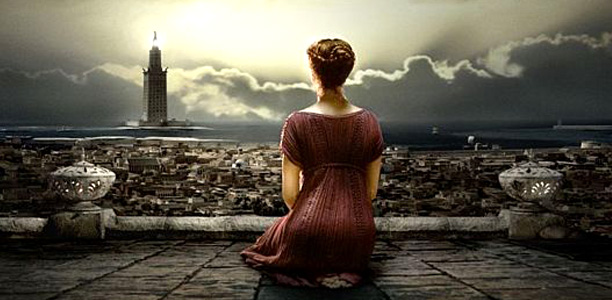
     

    If the themes of Galileo’s Dream interest you then you might want to see “Agora“, a 2009 film by Spanish director Alejandro Amenábar (Tesis, Abre los Ojos, The Others, Mar Adentro) starring Rachel Weisz. “Agora” (picture above) deals with the life of Hypatia, Greek philosopher and astronomer in Alexandria, at around the end of the 3rd century AD, at the turning point between the Greek/Roman Antiquity and the Christianity-dominated Middle Ages, and tackles themes dear to Robinson as well: science vs religion, or perhaps empathy vs intolerance, politics, history of religions and history of civilisations, astronomy… A truly excellent film that did not get the cinema release it deserved.

    Finally, Jo Walton wrote a great piece on Pacific Edge for the (rich) blog of Tor, KSR’s publisher for up to that novel (1990). “Water, love, and meetings” looks on utopia and and simply concludes “we’re no closer to utopia—or if we are, then not the one Robinson was after“.

    “Central to Tom and to what Robinson is doing is his meditation on his eighties Californian childhood, growing up in utopia, in a free country full of opportunity, but a utopia that was grounded in exploitation in the Third World and pollution of the planet. The key sentence, as he vows to work for a better world is: “If the whole world reaches utopia, that dream California will become a precursor and my childhood is redeemed.” That’s imperialist guilt in a nutshell, but in this book with its small scale issues of water in California and softball games we’re constantly being reminded that the rest of the planet is there, in a way that’s quite unusual in anglophone SF.“