KimStanleyRobinson.info

The reference site for Kim Stanley Robinson

Category: news

  • Ursula Kroeber Le Guin, 1929-2018

    Ursula Kroeber Le Guin, 1929-2018

    Ursula K. Le Guin passed away yesterday. Her unique voice in the field of fantasy and science fiction and writing in general will be remembered. For the psychological depth of her characters, for the anthropological dimension of her world-building, for her themes of genre and politics and ecology and mutual understanding, for the elegance of her prose, and for so many other things.

    Kim Stanley Robinson and Ursula go way back. At times it seemed that they were the only representatives of the utopia-striving ecological strain of speculative fiction. They met last time in 2014 at a panel on “Transformation Without Apocalypse: How to Live Well on an Altered Planet”. Stan has mentioned “The Left Hand of Darkness” is one of his favorites. Two of their stories appeared together in 1989 with the two-sided “The Blind Geometer”/”The New Atlantis” publication. Going further back in time, Le Guin was Stan’s teacher in some writing workshops when Stan was in his first years of writing for a living, in San Diego, 1977! Those months were determining for Stan’s career. Here is how he remembered these in his contribution to the compilation book done for Ursula’s 80th birthday in 2010:

    She taught two classes, one on the literature of science fiction, the other a writing workshop. I took both of them.

    The literature class was a seminar of about fifteen or twenty people. The class met on Tuesdays and Thursdays, and we were asked to read one novel per class, with two students making reports on that day’s book, and the rest then discussing it. The novels Ursula assigned were Hard To Be a God by the Strugatski brothers, Martian Time-Slip by Philip K. Dick, Camp Concentration by Thomas M. Disch, The Invincible by Stanislaw Lem, The Fifth Head of Cerberus by Gene Wolfe, The Dream Master by Roger Zelazny, The Exile Waiting by Vonda N. McIntyre, and And Strange at Ecbatan the Trees by Michael Bishop. We also discussed at some length Italo Calvino’s novels The Non-Existent Knight, The Cloven Viscount, and The Baron in the Trees, which I think were recent discoveries of Ursula’s, and perhaps her addition to the reports. She led the discussions with a light touch, and an obvious pleasure in the books she had chosen.

    In my report I joked that Number Five’s name in The Fifth Head of Cerberus seemed to be “Gene Wolf,” which made Ursula laugh. On the other hand, if one were to say something insulting about one of the books, as only a foolish young man would do, she could skewer one promptly and effectively.

    […]

    Ursula was very supportive of writing of all kinds, and as the month passed she helped us to cohere as a group of people who cared for one another, which is really the important thing in a workshop. I recall parties with her sitting on the floor. And I have a strong memory of her sitting immediately to my left when the class went to see the new movie Star Wars; we laughed our heads off. As a space-opera spoof it was even better than Buck Rogers in the Twenty-fifth Century.

    At some time during the month I gave her a long mess of a novella, which I later sorted out as the third part of Icehenge. She dutifully read this and made what comments she could. That was a generous thing to do, given how much other reading she had; and she encouraged me in the best way possible. Write more, she told me. Finish more stories and see what happens.

    There were people in the workshop writing excellent stories out of their own lives, heartfelt things that seemed to me to put science fiction to some ultimate existential questions. Why write science fiction at all, when people could say things so clearly and directly? What was the point? I talked to Ursula about these questions, and afterward pulled out a backpacking story I had started and abandoned two years earlier. Three friends in the high Sierra, one of them recovering from a head injury. The more I understood that the brain damage repair was both a science fiction device and an image for how I felt, the more “Ridge Running” became its own thing, separate from my trip while still relying on what I had done and seen up there.

    “I like this one best of all your stories,” Ursula said when the story was workshopped. “You should think about doing more like this one.”

    That was an important moment for me.

    Edit: Stan also wrote a piece to commemorate her at Scientific American.

    Taken all in all, her work was that of a complete person of letters and an important public intellectual. Until Monday she was one of the greatest living American writers; now she takes her place in American history, and her books will continue to be read by readers grateful for their many gifts.

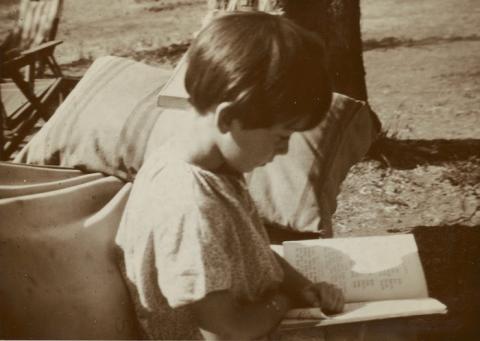
    (Photo: young Ursula, from the upcoming documentary “The Worlds of Ursula K. Le Guin“)

  • NY2140, or: How I Learned To Stop Worrying And Embrace Change

    NY2140, or: How I Learned To Stop Worrying And Embrace Change

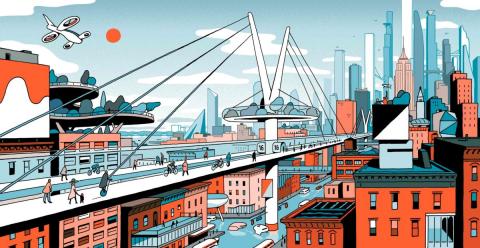
    (Top image of New York City with 13 meters sea level rise, a bit less than in New York 2140, by FireTree.net)

    Hurricanes, floods, fires, this has become part of a reality many have to face in the year 2017. The vulnerability of human infrastructure to natural events has become an evidence that has been violently brought home to our minds, and suddenly human affairs become part of Earth’s environment again. All these issues are familiar to the reader of KSR’s works, with extreme climate events being key events in many KSR novels: Blue Mars, Forty Signs of Rain/Green Earth, and most recently in his latest novel New York 2140.

    Stockholm University’s Resilience Center defines resilience as:

    Resilience is the capacity of a system, be it an individual, a forest, a city or an economy, to deal with change and continue to develop. It is about how humans and nature can use shocks and disturbances like a financial crisis or climate change to spur renewal and innovative thinking.

    …and this fits New York 2140 to a tee!

    First, a shout out to Orbit that presently manage the KSR Facebook page (like!) — and also to the fan-essentially-self-managed KSR Facebook group that’s been running since 2009 (join!).

    Here comes the usual list of links of everything KSR since the last update in June:

    KSR presented his latest novel New York 2140 at the heart of the action, in the iconic Strand bookstore, located in Broadway, Manhattan. See the video of the May event for Science Friday Book Club with host Ira Flatow here.

    KSR discusses the bedrock of science and economics in New York 2140, his writing process for the novel, and of course, the Anthropocene in this great audio interview for Generation Anthropocene.

    While in Barcelona in March this year, KSR spoke to the Spanish Jot Down magazine. The discussion ranged from his career and the Mars trilogy to progressive taxation, the EPA under Trump and the basque Mondragon system he often mentions, to mysticism, space exploration and art. A really complete interview! (Spanish version here) Some excerpts:

    After World War II there was quite extreme progressive taxation, even in the US under Eisenhower, a Republican president. After you made four hundred thousand dollars a year, that in our days will be like four million dollars a year, the tax rate was 91%. So essentially they capped the wealth, and you could not be a multibillionaire like we’ve got today, because everything you made after a certain amount went to support government programs. And you can advocate these kind of things without being a complete communist or a completely utopian person like a martian. You can talk about policies that used to be enacted and could be enacted again, there’s legal and precedent base.


    Within the already existing capitalist order you have alternative orders that are legal, they don’t need to be revolutionary, you don’t need to get into the chaos of Barcelona 1936 where anarchists and communists were fighting against each other over how to make a completely new society… Instead you have something like Mondragon where in the already existing society there is a change coming from inside.


    A lot of scientists are fairly naive and underdeveloped about what is their project. They don’t have much in the way of theory. Science needs to think of itself more as a humanism and more as an utopian politics that’s already enacting itself in the real world. This is what my books are trying to suggest. I’m doing what I can by telling stories about what science is, how science works and what scientists should do in terms of being political actors.


    Wilderness is a nice idea, but once you alter the atmosphere and the oceans there is no wilderness anymore, all the planet is a mongrel planet, and what you want to do then is to avoid extinctions. That takes working landscapes, like farms that also support some wildlife, or zoos, or landscape enclosures. I’ve read about these parts of Europe that are being almost abandoned, like central Spain, central Poland, the center of the US, Montana or North Dakota… Where is not easy or economical to do agriculture, people leave for the cities, and so big places of the countryside are empty now of humans. This is extremely interesting, because we need that. It’s not wilderness, but ex-human land where humans built towns or roads and abandoned them. We might have a world that includes some semi-wilderness, or empty land that is still human land or even lightly agricultural… Everything except for purity, I don’t really worry about purity anymore.

    The May discussion between KSR and George RR Martin at UC San Diego to support the Clarion Science Fiction Writers Workshop can be seen in its entirety here.

    The April discussion at Rutgers University, where KSR presented New York 2140 and participated in a panel with Rutgers faculty on climate science, urban planning, urban agriculture and the environmental humanities can be found here.

    A short written and a short audio interviews ahead of KSR’s presentation at Arizona State University on “The Comedy of Coping: Alarm and Resolve in Climate Fiction” in September. Mark Stapp, director of ASU’s Center for Real Estate Theory and Practice shared his expert perspective on aspects of New York 2140‘s future real estate: for him, Franklin Garr’s financial instrument, the Intertidal Property Pricing Index, “doesn’t seem far-fetched at all”.

    While in New York City, KSR stopped by Radio Motherboard‘s (Vice) studios for a podcast on NY2140, climate change, capitalism, Trump, nuclear weapons, technology, automation, and more.

    This Is Zero Hour dedicated an episode to planetary revolution and immigration, and spoke to KSR and Megan Essaheb (complete podcast here, KSR video excerpt here)

    New York 2140 is among the novels the New York Times looked at and asked their authors about in an article focused on climate-themed fiction, along with Paolo Bacigalupi, E.M. Forster, Jeff VanderMeer, Maja Lunde and others.

    If you haven’t had the opportunity to attend one of many “SF in SF” events, here is a recording of the last one with KSR, along with Cecelia Holland and Terry Bisson!

    From last year’s Balticon comes this discussion with Fast Forward, where KSR discusses 2312 and Aurora and his recent Robert A. Heinlein Award.

    Some video excerpts of KSR’s presentation at the Long Now Foundation in May 2016: how to use banks in the revolution, and looking back on his Mars trilogy.

    A short video on KSR’s reading habits and his library, and another one where he talks about audiobooks, in particular Shaman.

    And, finally, speaking of readings:

  • Even more NY2140 interviews & reviews

    Even more NY2140 interviews & reviews

    First, a tease: in his recent interviews, KSR has made no secret that he is hard at work on his next novel! — and that it will involve the colonization of the moon and China’s role in our larger human civilisation.


    What does KSR’s writing quarters look like? Since around the time of writing the Science in the Capital trilogy and Galileo’s Dream, he has been writing exclusively outdoors, from his back yard, winter or summer, witnessing the passing of the seasons. The Sacramento Bee provides us a short insight in the writer’s own home.


    KSR’s latest novel, New York 2140, is a novel both full of KSR’s usual themes and a novel like no other in his previous work. It is a work of everyday life and utopian hope in the midst of what many would consider a dystopian future, a work of climate-fiction and finance-fiction. Given the current state of the world and the discussion around climate change and the economic system, it feels very topical.

    In this important interview for New Scientist, “The power of good”, KSR talks utopia, the need to imagine post-capitalism, the financial crisis, and a blueprint for moving forward:

    Here’s the dilemma. Capitalism is the system we have agreed to live by. Its rules, while being legal and not involving anyone being evil or cheating, are nevertheless destroying the world. So we need to change the rules.

    It’s important what story you tell about the future. Stories that say the future can be better because people are smart, because they want democracy, because, ultimately, people rule and banks don’t, can be self-fulfilling. They give people actions to help break the story that says they are screwed because international finance is way more powerful.

    Most of my novels, I think, are actually fun because I’m doing realism in a way the world needs. As for anyone picking up the mantle, there’s a group of young writers who call themselves solarpunk, and what they’re trying is all about adaptation.


    Some interesting excerpts from this interview for Space.com:

    The way it came about is I did want to write a book about global finances that exist now, and how we might seize it, take it over and make it work for people. […] The book is making the case that climate change is basically a financial disaster, or has been caused by bad economics rather than bad technology or pure number of people. […] We are in an economic-slash-political system that is actually causing the problem, and so it’s very hard to make it into a solution for the problem. And that’s the story I wanted to tell.

    120 years on, materials science has given them what they call a kind of diamond spray, and also graphenated composites. Right now, these are both more ideas than realities, but they’re not far off. Both of those would be incredibly useful materials to have if you were coping with a drowned New York. 

    The interesting thing is that since I’ve finished the book, people have sent me articles that apparently Singapore is contemplating doing this very thing [floating islands that are tethered], because Singapore is another city that is at sea level, and they have a problem.

    I don’t want to suggest that it won’t be a gigantic disaster, because it will. But what I do want to suggest is that after the disaster, people are going to be coping. They will not give up. They won’t sit on the ground and weep and throw ashes on their heads and say, “Oh, woe is us. Our ancestors were idiots.” They will cope. So the coping is an interesting story to try to tell. It’s a science fiction story. It’s a combination of technical and political and all the other elements of the human story. It will be an interesting moment in history, and the main thing that I tried to say in this novel is that in the coping process, there’s going to be some positives, there’s going to be some comedy.


    Also, KSR’s event with fantasy author George R.R. Martin at UC San Diego to support the Clarion Science Fiction Writers Workshop got plenty of coverage! See reports by the San Diego Union Tribune, La Jolla Light and the UCSD Guardian (see also our previous update for more on that). Fun bit frpm La Jolla Light: Stan “was also sporting his brown hiking shoes that still had a little mud on them from The Sierras“!


    New editions:

    The solar system-wide interplanetary Grand Tour of Johannes Wright’s Orchestra of The Memory of Whiteness: A Scientific Romance, an early and wild KSR novel (1985), got a new paperback edition by Tor. Featuring a cover with a space and Saturn montage, and praise by Greg Bear.

    Aurora has been translated in German (Heyne) and Spanish (Minotauro). The German translation of New York 2140 is scheduled for January 2018.

    Italians finally got a translation of Green Mars and, since March, of Blue Mars as well, along with a reedition of Red Mars (Fanucci Editore). 20 years after the first translation of Red Mars, the trilogy is complete!

    2312 has been translated in Japanese (Tokyo Sogensha, in two volumes, with some crazy visuals, as usual!), in Chinese (Congqing Publishing Group; see also KSR’s visit to Beijing last year), and also in Turkish! On that last one, see an article written by translator M. Ihsan Tatari on the tough 8-month work of translating 2312 into Turkish.


    Reviews:

    Some New York 2140 reviews:

    While we are at it, several reviews for Aurora as well — especially since it has been translated in other languages as well:

    And also:


    Top illustration by Vicent Mahé for a New Yorker article on New York 2140.

  • More NY2140 interviews & reviews

    More NY2140 interviews & reviews

    KSR’s latest, New York 2140, has been out for over a month now, and has been gathering quite a few readers!


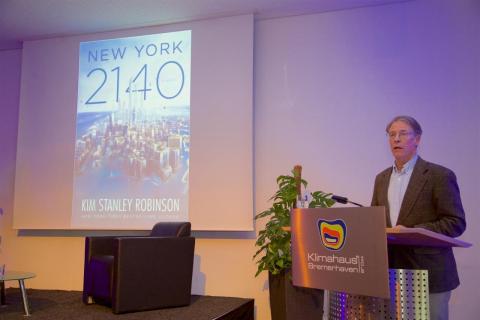
    To promote the book, KSR was on tour in Europe, with events in Barcelona, in Germany and in London. Top photo from an event at Klimahaus in Bremerhaven, Germany — photo by Fritz Heidorn/Oldenburg, Germany. More photos from KSR’s stay in Bremerhaven and Berlin as well as a couple of short videos can be found here.


    In London, an event united 3 excellent writers, KSR, Adam “Yellow Blue Tibia” Roberts and Francis “Red Plenty” Spufford (whose latest novel Golden Hill also takes place in Manhattan, but in the 18th century!). A report on that discussion over here.


    This interview for NYMag covers many NYC topics as one would expect, especially the detailed research on-site, i.e. walking around the city and getting to know its history.

    I thought of the book eventually as a comedy of coping, and to do that I picked a time, or perhaps 40 years after the disaster itself. […] science fiction has to imagine the people who come after, when the situation will be natural, whatever it is. […] I was invoking a somewhat nostalgic, more romantic New York of the imagination that’s more human scale, more neighborhood-focused, more localized, and more kind of hand-crafted, you might call it. 

    I wanted a finance novel that was heavily based on what lessons we learned — or did not learn — from the crash of 2008 and 2009. All science-fiction novels are about the future and about the present at the same time.

    [On Franklin the trader being a sympathetic character] I did that on purpose. People who succeed by using the currently shifting rules of capitalism are not villainous, nor have they broken the law or cheated. […] That point needed to be raised because, as Orson Welles once pointed out, everybody has their reasons. […] I must admit, in the first draft he was more of a jerk, but he began to step on the toes of the citizens. So with the changing of frighteningly few sentences I made him more of a geek. Not that different than my scientist characters who are funny because they try to evaluate social life as if we’re nothing but a theoretical problem in physics or sociobiology. I like my finance guy.

    Can you legislate fundamental change? Essentially we need fundamental change, we have to hope the answer is yes. Because the alternatives to legislation are all terrible. Legislation is by far the best method for big social change. Get the right congress in and the right World Trade Organization technocrats in and you change.


    In this interview with Inverse, “The Man who put Science in Science Fiction”, KSR talks about his writing, his method for world-building, these “infodumps” he’s well known for (and criticized (and praised) for), his characters in NY2140, his impressive use of epigraphs and quotes in this novel.

    Beyond the depiction of the future, what is this novel about?

    It’s about finance, and climate change, and New York as a place, and those particular characters, and what we could do now to influence events to make a better future for the people yet to come. Utopian climate change fiction: the obvious next hot genre.


    In the Science Friday podcast, KSR describes daily life in his future drowned New York. A “citizen” chapter of the novel can also be read at Science Friday.


    NY2140 as well as climate science, urban planning, urban agriculture and environmental humanities were discussed in a panel discussion at Rutgers University with KSR and Rutgers researchers. Here’s a report from that with quotes from faculty members.


    A surprising pairing took place in an event hosted by the Arthur C. Clarke Center for Human Imagination at UCSD — although not so surprising when one considers they are both fan favorites of the SF&F genre: George “A Song of Ice and Fire” R. R. “Game of Thrones” Martin and Kim Stanley Robinson! Here’s a summary of what was uttered at the event, along with some tease from both authors on what’s next: 

    Robinson teased the audience early on with the prospect of a film or television adaptation of his Mars Trilogy at some point in the future. […] As to whom [Martin] would like to see assume the Iron Throne, Martin left the audience with a message that could perhaps serve both to sum up the entirety of the event and to annoy any avid fans in attendance: “Keep reading.”


    Also: plenty of reviews of NY2140 are out!

    John Clute for Strange Horizons: “New York 2140 reads almost like a game. It is a scherzo, something happening all the time […] astonishingly full of joy: the joy of telling; the joy of sharing the reasoning behind events; the joy of inducing good people to cohabit.”

    Niall Alexander for Tor.com: “At six hundred plus pages, New York 2140 is somewhat short on plot for such a long novel, but it’s absolutely, positively packed with characters rife with life […] characters little and large cross paths, and as the narrative threads we’d thought independent—inconsequential, even—gather into something greater because they’re suddenly something shared.”

    Cory Doctorow for BoingBoing: “with New York 2140, Robinson starts to connect the dots between these different futures [2312, Aurora] with a bold, exhilarating story of life in a permanent climate crisis, where most people come together in adversity, but where a small rump of greedy, powerful people get in their way.”

    Gary K. Wolfe for Locus: “As such colorful and eccentric characters might suggest, a good portion of New York 2140 has an oddly Dickensian feel to it […] there have been more than a few environmental catastrophe tales set in a future New York, but possibly none of them have been this interesting.” (also for the Chicago Tribune)

    And some others:

    The usual linkstorm ends here. More will follow. In the meantime, you can start your own petition for a Mutt and Jeff vignette spinoff!