KimStanleyRobinson.info

The reference site for Kim Stanley Robinson

Category: novels

  • The Ministry for the Future

    The Ministry for the Future

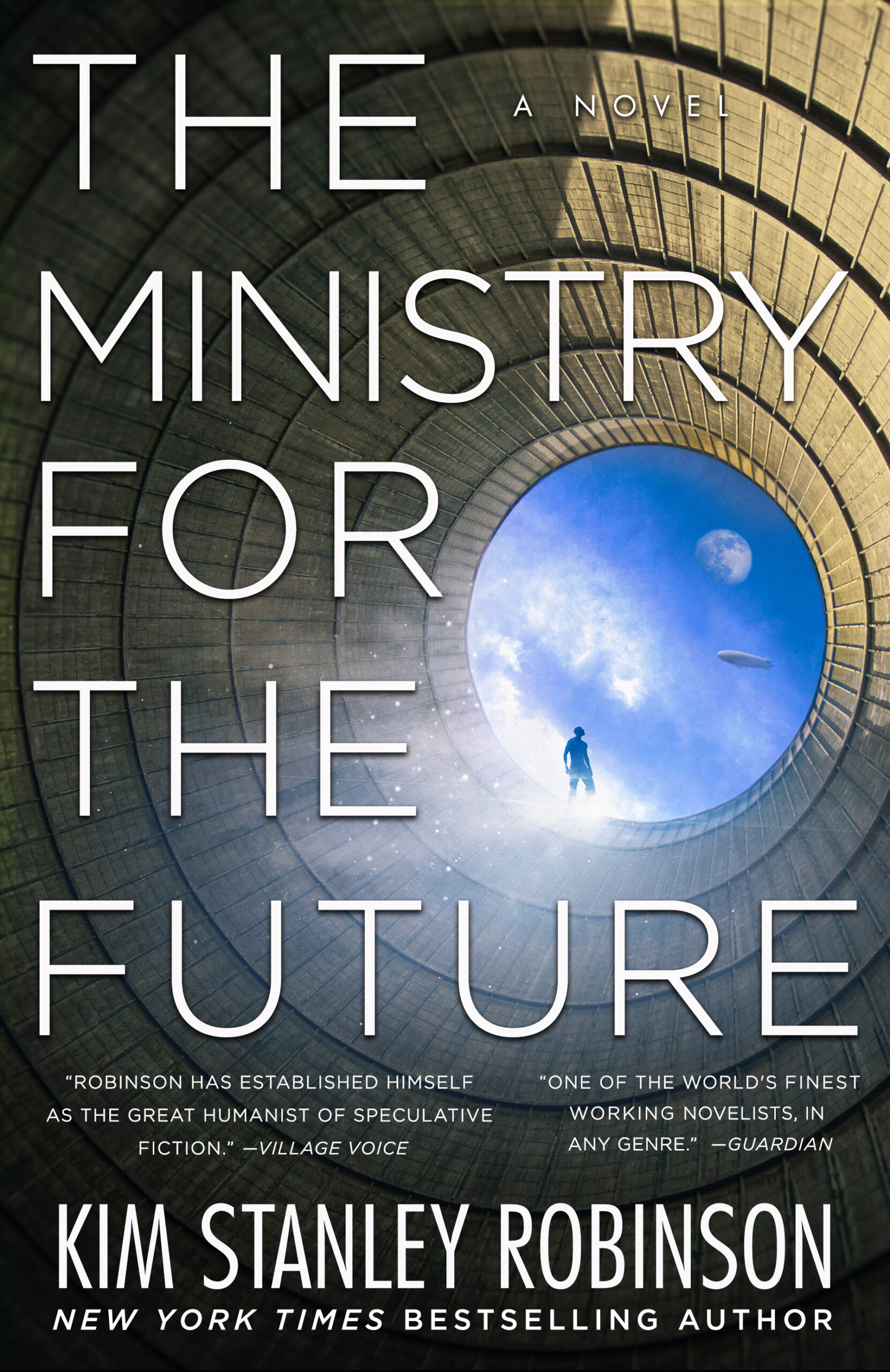
    “The Ministry for the Future” is Kim Stanley Robinson’s next book, to be published in October 2020, by Orbit.

    According to Robinson in a May 2020 interview, it “is describing a new few decades that if enacted by the world community, would possibly dodge the bad parts of the futures I wrote about in New York 2140 and 2312. In all three books some people are trying to do things to get people into a better balance with Earth’s biosphere, but the earlier we start doing that in a big way, the less remediation and catching up we’ll have to do. So the new book has the most intense focus on what we could do right now, and it plays off the creation of the Paris Agreement, which was a major event in world history.“

    The official synopsis reads:

    Established in 2025, the purpose of the new organization was simple: To advocate for the world’s future generations and to protect all living creatures, present and future. It soon became known as the Ministry for the Future, and this is its story.

    From legendary science fiction author Kim Stanley Robinson comes a vision of climate change unlike any ever imagined.

    Told entirely through fictional eye-witness accounts, The Ministry For The Future is a masterpiece of the imagination, the story of how climate change will affect us all over the decades to come.

    Its setting is not a desolate, post-apocalyptic world, but a future that is almost upon us – and in which we might just overcome the extraordinary challenges we face.

    It is a novel both immediate and impactful, desperate and hopeful in equal measure, and it is one of the most powerful and original books on climate change ever written.

    The cover illustration was unveiled in April 2020.

  • Red Moon

    “Red Moon” is Kim Stanley Robinson’s ninteenth novel, published in October 2018, by Orbit.

    It covers, among other things, the colonization of the moon in the 21st century, with China having settled the South Pole and an alliance of other countries having settled the North Pole. Social changes inside China, US-China relations, spying and surveillance and artificial intelligence are other themes of the novel.

    The official synopsis reads:

    Red Moon is a magnificent novel of space exploration and political intrigue from New York Times bestselling author Kim Stanley Robinson.

    It is twenty-five years since China established the first colony on the moon, and the lives of three people are about to collide.

    American Fred Fredericks is making his first trip there, his purpose to install a communications system for China’s Lunar Science Foundation. But hours after his arrival he witnesses a murder and is forced into hiding.

    It is also the first visit to the moon for celebrity travel reporter Ta Shu. He has contacts and influence, but he too will find that the moon can be a perilous place for any traveler.

    Finally, there is Chan Qi. Daughter of the Minister of Finance, and without doubt a person of interest to those in power. She is on the moon for reasons of her own, but when she attempts to return home to China, in secret, the events that unfold will change everything – on the moon, and on Earth.

    The cover illustration was unveiled in March 2018.

    Excerpts:

    • Orbit: Fred‘s landing on the moon (first chapters) (audio book clip)
    • Syfy: Ta Shu‘s first impressions of the moon
    • Hachette: the Analyst and the quantum computer Little Eyeball
    • The Verge: Ta Shu goes on a moonwalk with an Earthrise

    KSR presents the book for Orbit:

    Structure

    Limited third person narrative. Chapters alternate between the principal narrative (Fred and Qi, and at times some additional characters; 20 chapters) and two additional sets of chapters (Ta Shu, 8 chapters; and the AI, 14 chapters). All chapters have titles in pinyin Mandarin Chinese followed by their English translation; several titles are famous quotes from Chinese historical figures and are noted as such.

    Characters

    Main characters

    Frederick J. Fredericks (“Fred“): US citizen, technical officer for the Swiss company Swiss Quantum Works (quantum computer engineer); lone introvert

    Chan Qi: Chinese revolutionary figure, daughter of prominent Chinese official

    Ta Shu: famous Chinese videoblogger and traveller, poet and Feng Shui adept

    The Analyst: Chinese analyst at the Artificial Intelligence Strategic Advisory Committee

    Rest of characters in order of appearance

    Chang Yazu: chief administrator of the Chinese Lunar Authority

    Li Bingwen: Party secretary of the Chinese Lunar Authority

    Valerie Tong: assistant at the American consulate of the Chinese Lunar Authority

    John Semple: station chief at the American consulate of the Chinese Lunar Authority

    Jiang Jianguo: inspector, Chinese Lunar Authority

    (to complete)

    Summary

    (to complete)

    Analysis

    The novel takes place in 2047, at the end of the 50-year “one country, two systems” period for Hong Kong and Macau following the British colonial period, when Hong Kong is expected to be fully integrated into the People’s Republic of China.

    Common characters with Antarctica: Ta Shu, Valerie

    Common themes with New York 2140: “Chinese equivalent” to the protest revolution, Householders’ Union

    Chinese chapter names and in the text

    (to complete)

    Reviews

  • New York 2140

    “New York 2140” is a Kim Stanley Robinson novel published on March 14 2017 (hardcover, ebook, audiobook) in the USA, Canada and Australia (March 16 for UK). 624 pages. The paperback was released on March 14 2018. It is a comedy of coping in a future where climate change and sea level rise has happened, but life goes on.

    Official synopsis:

    A new vision of the future from Kim Stanley Robinson, the New York Times bestselling author of science fiction masterworks such as the Mars trilogy, 2312, and Aurora.
    The waters rose, submerging New York City.
    But the residents adapted and it remained the bustling, vibrant metropolis it had always been. Though changed forever.
    Every street became a canal. Every skyscraper an island.
    Through the eyes of the varied inhabitants of one building Kim Stanley Robinson shows us how one of our great cities will change with the rising tides.
    And how we too will change.

    Structure

    The novel is broken down in 8 parts, each consisting of several chapters following one or a group of the central characters. Most chapters are written in a limited third person narrative, except the Franklin chapters, in first person narrative, and the citizen chapters, which are transcripts of in-universe logs or articles. The Mutt and Jeff chapters are entirely written in dialogue, like theater. Quotes from a variety of sources on New York are interspersed between chapters.

    Characters

    Characters are connected by the Met Life building, most of them being neighbors inside that building.

    Mutt and Jeff: quants for financial markets, get abducted when they unleash some disrupting code in the way financial markets work; a comic-tragic duet; a riff on the comic strip cartoon of the same name, invented in 1907 in San Francisco

    Inspector Gen: respected New York police inspector, with a good knowledge of her district, looks into their disappearance

    Franklin: hedge fund manager at WaterPrice, creator of the financial product IPPI (Intertidal Property Pricing Index), womanizer, likes to cruise the New York canals with his hydrofoil bug

    Vlade: the Met Life building’s superintendent, solves all issues that arise, particularly anything that has to do with water

    a citizen: a disgruntled sarcastic citizen with an acute knowledge of history, in particular New York local history (could be Mr. Hexter, that the boys Stefan and Roberto become friends with)

    Amelia: cloud (internet) video superstar, travels the world in her airship Assisted Migration, often does environmental documentaries and participates in animal conservation missions

    Charlotte: social worker at the Householders’ Union, helps run the Met Life building, has run-ins with local, coop, city-wide, state-wide and national politics

    Stefan and Roberto: orphan 12-year-olds that try to survive, and try to salvage sunken treasures; the Dickensian water rats

    Summary

    Part One: The Tyranny of Sunk Costs

    Part Two: Expert Overconfidence

    Part Three: Liquidity Trap

    Part Four: Expensive or Priceless?

    Part Five: Escalation of Commitment

    Part Six: Assisted Migration

    Part Seven: The More the Merrier

    Part Eight: The Comedy of the Commons

    Reviews