The Science In The Capital trilogy consists of three novels by Kim Stanley Robinson that explore the interaction of science and politics in the United States capital, Washington, D.C.. They were also marketed as the Capital Code trilogy and have also been called the 40/50/60 novels. An omnibus edition, but with compressed and amended text, came out under the title Green Earth.
Because of their basis in realistic situations, their depiction of topical themes and their setting in a time quasi-concurrent with the present at the time of their writing, they are notable for the sense of urgency that transpires from them. Serious weight is given to the need to tackle climate change on both national policy and international relations levels. They were written during the presidency of George W. Bush, whose ideology and policy-making was opposed to taking any action that was significant enough on these matters.
The three novels are:

Forty Signs Of Rain |

Fifty Degrees Below |

Sixty Days And Counting |
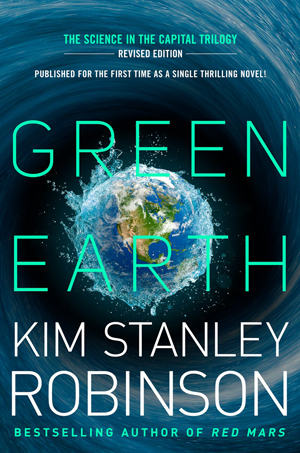
Green Earth |
Themes and concepts
- Abrupt climate change and the thermohaline circulation in the Gulf Stream
- Modern urban lifestyle and “repaleolithization“
- Capitalism and permaculture
- The prisoner’s dilemma and morality
- Optimodal living and Buddhism
- Emerson and transcendentalism
- Scientific research, the merit review process and science in politics
- Runaway surveillance and intelligence agencies
(to develop)
Characters
Main page: List of Science In The Capital trilogy characters
- Frank Vanderwal
- The Quiblers
- Charlie Quibler
- Anna Quibler
- Joe Quibler
- Nick Quibler
- Phil Chase
- Diane Chang
- Caroline Churchland
The trilogy shares some characters with the novel Antarctica, more specifically US Senator Phil Chase and his envoyé to Antarctica Wade Norton.
Settings
Main page: Places in the Science In The Capital trilogy
The main setting for the trilogy is, of course, the nation’s capital, Washington. There are frequent visits to California, a hub for biotechnologies research, and occasional visits to other places around the world (the island nation of Khembalung, the Atlantic ocean, China).
Reviews
Reviews for the whole trilogy
Reviews for Green Earth
- Los Angeles Review of Books: Weather Permitting, by Rebecca Evans
- Weighing a pig doesn’t fatten it


