KimStanleyRobinson.info

The reference site for Kim Stanley Robinson

Category: Uncategorized

  • KSR.info 3.0

    KSR.info 3.0

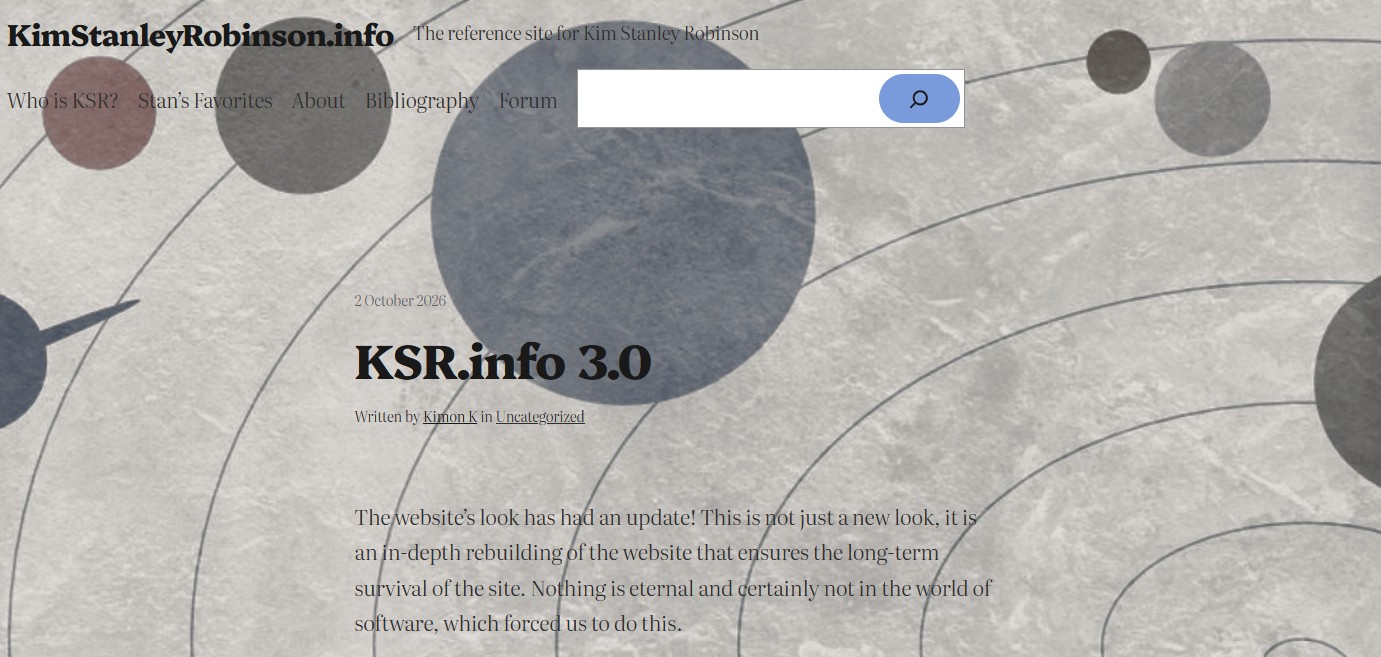
    The website’s look has had an update! This is not just a new look, it is an in-depth rebuilding of the website that ensures the long-term survival of the site. Nothing is eternal and certainly not in the world of software, which forced us to do this.

    Things might still change a bit as we find our footing. With fewer software issues to deal with, we should be able to concentrate on what matters, the content: info on the books, news and interviews, comments and analysis.

    This is the third refurbishment, after the website’s launch in July 2009 and a previous iteration in November 2015. Over seventeen years already!

    With many thanks to Stephen Fernie.

    Stay tuned for new things, and drop us a line in the comments or in the “forums“.

  • Kim Stanley Robinson

    Kim Stanley Robinson (born March 23, 1952) is an American novelist, widely recognized as one of the foremost living writers of science fiction. Robinson began publishing novels in 1984. His work has been described as “humanist science fiction” and “literary science fiction”. Robinson himself has been a proud defender and advocate of science fiction as a genre, which he regards as one of the most powerful of all literary forms.

    Biography

    Robinson was born in Waukegan, Illinois, but moved to Orange County, California, when he was two. As a child he loved to play in the orange groves stretching out for miles around his home, so when suburban sprawl began to encroach and the groves were torn out and paved over, the rapid change of modern life hit close to home. It was not until college in 1971 that he would stumble upon new wave science fiction and find in it an expression of that very sense of rapid change that had made such an impression upon him growing up, at which point he knew almost immediately that he would be committed to science fiction from then on. He enrolled at the University of California-San Diego (UCSD) in 1970 and received his B.A. in Literature in 1974. During that time he developed the idea to write a trio of books exploring three different alternative future histories in which southern California had gone down different paths, what became the Orange County trilogy. After briefly leaving California to receive an M.A. in English at Boston University in 1975, Robinson returned to UCSD to complete his Ph.D. Though science fiction was something of a “literary ghetto culture” in the academic world, Robinson could not have had a more sympathetic advisor in Fredric Jameson, who suggested that Robinson do his thesis on the works of Philip K. Dick, whom Robinson was not particularly familiar with at the time but whom Jameson regarded as the greatest living American novelist. Robinson agreed to the idea and finished his Ph.D. in 1982, a revised version of which was published in 1984 as The Novels Of Philip K. Dick. In 1978 Robinson took a break from his Ph.D. work and moved north to Davis, Califonia, where he worked in a bookstore and spent a lot of time outdoors, especially backpacking in the mountains, where he continued to develop his love for landscape and the outdoors. While in Davis he met Lisa Howland Nowell, an environmental chemist, and in 1982 upon completing his Ph.D. he returned to Davis and the two were married. He taught freshman composition among other courses at UC Davis, another autobiographical tidbit that would be bestowed upon his fictional alter-ego Jim in 1988’s The Gold Coast. Then a few years later, after publishing his first few novels, his wife’s post-doctoral work in environmental toxicology took the couple to Switzerland, where they lived for two years, and at which point he began to write full time. Her work also took them to Washington, D.C., and during their four years there Robinson was a stay-at-home parent to their first son while his wife worked. Finally, in 1991 they moved back to Davis to buy a house in Village Homes — a planned community that shares many things in common with the community depicted in his 1990 novel Pacific Edge — where their second son was born. Robinson is still the stay-at-home parent, giving him plenty of time to write, while his wife continues to work full time as a chemist. As a result, much of the couple’s social circle is made up of her friends and colleagues, giving Robinson ample material with which to write about scientists. As can be gathered from above, Robinson enjoys inserting personal life experiences or autobiographical elements in his works. For example:

    • Robinson enjoys mountaineering greatly, which can be seen in landscape descriptions and trekking trips in nearly all his works.
    • His stay in Switzerland is a likely inspiration for frequent references to Swiss government and people (Green Mars, Fifty Degrees Below).
    • He has visited Greece and enjoys the architecture of the Greek islands (The Gold Coast, Blue Mars).
    • He likes softball, referenced in Icehenge and Pacific Edge, and plays the frisbee golf described in Fifty Degrees Below.
    • At times he is a stay-at-home dad, like Charlie Quibler in the Science In The Capital trilogy.
    • He is a Californian teacher, like characters in The Gold Coast and The Years Of Rice And Salt.

    Early Writings: Short Fiction and Doctoral Thesis

    Icehenge

    Novels: 1984-1990

    During a drive to visit his parents, still just up the coast in Orange County, as he passed through Camp Pendleton Marine Base he was struck by the contrast between that undeveloped patch of land and the surrounding urban sprawl, and came up with the idea to write a trio of alternate futures for that place, the Orange County trilogy. The first book, The Wild Shore, would be set in that very patch of undeveloped land, while the second, The Gold Coast, was an opportunity to use science fiction as autobiography and finally express poetically his feelings about Orange County’s orange grove past and urban sprawl future that had been bubbling in his mind for twenty years.

    Novels: 1992-1999

    The Mars trilogy is the result of a long-time passion of Robinson for Mars, as was obvious from his earlier writings. In the trilogy he was able to use the scientific research he conducted in Martian geography for Icehenge and realize the full scope of social experimentation that he had initiated with the Orange County trilogy. Antarctica

    Novels: 2002-2009

    The Years Of Rice And Salt

    The Science In The Capital trilogy

    Galileo’s Dream

    Novels: 2012-onwards

    Shift from Bantam to Orbit

    2312

    Shaman

    Aurora

    New York 2140

    Major themes

    Humanism, utopia, environmentalism, transcendentalism

    Criticism and Analysis

    (to be expanded)

    See also
  • Stan’s Favorites

    For those who want to have a good introduction to Stan’s thoughts and ideas and for those who are already acquainted with his works and are hungry for more, this is a compilation of interviews considered to be Kim Stanley Robinson’s most comprehensive and interesting. Mr. Robinson kindly contributed to the selection of the talks and interviews presented below.

    A much fuller list of interviews (video, audio, print) can be found here at KSR.info.

    Listed below are some Video, Audio and Print interviews.


    VIDEO


    “Science, Religion and Ideology” at Duke University (January 29, 2010)

    Part 1 of 7 (click through the related videos to track the following parts)

    Audio of the whole thing (launches iTunes)


    Oregon State University: “Who Owns The Sky? – “The Future Is A Commons” (February 21, 2008)


    Google and Climate Change, part of Google TechTalks (December 11, 2007)


    Yozone.fr interview at the Utopiales 2006, Nantes, France (November 3, 2006)


    UCTV: UCSD Guestbook (July 11, 2000)


    AUDIO


    Time and the Novel (August 14, 2014)
    Lecture by Kim Stanley Robinson at LonCon 3, the 72nd World Science Fiction Convention, Litarature Talk 1477, Thu 14.08.2014 19:00 BST in Capital Suite 14, recorded by Martin Stricker http://www.martin-stricker.de/ for the Phonothek of the Science Fiction Club Germany e. V. http://www.sfcd.eu/
    — and an SFCD + KSR.info exclusive!

    I Should Be Writing podcast (February 11, 2009)
    Conversation between James Patrick Kelly and Kim Stanley Robinson
    Direct audio link

    IT Conversations (April 4, 2007)
    Dr. Moira Gunn speaks with Kim Stanley Robinson, author of “Forty Signs of Rain” and “Sixty Days and Counting.” They consider one scenario of what America would be like if global warming predictions came true.
    Direct audio link


    PRINT


    Science Fiction Studies (July 2004)
    Future Politics: An Interview with Kim Stanley Robinson (by Imre Szeman and Maria Whiteman)

    Strange Horizons (August 15, 2005)
    Interview: Kim Stanley Robinson (by Larre Jamneck)

    LabLit (February 4, 2007)
    The day after today: Interview with novelist Kim Stanley Robinson (by Jennifer Rohn)

    PeaceWork Magazine (July 10, 2008)
    Robust Utopias: A Conversation with Science Fiction author Kim Stanley Robinson (by Sam Diener)

    BLDGBLOG (December 19, 2007)
    Comparative Planetology: An Interview with Kim Stanley Robinson (Geoff Manaugh)

    Infinity Plus (October 2009)
    Wilderness, Utopia, History: an interview with Kim Stanley Robinson (by Nick Gevers)

  • About KSR.info

    About this website

    KimStanleyRobinson.info (KSR.info) is a website dedicated to the American author and thinker Kim Stanley Robinson, and to the discussion of his works. KSR.info is not officially sanctioned by Kim Stanley Robinson or any of his representatives. This is a fan non-profit-oriented effort and no copyright infringement is intended. Despite the fact that Mr. Robinson is aware of KSR.info and approves of this web-based platform for the presentation of his work, this site is unofficial and the views expressed here cannot be used as those of Mr. Robinson’s.

    A great part of this website is the free online encyclopedia on all things related to KSR’s works (called MangalaWiki in the first version of this site). Anyone is free to join, edit and help build it.

    The encyclopedia and the site are meant to serve as springboards for further analysis and discussion of the themes tackled by KSR’s works — sustainability, politics, humanism. Criticism is not prohibited, only as long as it is respectfully and coherently argumented. Please be respectful of other people’s opinions and refrain from vandalizing.

    KSR.info was created in July 2009 by Kimon.

    You can contact the creator and webmaster of KSR.info at postmaster (at] kimstanleyrobinson.info

    VLA

    How can I contribute?

    KSR.info hopes to be a community-run website. Contributions to the content and to the structure of the website itself are wanted and encouraged!

    Some ways in which you can contribute:

    • Register/Sign in and help build a comprehensive encyclopedia on the works of KSR
    • Help build a comprehensive interview list
    • If you come across an article of interest concerning KSR, such as a noteworthy review or KSR-inspired art, do post it
    • The same goes for articles of interest concerning related themes and issues: the environment, politics, science, history… the list is nearly infinite
    • KSR.info will host or link to content that is not exclusively focused on KSR. Sustainable living initiatives, social themes in science fiction, suggested writers and thinkers, if you’ve read KSR you know that nearly anything can be relevant.

    Finally, you can also contribute with suggestions pertaining to the structure of the site. Should we add a gallery of inspired-by art? A workshop on topical international issues? A newsletter? Be creative!

    Please send me an e-mail to the address postmaster {at]] kimstanleyrobinson.info with any suggestions or registration requests, or use our Forum!