The title of Kim Stanley Robinson’s next novel will be “SHAMAN“!
It will be published towards Autumn 2013.
It will, in part, take place in the landmark pictured below — although the temperature of the site will be sensibly different.

The reference site for Kim Stanley Robinson
The title of Kim Stanley Robinson’s next novel will be “SHAMAN“!
It will be published towards Autumn 2013.
It will, in part, take place in the landmark pictured below — although the temperature of the site will be sensibly different.
RED MARS was first published in September 1992 (HarperCollins, UK) and received a wider release in February 1993 (Bantam Spectra, USA), thus beginning the release of the MARS trilogy.
2312, a novel reimagining a future like that of that trilogy and extending it further in time, was released nearly exactly 20 years later: May 2012 for the hardcover, and the paperback is coming in Summer 2013!
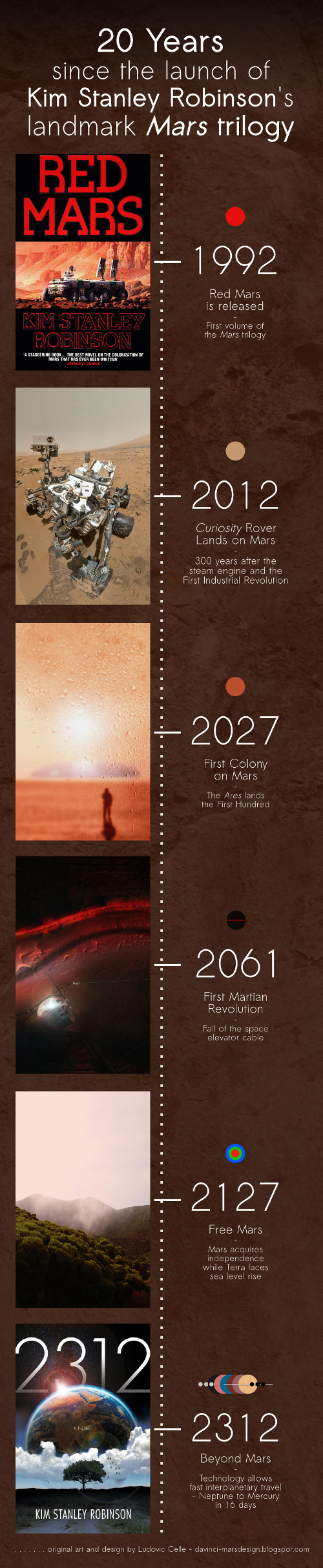
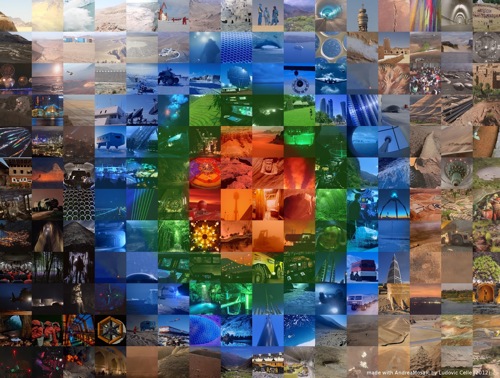
To celebrate this anniversary, Ludovic Celle has created the montage below! You can find a higher definition version of that image here, or on Ludovic’s Da Vinci Mars Design blog.
Marina Abramović, influential Serbian performance artist, was in part the inspiration for the character Swan Er Hong in Kim Stanley Robinson’s 2312. Something Abramovic is aware of herself; extract from an interview:
“Do you know Kim Stanley Robinson?” Abramović figures in the storyline of 2312, Robinson’s big new SF novel, which delights her, because she is keen on the idea of space travel, having exhausted herself into out-of-body experiences. “These pieces are great for galactical trips.” She was saying, “There is nowhere to escape except ourselves.”
Now, Muse Magazine has published an art photoshoot with Abramovic with about twenty photos, and Kim Stanley Robinson provided the accompanying text. This piece is a treat for the Robinson fan, mixing references to the world of Galileo’s Dream, 2312, Swan’s work and, as if there were a Galileo-like entanglement between Swan and her, back to our Abramovic — or rather her imaginary alter ego in this space-themed photoshoot! The entire text is below, available here, but for the images you have to find the print magazine (the text makes more sense with the images, but the two that are here can give you a feeling).
The Many Cosmos Of Marina
Marina Abramović
Photography Guy Aroch Written by Kim Stanley Robinson Special Art Direction Thomas Berloffa
Every artist learns to fly in a different way.
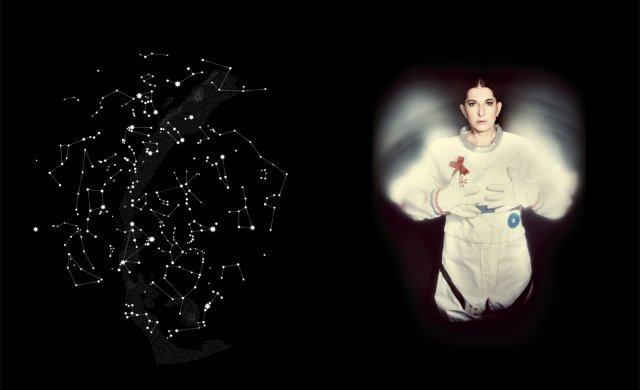
The images here are moments captured from Marina’s next flight. It hasn’t happened yet; these images come from the future, courtesy of Mnemosyne, the MUSE of memory, who remembers equally the past, present, and future.
Marina Abramović, having over the course of a long career transformed performance art from a disorganized collection of gestures into one of the supreme human art forms, thus in the process becoming the queen of twenty-first century high art on Earth, decides to take off through time and space, on a tour of the city-states dotting the solar system in the year 2312. There are new worlds to conquer!
She will fly like Icarus, and so crash and burn: not ignorantly or by accident, but on purpose, because one of Marina’s signature moves as an artist is what engineers would call “the test to destruction” – she jumps into her ideas and pushes them to their utmost limits, far beyond the bounds of safety. If there is a sun to fly into, that’s where Marina will be aiming her spaceship.
Marina is a charismatic. Recall the etymology of that word: to have charisma is to be dealing with a wound. What is the nature of Marina’s wound? As a child she was brought up by atheist communist bureaucrat parents, and Serbian Orthodox patriarch grandparents, in a space once called Yugoslavia. There is no synthesis that will bring together all the antitheses she grew up with; her dialectical exploration of her life and times will go on ceaselessly, without any end or resolution. The stars are her destination. Do you see how the constellations crowding the night sky next to her spell out “ABRAMOVIĆ”? No? That’s because they are spelled out in the Cyrillic alphabet.
See how she flies like Icarus, flapping her wings. A lifetime of rigorous discipline in training her body to be the raw material for
her art, also in plucking images and experiences from her dreams, means she can fly under her own power when she wants to. And she often wants to.
The blue disk on her uniform contains recordings of her performances. Most of the greatest examples of Terran performance art are here, from her violent, bloody, and dangerous confrontations of the 1970s, to her warm, generous, and startling recognitions of the early twenty-first century. In 2312, artists often simply speak of “doing an abramovic” especially if their performances are strange, difficult, or intense.
The red ribbon and medallion she wears over her right breast is called the Rose of the Balkans, now one of her nicknames. In Marina’s youth, she cut the five-pointed red star of Yugoslavia into the skin of her own chest and belly. By her work over the years, by looking people in the eye, she slowly turned that bloody star into a rose.
The Meeting: When Marina looks through her time telescope into the studio on Mercury, she sees a young performance artist, trying her best to animate the dead art of the past. All the craters on Mercury are named after famous artists, writers, composers, poets and painters: Goya overlaps Sophocles, Van Gogh and Cervantes touch at their rims, Chekhov and Michaelangelo are both double craters, Ovid stars the rim of the much larger Pushkin. In such a landscape as this, the young artists are completely confused and intimidated by the burden of the past. This young performer desperately needs help, and Marina can see that.
The Fight: Marina therefore breaks into the time-space continuum of the young Mercurial artist, which tears the fabric of reality, and shocks the youth into a fighting response. Reality spins before her in a whirling snarl, and she perceives the newly arrived Marina as a deadly threat.
To hold off the intruder with chopsticks: it isn’t really going to work. She needs to try something else, she needs to see the situation in a new way. Who is this intruder, why does she look so alluring, so full of possibilities? Put on the kind of protective lenses you would wear to look directly at the sun, and see better who it might be.
The young artists of Mercury are so astonished and overwhelmed to have Marina flying into their world that they cannot help acting like statues when she is around. They are too scared to look at her. Above them, Marina’s route through the cosmos manifests as a torus, a wormhole through space and time. If you go in one side, you come out the other side, after an instant which is also an eternity:and you don’t come back the same.
The Performance: The moment you cast yourself into a performance is a frightening one. A part of you must go away, that’s just the way it is. You give up your ego, your super-ego, your entire sense of self.
Time to be the performance. Doing it in Marina’s style, the performance will include a big element of endurance. In this case, it looks like a month has passed. But is that one month? All months?
It takes a while to get used to it, but for some, performing under the eye of Abramović is a transcendent experience. Under her eye a blessing descends on your heart, which is sometimes visible as a butterfly, as when Gabriel Garcia Marquez’s Remedios the Beauty was carried off to heaven in a flock of butterflies. I, the teller of this tale, have experienced this with Marina myself. The butterfly was yellow and black.
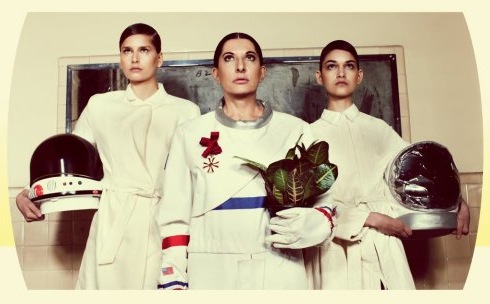
The Come Back: Eventually the younger artists are ready to fly with Marina, off toward the sun. They are apprehensive, and so Marina carries kratom leaves, so she can offer the new fliers the soothing scents of the leaves, and later a tea made from them. For this flight they will need helmets: Marina will be holding her breath, which she can do for many hours at a time.
She will be living through the young artists’ performances, and they will encouraged by her presence. As they perform, for the rest of their lives, they will always remember her as they saw her most, wearing the glasses she always wears when she is teaching the young, when she wants to see them at their best.
Under this geeky, four-eyed, professorial gaze (Marina as Marion the Librarian, Marina as The Teacher Who Really Looks At You), the young artists blossom and fly! Try it yourself and you’ll see: for life itself is a performance. What will these young artists of Mercury’s performances be like, when they happen? Will Marina really come back to Earth, or is she gone for good? If she does come back, will she be the same Marina who left us so many centuries before? Will we be able to see her without wearing protection for our eyes? Will the room fill with butterflies? If we do see her, will we all then be on Mercury together?
Stay tuned.
Developing themes touched upon in his Science In The Capital trilogy and 2312, Kim Stanley Robinson wrote an article for the onearth online magazine, “Earth: Under Repair Forever“, dealing with…terraforming of Terra! i.e. geoengineering.
For the rest of history, we will be required to work at repairing the damage we’ve already done to the biosphere. Geoengineering, then, has become our ongoing responsibility to life on this planet, including all human generations to come. All of which leads to the question: can we actually design and accomplish any geoengineering projects that would mitigate or reverse climate change? Putting aside issues of political capability, are any of these projects physically possible?
Stan was even more strong on his choice of words when he visited the Mount Shasta Library recently. One of Stan’s short stories is called “Muir on Shasta” (it appears in “Remaking History” and “The Best Of Kim Stanley Robinson“). He spoke on various subjects:
In response to a question on GMOs, Robinson said that an extended family member had developed a new strain of rice. “Global warming has meant the monsoons are much greater than before,” Robinson said. “The rice can survive under water for two months instead of two weeks. I think that’s good.” Robinson acknowledged that when scientists from the companies that produce foods with GMOs say it is safe, they are greeted with suspicion. “When you are mad at science, you are really mad at capitalism,” Robinson said. “The danger is when it becomes private for profit, like a Monsanto. The world should be a public utility. We should have public source genetic engineering.”
UK literary magazine Structo also featured Stan with an interview in its #8. Released in July 2012, it is now available online to read here. The interview, focusing on 2312 but not exclusively, is very enjoyable!
Stan was also extensively featured on literature journal Puerto del Sol, v.47 #2, an issue dedicated to “Utopias!” featuring original poetry and prose, reviews and a roundtable Q&A. The issue can be ordered from the magazine’s website, however the KSR-related material is also available as pdfs:
A roundtable Q&A with authors Jacqueline Dutton, Daniel Heath Justice, Kim Stanley Robinson and Lorenzo Veracini.
If I understand the term, settler colonialism describes my own situation as a person of European ancestry living in California, and so I suppose it has an impact on me implicitly, as I, like so many others, have to consider what it means “to become native to this place,” as Wes Jackson named the project. In my case, the central valley of California is now my home. It’s important to remember how it was here before the Europeans arrived—”the Serengeti of North America” as it has been called—and what it is now, a space of industrial agriculture, with a manipulated water system and greatly altered ecosystems.
And an in-depth review of 2312 by Joe Epstein:
The hospitable world seems endless to our intuition—why else would so many dismiss climate change flatly?—yet our home is only a gossamer sheet on Earth’s surface, and even there only under specific conditions, and virtually the entire rest of the universe is unlivable without improbable technological feats. On a cosmic scale, our civilization is as fragile as the biofilm in a shower drain. Robinson manages, with Terminator, to convey awe at the fact that anything should exist in the first place, and the pleasure of exploration for its own sake.
In addition to his thorough stage setting, Robinson continues to celebrate—more than most sci-fi authors—the actual humanity of his characters.
One doesn’t have to work very hard to see the present in 2312, with half the world impoverished, the disparity between those with personal aircraft and those who dig their toilets unyielding, and so many denying we can ruin things for ourselves, even as libraries of evidence mount to the contrary.
Ultimately, 2312 is an update, a continuation, and a condensation of Robinson’s themes: the importance of sustainability and stewardship; the sheer difficulty of any space activity, an incredible challenge still not sufficient to dissuade human ingenuity; and the joy of mindful experience at all, of being a person who can feel, think, wonder, and love. Consider how often Robinson’s characters, almost all inhabitants of futuristic science fiction, adjourn for coffee and pastries, or head to cook, dine, and clean at a communal kitchen, or relax by hiking, examining flowers, spotting birds. Robinson centers aggressive, progressive sci-fi stories, covering incomprehensible distances, on humans doing human things. In this way, Robinson is among the most humane of writers.
Speaking of reviews, Bookbag on 2312.
The thoughts above on the fragile nature of our ecosystem and its small size compared to the enormity of the universe is referenced in an article in Nature as well, where Stan discusses the ever-growing list of exoplanets that have been discovered:
The stars exist beyond human time, beyond human reach. We live in the little pearl of warmth surrounding our star; outside it lies a vastness beyond comprehension. The solar system is our one and only home.”
(Pictured above: illustration for Structo #8)
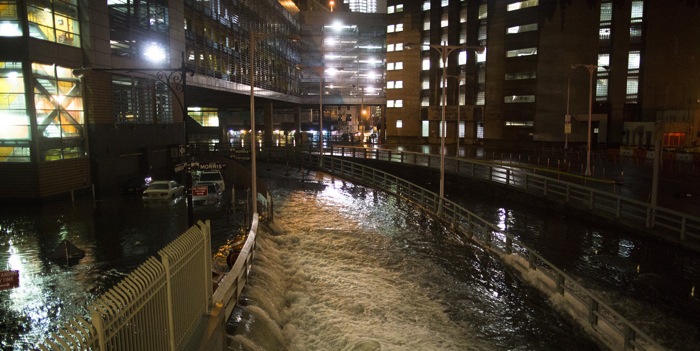
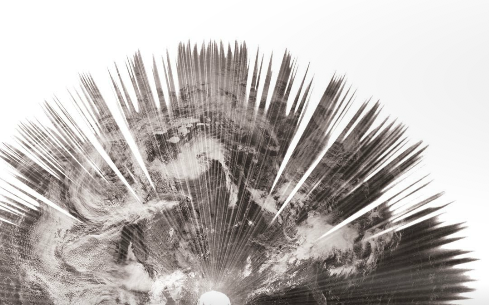
Pictured above: New York flooded by Hurricane Sandy, October 2012. These images should ring a bell in two different ways to KSR readers. First, there’s the close-future Science In The Capital trilogy, wherein in Forty Signs Of Rain Washington DC is tragically flooded in the midst of undeniable climate change; an unhappy event like Hurricane Sandy. And then there’s the far-future 2312, where climate change and rising sea level has made of New York City and Manhattan island in particular a Venice of the future, where tall buildings directly emerge from the water and the scenery is full of overhead bridges and piers; a description that is far away from the flooding as it was lived by today’s New Yorkers, but a description of a city of which its inhabitants are very much proud of on 2312! Photo by John Minchillo.
In a short video interview for io9, Kim Stanley Robinson evoked the novel that got him into science fiction: Clifford D. Simak’s The Goblin Reservation. It’s relatively unknown, but it was a 1969 Hugo Award nominee; interestingly, John Brunner’s Stand on Zanzibar won that year, and that novel had a much more obvious influence on Stan’s 2312!
Stan was also interviewed by PrintAsia on 2312 and writing:
What is the basic difference between the Kim Stanley Robinson who compiled the Mars Trilogy and the KSR who wrote 2312?
Twenty years or so! As a writer, I think that has made me less patient, and more interested in trying different structures and narrators.
Further on 2312: A stellar review by popular blogger and writer Cory Doctorow:
2312 is an epic story of political intrigue among the many worlds. To call it epic is to do it a disservice. It’s the kind of book that makes you realize that the ambition of Red Mars was just a warm-up; that books like Years of Rice and Salt, which reimagined millennia of history, were just a kind of mental exercise for Kim Stanley Robinson. 2312 paints an absolutely credible and astonishingly beautiful picture of the centuries to come, of the sort of schism and war, the art and love, the industry and ethics that might emerge from humanity going to space without conquering it and without solving all its problems.
In lukewarm news, full videos of four panels from last year’s Worldcon (Aussiecon 4) surfaced on YouTube! They are:
Kim Stanley Robinson’s panel on Utopia and Climate Change
Kim Stanley Robinson, Gregory Benford, Tom Wigley, Sam Scheiner on Geoengineering: A Short Introduction
Kim Stanley Robinson, David D. Levine, Jim Benford on Race to the Red Planet
Kim Stanley Robinson, Sean McMullen, Grace Duncan, Tiki Swain, Jonathon Cowie on Climate Change: Possible Futures for Planet Earth
Starship Sofa’s podcast #249 has a recording of Stan’s short story “The Timpanist of the Berlin Philharmonic, 1942“, narrated by Diane Severson. The story appeared in 2010’s The Best Of Kim Stanley Robinson.
Finally, Kim Stanley Robinson will be appearing at the Humanity+ conference on “Writing the Future” in San Francisco, on December 1-2. He is scheduled at 10am on Saturday December 1. The subject of his talk?
Science as a Utopian Project
I want to explore the relationships between science, science fiction, and society, with a view toward seeing where science fiction might help us to shape our efforts in the present to make a better future.
Humanity+ @San Francisco
San Francisco State University
Seven Hills Conference Center
800 Font Boulevard
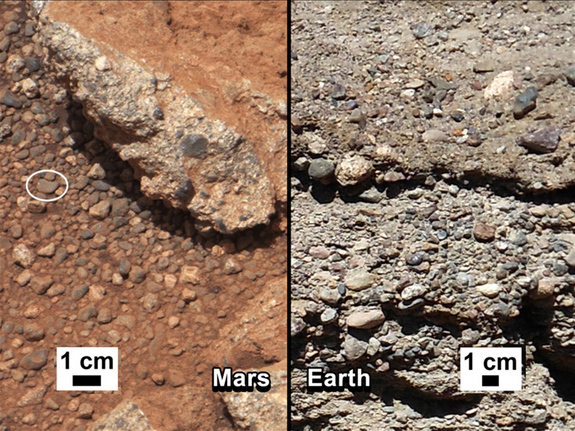
Pictured above: comparison of Martian rock outcrops with their Terran equivalent, proof of water on Mars by NASA’s Curiosity rover!
A whole summer’s worth of catching up with 2312 and Kim Stanley Robinson press coming up!
FDL Book Salon hosted a live web chat with Stan, where he interacted with members at length on a huge number of subjects! Highly recommended!
Blue Mars and the Mars trilogy is more utopian in many ways, and 2312 shows the darkening of the last 15 years of global history, the sense that things will stay a mess for a long time. But this may be true at the same time that progress is made in other areas, which ultimately may prevail. So I feel like 2312 also is utopian, but in the ongoing redefinition of utopia I have long been suggesting that it’s a name for a particular kind of struggle, and that it will go on for a long time and been pretty painful throughout. But with some good results!
My research these days is mostly on the internet, but also I phone scientists I know often, and I got Chris McKay to convene a lunch group at NASA/Ames in Mountain View and I went down and asked the eight or nine people there a couple hours of questions, it was great help.
SF Signal interviewed Stan on 2312, Mars and climate change:
One change I can say for sure, since the writing of the Mars trilogy: I need always to say very clearly that Earth is and always will be the center of the human story, that Mars and the rest of the solar system can be helpful and interesting (even just as thought experiment setting) but Earth has to be our focus for the next two centuries for sure, and really, for all history to come. We all should remember that and act on that.
The About SF podcast interviewed Stan at length, with two episodes available totalling over an hour! Part 1 and Part 2 available. He discusses his research about the planet Mars for his trilogy, his inspiration for writing the novels, and his ambitions for writing science fiction.
Stan was interviewed for UK literary magazine Structo, Issue Eight, you can order it on their site.
Stan also presented 2312 on Google Talks, and answered audience questions.
Marina Abramovic, performance artist and inspiration for the character of Swan in 2312, mentioned Swan in an interview for the Wall Street Journal!
I also want to create a platform to work with scientists and with new technology. I had lunch a few months ago with Kim Stanley Robinson, a science-fiction writer who gave me a new book he wrote called “2312.” I’m one of the characters in the book. He said, “I saw you at MoMA, and you are great for creating galactic troubles.” So I am now doing performances on an asteroid near Mercury, just so you know.
With over four months in bookstores around the world, 2312 keeps getting reviews and reviews.
io9:
If this novel sounds like your typical post-human epic, however, it isn’t. Absolutely it has space battles and AI orgies and moons being chopped up and hurled at planets. But it’s also full of strange prose-poems about science and consciousness. And every few chapters, Robinson gives us a history lesson in fragments of text that hint at all the ways humanity has changed over the 300 hundred years between now and the year when the story takes place. In this way, 2312 is able to be more than just a simple story. It’s a future history, a dream of all the complicated ways we might muddle through as a species, spreading out into space without ever really fixing all the old problems that have nearly extinguished us again and again.
It is a real rarity in contemporary fiction – especially genre fiction, but also in TV and movies – to find characters who are totally actualized, who speak with their own voice instead of the author’s voice, who are not just robots built to drive the machinery of the plot. Instead, each character is unique and together they interact in ways that totally make sense given this uniqueness.
And then there are even more reviews around for your reading pleasure! Moon and Back, Blog Critics, Wind City Times, Experts Column, Portland Book Review, Cross Roads, Yatterings, Otago Daily Times, Dansville Online, Sunny Reads, George Kelley, Fill Your Bookshelf, Paper Droids, Pease Exchange, Omnivoracious, MC Reviews, A-Kon, and a video review by Olivier’s Book Club (part 1, part 2)….!
Kim Stanley Robinson, like last year, is participating in the Clarion Write-a-thon!
What is a write-a-thon, anyway? It’s just like a walk-a-thon. But instead of walking, we’re writing, and instead of making pledges per mile, we’re making pledges per word, chapter, or story. Writers get support, encouragement and motivation, and the option of joining a team with a writing mentor! Those who care about the writers in their life get a way to show their support. And money is raised for a literally fantastic cause — the Clarion Science Fiction & Fantasy Writers’ Workshop.
Pictured below: a Mars trilogy-inspired mosaic by the awesome Da Vinci Mars Design! A much higher resolution is available there.
Another wave of 2312 material!
First, the interviews:
Once more, Kim Stanley Robinson was interviewed by Rick Kleffel of the Agony Column, at Stan’s appearance at the Capitola Book Café on June 16 (direct mp3 link). Very entertaining and informative!
Stan was also interviewed by Wired’s Geek Guide to the Galaxy (direct mp3 link). At their site you can also read a transcript of the whole thing. Lots of topics are touched upon: the Mondragon Accord, Jimmy Carter in Nepal, whistling Beethoven, the technological singularity, science fiction history, science fiction novels references in 2312, …
Stan was also interviewed by Far Beyond Reality, in text form. A soundtrack for 2312?
All of these might work as a kind of soundtrack for a reading of 2312, as they often served as soundtrack for writing it. In particular I guess I would recommend the fourth symphonies of Brahms and Tchaikovski, and the late string quartets of Beethoven, and Satyagraha.
And the reviews:
One of the very best reviews I’ve read comes from Gerry Canavan, writing for the Los Angeles Review of Books:
The wonderfully inventive 2312 is, in this way, Robinson’s most aesthetically reverent work to date. Science, engineering, history, politics, philosophy, parenting, love — in this novel all are reimagined as essentially artistic practices, as the sorts of ecstatic creative pursuits people might devote themselves to once liberated from the drudgery capitalism inflicts on us. It might, therefore, be Robinson’s most nakedly utopian novel, his most ambitious attempt to show us just how good life after capitalism could be. Finally: a time for play.
But at the same time, 2312 could be Robinson’s least utopian novel — beginning, as it does, from the rejection of the “Mars Trilogy”’s happier historical trajectory in favor of a world(s)-system in which the ongoing historical struggle between the residual (feudalism), the dominant (capitalism), and the emergent (none dare call it communism) never crests, but just goes horribly on and on and on. Indeed, there is a suggestion late in the novel as pessimistic and unhappy as any I can recall Robinson making: that perhaps some people are just bad, that (worse still) perhaps true evil will only exist after scarcity.
An interesting though odd review comes from Strange Horizons; it’s actually more of a critique of the pro-technology ideas underlying Robinson’s approach to the future:
So much of Robinson’s playfulness with the broad canvas of the solar system reminds me of a remark made by J. Robert Oppenheimer about the US building of the H-bomb—i.e., that it was “so technically sweet” that it could not be foresworn. So, as a political ecologist, I mourn for the domineering technological command over the planets and the moons envisaged by this fictionally realized blueprint of the cosmos. […] Perhaps Robinson’s book may yet inspire another SF writer to think beyond the technological sublime into other realms and other plausible futures more firmly grounded in the ecological imagination and our corporeal existence and recognize that in that imagined paradisal future, et in Arcadia ego.
Jeff VanderMeer for the Los Angeles Times (“Perhaps Robinson’s finest novel, “2312” is a treasured gift to fans of passionate storytelling; readers will be with Swan and Wahram in the tunnel long after reaching the last page.“) and Rick Kleffel are massively supportive of the novel
The Canberra Times/Sydney Morning Herald place 2312 in the context of the science fiction genre:
This particular vision of the future – an environmental catastrophe on Earth, followed by a rapid and transformative expansion into the solar system – is common to much contemporary science fiction. And while Robinson’s version is perhaps less plausible (and certainly less densely imagined) than that explored in Paul McAuley’s stunning The Quiet War series, or Alastair Reynolds’s recent Blue Remembered Earth, it nonetheless presents a future that is in turn awe-inspiring, unsettling and challenging, not least in its preparedness to demand that the reader thinks seriously about the possibilities of using technology to make other planets habitable by humans. […] These are not small criticisms, nor is it coincidental that they are criticisms that might also be made of sci-fi’s golden-age writers such as Robert Heinlein and Isaac Asimov, both of whom shared Robinson’s belief in the transformative nature of scientific rationality. Yet nor do they detract significantly from 2312’s real achievements, in particular its power as a reminder not just of the possibilities of science, but of sci-fi’s importance in opening our minds to those possibilities.
Science fiction legend Ray Bradbury passed away recently, on June 5th 2012 at the respectable age of 91. Bradbury was of course the writer of one of the novels that defined the image of the planet Mars in the collective consciousness, The Martian Chronicles, a novel referenced in Stan’s Mars trilogy.
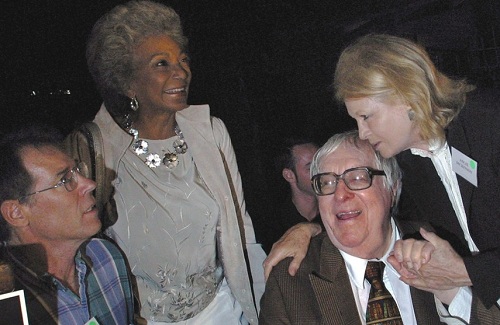
Of course, Kim Stanley Robinson and Ray Bradbury share the same home town: Waukegan, Illinois! Stan has also met and has spoken highly of Bradbury in the past. This photo (source) shows Robinson and Bradbury with actresses Nichelle Nichols and Angie Dickinson, at Bradbury’s 83rd anniversary in 2003. The celebration had been covered by Planetary Radio, and included appearances by Bradbury and Robinson.
Upon Bradbury’s passing, Stan had this to say to Wired:
I felt a bond with Ray Bradbury, because we were both born in Waukegan, Illinois, then were moved by our parents to Southern California when we were children. I feel that we both ended up as science fiction writers partly because of this childhood history; southern California has been a science fictional place for a very long time.
Bradbury was one of the first break-out stars from the science fiction community into mainstream American culture, and this was no coincidence but because of his open and welcoming style, and the way his science fiction always focused on the human side of things, adding strong emotions to what had previously been perhaps drier or simpler. He was a great ambassador to the world for science fiction, and was beloved in the science fiction community as well. He was a truly inspirational figure to many, because of his positive nature and his boundless enthusiasm for reading, which he conveyed so well, and for life in general. His fiction always reminds us that no matter what strange future we move into, human emotions will stay central to our story. His best stories and books will be a permanent part of American literature. We were lucky to have him and I’m sorry he’s gone.
Stan also shared memories of Bradbury in this short audio interview for the Takeaway. (a shorter version aired next day).
Thanks to albinoflea for the reasearch!
The rockets came like drums, beating in the night. The rockets came like locusts, swarming and settling in blooms of rosy smoke. And from the rockets ran men with hammers in their hands to beat the strange world into a shape that was familiar to the eye, to bludgeon away all the strangeness, their mouths fringed with nails so they resembled steel-toothed carnivores, spitting them into their swift hands as they hammered up frame cottages and scuttled over roofs with shingles to blot out the eerie stars, and fit green shades to pull against the night.
(from “The Locusts”, The Martian Chronicles)
Kim Stanley Robinson is continuing the promotion of his latest, 2312.
Very notably, Stan was recently in the UK, where he did a panel with fellow writer and friend Iain M. Banks; they both read from each other’s books, talked about writing, and in general had good fun.
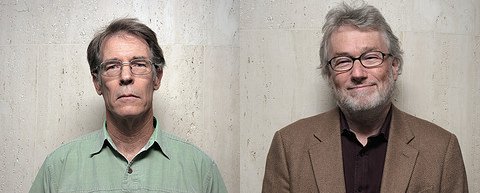
(Photos above by Joel Meadows)
This blog has a good round-up of the event.
Stan also appeared in Bath. In this video he reads from the Prologue to 2312.
One of the very best, in-depth interviews of Stan I’ve seen lately comes from the New Zealand Listener! The interview appeared in print version under an article write-up form, but interviewer David Larsen was kind enough to put the much longer full version online as well. They discuss in detail several aspects of Stan’s work, his themes over his enitre career, poetry, literary inspirations, specific plot points, real-life inspirations and trivia, very informative for the Robinsonite! One excerpt:
One of the things 2312 is is a question. Could we both wreck the Earth and have a rather active space civilisation at the same time? Could the Earth be thoroughly wrecked and yet also be flourishing in certain limited respects? I don’t know the answer to those questions. They’re proposals that I’ve put out there, saying could it be this way? Whether it’s physically possible or not I’m not quite sure. I have this double feeling: that the sciences are making us immensely powerful, so that the potential for a flourishing future civilisation a few hundred years from now is really quite realistic, and yet at the same time we’re in this dangerous moment, where we’re thrashing the environment and we have climate change, and it’s quite clear that politically the system is being manipulated by certain people who want to keep the destruction going, because they’re not convinced that it is destructive, or they don’t care because they don’t think it’ll apply to them or their families. So they’re going to be hard to beat, even in the best scenarios, because they have amassed a lot of money and political power resulting from money. So in 2312 I’m contemplating a future that seems to include environmental disasters like the raised sea levels, not at all unrealistic to postulate, and yet at the same time have things flourishing, because of materials science, because of medicine, because of all of the things that we’re learning. The ways we can manipulate nature and biology are becoming rather stupendous with potential. 2312 is an attempt to splash all that into one story. It’s a distorted lens aimed at 2012, at where we are right now.
But the whole thing is worth reading!
For an interview with the Huffington Post, Stan reacts on the privatization of space, on the force of technology, on climate change, on “Happy Space Sad Earth”. An interesting excerpt:
[J]ustice is another climate change technology that we have in the picture except for getting into this weird definition of technology as nothing but a silver bullet that we imagine might help. There’s also Jevon’s paradox that the better we get at efficiently using energy the more energy we use; so that and that machine technology improvements per se do not necessarily reduce our impacts because we immediately double down on how much we use.
It is important to de-carbonize but also important to make more horizontal the hierarchy of power and wealth. In other words, a world wide middle class that is modestly using resources by way of clean tech is the only real solution.
Stan was invited in the io9 video podcast and talks about 2312 (sadly, the interview feels edited down too much).
Reviews of 2312 are massively pouring in, from professional reviewers and from random bloggers alike. Some are enthusiastically positive, some are more mitigated, there’s something for everyone.
Everything is a perpetual project of improvement. […]It goes back to the roots of the sci-fi genre and puts at its centre utopian and dystopian visions of the social models our descendants might inhabit, with a flashy travelogue around the places they might live. It is a novel of ideas that also sets out to be tremendous fun.
Kim Stanley Robinson’s 17th novel is complex and sometimes bewildering, 500 pages crammed full of strange but decent characters whose actions play out against a vastly constructed utopian background.
2312 is like a Klimt painting on steroids and LSD
[T]he title takes its name from the year in the same way that a book might be titled “1793” or “1848” — 2312 in this universe is a year looked back upon as a turning point in history, where the events described in the book changed humanity’s course.
The slow, gathering surge toward an epic conclusion merely peters out in the end. [… KSR paints] a picture of humanity as a stagnant people who are merely distracting themselves until they die (ironically delayed due to longevity treatments) […] As I read the book, I actually thought the protagonist was a thumbnail for a moribund humanity who had reached the limit of its abilities. It was almost as if the human race was bumping up against a wall which, for all of the mind and body enhancements, it could not conceptually break through due to fundamental flaws in its construction.
I tried to imagine what it would be like to go back in time to 1712 and to not only explain what the world is like in 2012, but also how it got to that point over the 300 years in between. This is essentially the task that Kim Stanley Robinson sets himself in describing the world in 2312. […] A divide has sprung up between the spacers (the ‘haves’) and the majority of Earth dwellers (largely the ‘have-nots’) […] The main issue I had with the book was that 2312 doesn’t quite know what it is trying to be. […] in general there was just too much information and too many ideas fighting for attention within one book.
…and more from Washington Bus, Chicago Tribune, The Daily Mail, For Winter Nights, Worlds Without End.
Even more coming soon!
2312 press continues full speed!
As always, check out the calendar on the left for KSR readings, panels, events, in the USA and in the UK.
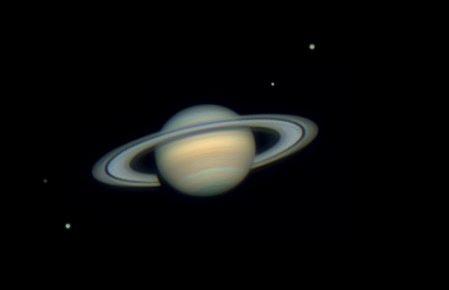
The Planetary Society‘s Planetary Radio podcast interviewed Robinson (direct mp3 link), among recent exciting space-related activity such as the Space X Dragon launch and an appropriately 2312-themed video of Satrun’s rings.
Continuing with the interviews, the SF Site interviewed Robinson. Excerpt:
[I]t is an open question whether the space project could be a significant help to humanity in trying to get into balance with the biophysical realities on Earth. I don’t think we know the answer to this question, and it won’t be easy to answer it without continuing to try to go into space usefully, and see what happens. […] But no matter what we do in space, Earth will remain at the center of the human story. That’s one of the things 2312 tries to say. But mostly the book is asking questions. It’s not really saying “this could be,” but rather, “could this be?” I think it may be that human civilization is so big and various that different things might happen in different parts of it, and advances in some areas occur despite massive problems elsewhere. But this is mainly a question to be asked; is that possible? Could we bootstrap our way out of some of our problems while they are still vexing us?
SF writer John Scalzi features a short interview with Robinson on his blog. Excerpt:
I was forced to use the Kitchen Sink Theory of Novel Construction—again, of course—indeed, more than ever—but it was necessary, because the future is going to be a wild place, a recombinant multiplicity of clashing elements, a real mess. To do justice to realism these days, the kitchen sink is really nowhere near the end of what needs to get tossed into the mix.
Also, a great hour-long panel with Robinson from last November found its way on YouTube here. Stan discusses “Valuing the Earth and Future Generations: Imagining Post-Capitalism” at the Center for Values in University of Texas at Dallas.
2312 features, among many other systems, an economy that is aided by computers to tune demand with supply. It’s interesting to read Stan write about Francis Spufford’s recent SF novel Red Plenty, a novel that has had trouble getting categorized as fiction in bookstore (I personally encountered it in the ‘History’ shelves!).
According to Publishers Weekly, 2312 seems to be doing good at sales!
Reviews also have been pouring in!
Locus (by Gary K. Wolfe):
2312 is as flat-out a celebration of the possibilities of SF as I’ve seen in years, not only in terms of classic space adventure […], but in terms of gender evolution, quantum computing and artificial intelligence […], and ecological catastrophe […]. Robinson takes on so much information here, and so many techniques, that the novel sometimes seems on the verge of flying apart from its own imaginative momentum, but it’s something of a wonder to watch Robinson pull in all the kites in the end. Readers who want only the clean narrative arc of the planet-saving space opera that anchors the narrative might find a good two-thirds of the novel a distraction, but for the rest of us it’s a catalog of wonders.
Tor.com (Stefan Raets):
Remember that U2 song “Tryin’ to Throw Your Arms around the World” from Achtung Baby? 2312 feels like Kim Stanley Robinson trying to throw his arms around the solar system, bringing the intimately personal sphere into the system-wide one, and vice versa. The result is easily one of the best science fiction novels of the year so far: a challenging, sprawling, multi-layered story that will provide food for thought long after you turn the final page.
Kim Stanley Robinson, whose new novel, 2312 , is his boldest trip into all of the marvelous SF genres—ethnography, future shock, screed against capitalism, road to earth—and all of the ways to thrill and be thrilled. It’s a future history that’s so secure and comprehensive that it reads as an account of the past—a trick of craft that belongs almost exclusively to the supreme SF task force of Le Guin and Margaret Atwood.
His new book 2312 is bursting with so many ideas and vivid characters that readers will be almost upset to hear it’s a stand-alone. How could anyone create such a vivid, believable, mind-bursting future and not want to explore it further?
And also reviews in Fantasy Fiction, Tzer Island and USA Character Approved.
Finally, a funny bit of trivia: the Linux Mint 13 has been named “Maya”, in part in reference to Maya Toitovna!
(Pictured above: Saturn and some of its moons, from APOD)
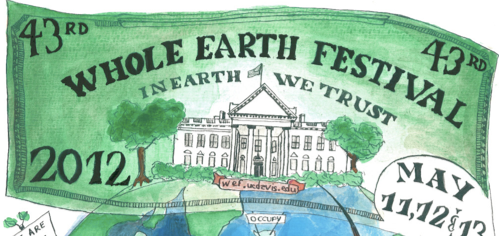
SF writers Robinson and Paolo Bacigalupi (of The Windup Girl fame) recently (May 12) appeared together at the Whole Earth Festival in Davis, where Robinson lives. The Whole Earth Festival exists in Davis since 1969. In an interview with Davis Enterprise, Robinson provided some thoughts on his writing and Bacigalupi:
Readers of Robinson’s other books also will recognize that the story in “2312″ is set several decades after the events in Robinson’s landmark Mars trilogy.
“There’s a line from Ursula Le Guin through me that extends to Paolo,” Robinson said, “a kind of green environmentalist strand of science fiction. It’s not a dominant strand in the field, but it is important.”
This is the first time the two have met.
On May 13, Robinson gave the Commencement Address for the UC Berkeley English Department. A short clip of this apparently very entertaining talk has surfaced on the internet here (despite poor audio quality).
Also, during his UK tour in June, Robinson will be appearing with fellow SF writer and friend Iain (M.) Banks (of the Culture books fame) in London.
Links: British Library | Forbidden Planet | Orbit Books announcement
Saturday 9th June 2012
Doors 3pm for a 3.30pm start, followed by a signing at 5pm
Tickets £7.50, concessions £5 – available here
Conference Centre
The British Library
96 Euston Road
London NW1 2DB
United Kingdom
Check out the calendar on the left for more 2312 promo events with Robinson! (USA and UK so far)
2312 is out, and of course Kim Stanley Robinson is out there to promote it (check calendar on the left).
Robinson was interviewed by Space.com: Part 1 (Terraforming the Solar System) and Part 2 (The Future in 2312). Terraforming, public vs private space exploration, Mondragon, genders and body modifications, it’s all here.
[2312 is] far enough out that it gives you time to think about the differences between now and 1712, if you run it in the other direction.
Robinson also reacts in another Space.com article on space exploration and science fiction.
“Beyond the solar system’ is too far away. […] It’s a joke and a waste of time to think about starships or inhabiting the galaxy. It’s a systemic lie that science fiction tells the world that the galaxy is within our reach.”
Head over to Wired.com and their podcast Storyboard for an hour-long interview with Robinson! Hear about 2312, time travel, Antarctica and the future of humanity in Storyboard 82 (direct mp3 download here).
Robinson was also interviewed by SciFiNow and provides many insights in the thinking that went behind 2312. Excerpts:
The idea that sparked it had to do with the central story, a romance between two people, one from Mercury, the other from Saturn (with matching personality traits). I needed a solar system-wide culture to make it possible for people to be living in those two places, and it grew from there.
What do you model your future society’s on in 2312? Is there a base coat that we can find on Earth today?
China, the West, the under-developed world, vampire capitalism, alternative economies like that in Mondragon, Spain, technological advances and environmental damage, the uneasy mix of hope and fear, utopia and catastrophe—all these are already here, and in the case of this book, being displayed as if from three hundred years further on.
[…]
I am mostly at ease with being thought of as political. Science fiction, by postulating future histories, always contains theories of history and theories of human nature, so political philosophy is simply part of the genre. Ignoring that, or pretending that you can dodge that, is to try to reduce science fiction to nothing more than a game. But as fun as it is, science fiction can be so much more than a game.
And of course, the reviews are coming! Apart from a review in Locus Magazine, several have appeared online.
2312 is a thoughtful read, and I’m glad that I took my time while I read it. While slow and ponderous, I found myself struck by the concepts that Robinson was pushing forward, scientifically, and socially. This novel takes space opera and makes it truly epic in a way that I really haven’t read in a while, and imparts a sense of wonder in our surroundings that made this a very good read.
The real hero of “2312” is human enterprise. There are so many things we could do! Jog round Mercury like the rolling city, dawn always coming up behind you. Use orbiting mirrors to burn the canals back into the surface of Mars and make the Ray Bradbury images come true. Create giant artworks on the surface of Jovian moons. One thing we can’t do, in Mr. Robinson’s view, echoing Arthur Clarke’s, is go star-traveling; even the nearest stars are out of our reach. The solar system is what we’ve got, and we need to do better with it than we have done with Earth.
2312 is Kim Stanley Robinson’s first widescreen, big-budget, blockbuster SF novel in some considerable time.
Existentially sprawling, and scientifically fascinating yet completely accessible, I’m reluctant to categorize 2312 as science fiction.
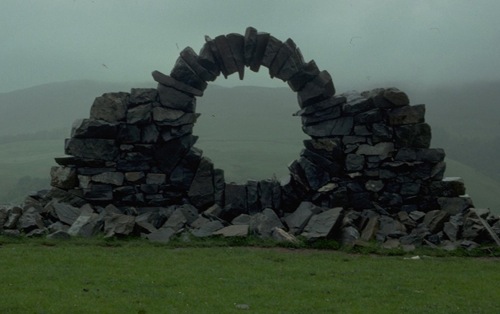
(Pictured above: land art by Andy Goldsworthy, photo by the CASS Sculpture Foundation; Goldsworthy is an influence in the world of 2312)
