









KimStanleyRobinson.info

The reference site for Kim Stanley Robinson

  • Releases: In The Sierra: Mountain Writings

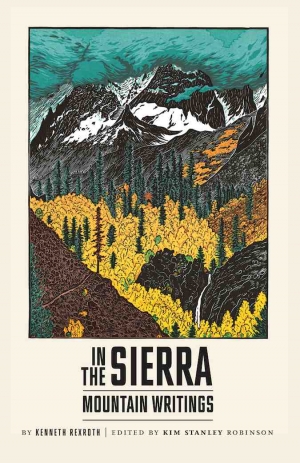
    In The Sierra: Mountain Writings has now been released! A work of love by Kim Stanley Robinson, this is a collection of Sierra-themed poems by Kenneth Rexroth, edited by Robinson, with his introduction and notes. The beautiful cover is by illustrator Tom Killion; the book also includes a ‘Rexroth’s Sierra’ map designed by Robinson and drawn by Killion.

    Over the course of his life, Kenneth Rexroth wrote about the Sierra Nevada better than anyone. Progressive in terms of environmental ethics and comparable to the writings of Emerson, Thoreau, Aldo Leopard, Annie Dillard, and Gary Snyder, Rexroth’s poetry and prose described the way Californians have always experienced and loved the High Sierra. Contained in this marvelous collection are transcendent nature poems, as well as prose selections from his memoir An Autobiographical Novel, newspaper columns, published and unpublished WPA guidebooks, and correspondence. Famed science-fiction writer Kim Stanley Robinson has compiled a gift for lovers of mountains and poetry both. This volume also contains Robinson’s introduction and notes, photographs of Rexroth, a map of Rexroth’s travels, and an amazing astronomical analysis of Rexroth’s poems by the fiction writer Carter Scholz.

    The release is by prestigious publishing house New Directions.

    Two events have been planned so far related to this new release, of course in California.

    Kenneth Rexroth Celebration at Book Passage in Corte Madera

    Link 1 | Link 2

    May 6, 7 pm

    Book Passage
    51 Tamal Vista Blvd
    Corte Madera, California, 94925
    United States

    A Celebration of Kenneth Rexroth’s Mountain Writings at City Lights Bookstore

    Link 1 | Link 2

    May 15, 7 pm

    City Lights Bookstore
    261 Columbus Avenue at Broadway
    San Francisco, CA 94133
     

  • Writing Climate Change discussion + more

    Over at Strange Horizons, a round table discussion between seven writers was published in February on the issue of climate change in fiction. Kim Stanley Robinson, notably with his Science in the Capital trilogy, was among them.

    Excerpts (also relevant to 2312!):

    Thinking about this composite epic we make, it occurred to me that it is thin in the middle. What I mean is that there is lots of near-future SF, and lots of space opera, but in between the near future and the far future is a much emptier zone—from say a century to a millennium after our time. Maybe this is just a difficult period to imagine, or maybe it forces the writer to include history, always a challenge to the novel as a form. Whatever the reason, that’s also the time when climate change will be impacting us, so if science fiction writers shy away from that time zone, an unintended result is there is no easy way to write about climate change.

    I like all three of these zones. Near future stuff is a way of talking about now as a kind of moving target—it’s the best current realism. Space opera reminds us that we live in a big universe, and could become “cosmic engineers” if we were to hold on for the long haul. But maybe we need more of the in-between, which we could call “future history,” if science fiction is to be really robust. That mid-zone knits together near and far futures, and helps SF to say interesting things about what humanity should try to do. Climate change might be an aspect of many stories set in that zone, as simply the likeliest future we face.

    I am often called a political writer, but since I don’t believe in art for art’s sake, I can’t really complain. Novels should have politics in them, but they should also try to be beautiful, which is not something we usually say about politics. Really the novel is a very big, capacious form, and I put my faith in readers who are generous and open-minded. They do the work of bringing stories to life, so they can say what they want, and all the writer can do is try to learn.

    Indian SF author Vandana Singh also provided some positive thoughts on the Science in the Capital books.


    2012 will also mark the celebration of the 20th anniversary of the release of Red Mars! A NASA astrobiologist offers his thoughts on these pressurized lava tubes that were used as settlements so memorably in Green Mars (Dorsa Brevia), in “Ask an Astrobiologist“:


    There are certainly many lava tubes on both the Moon and Mars. More are being discovered all the time with high-resolution photos we are taking from orbit. Lava tubes form when a lava flow begins to congeal and forms a roof of rock over the flow. When the hot lava eventually subsides and drains, a tube is left behind. I have watched lava tubes form in Hawaii, and once I accidentally walked across a tube with a roof only a few inches thick and a major river of lava still flowing inside (not an adventure I would recommend to anyone). The only problem is that lava tubes tend to form many “sky-lights” where sections of the roof collapse. Looking down from above, we see lava tubes only when there are such openings. Thus we really don’t know how many tubes there are or how easy it would be to seal them. I think that Robinson’s idea remains a good one, however. His Mars Trilogy is practically required reading for astrobiologists.


    Still on Mars, the fictional mathematician and physician that revolutionized the field in the twenty-second century in the Mars trilogy (Blue Mars), Bao Suyo, is mentioned in “A Wealth of Numbers: An Anthology of 500 Years of Popular Mathematics Writing“, an anthology that was just published by Princeton University Press! A full seven pages of Blue Mars are reproduced within.


    In other news, the 1986 short story “Our Town” is going to be released on April 24 in the online SF&F magazine Lightspeed, for its April 2012 issue.

    More soon!

  • Kim Stanley Robinson turns 60!

    Happy birthday to our favourite writer, who today safely and healthily reaches the honourable number of 60 solar circumnavigations! May he see many more!

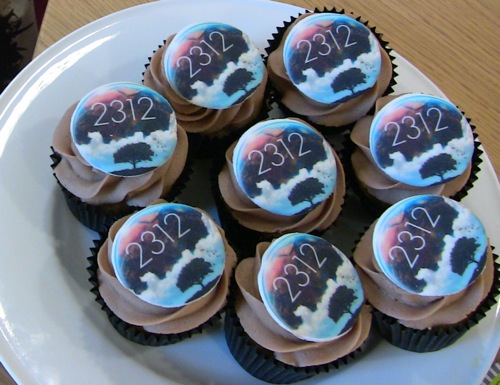
    (Pictured: 2312 cupcakes. Yes, you read correctly: 2312 cupcakes!)

  • Thinking Community + Blue River Quorum

    Last October, the “Eye of the Storm: Re-imagining Ethics for Changing Times” project gathered in a “Thinking Community” event, close to Oregon State University.

    Our premise is that old, human-centered moral systems have allowed us to damage the Earth, to our own peril and the peril of countless ecosystems and species. This cannot continue. We must find new ways to understand our moral responsibilities to one another, to the Earth, and to the future. Can these perilous times prompt us to discover and create a new set of ideas about how we ought to live?

    The gathering was sponsored by Oregon Humanities, Oregon State University’s Environmental Humanities Initiative and the Spring Creek Project for Ideas, Nature, and the Written Word.

    Among the many participants was Kim Stanley Robinson.

    Along with the gathering, the Blue River Quorum was also convened.

    We were philosophers, scientists, writers, poets, students, and professors of various bents. Over four intense days we thought collaboratively and open-mindedly, we learned from one another, and we worked hard to create something together none of us could create alone.
    (Blue River Quorum member Michael P. Nelson, in Minding Nature, Vol. 4, No. 3)

    The Quorum resulted in the Blue River Declaration: Ethics for a Changing Planet, a manifesto on the individual, the community, and the interconnectedness with the rest of the Earth.

    It is available as a pdf document or a printer-friendly 3-panel brochure. Well worth reading, pondering and spreading around!

    The necessity of achieving a concordance between ecological and moral principles, and the new ethic born of this necessity, calls into question far more than we might think.  It calls us to question our current capitalist economic systems, our educational systems, our food production systems, our systems of land use and ownership. It calls us to re-examine what it means to be happy, and what it means to be smart.  This will not be easy.  But new futures are continuously being imagined and tested, resulting in new social and ecological possibilities. This questioning will release the power and beauty of the human imagination to create more collaborative economies, more mindful ways of living, more deeply felt arts, and more inclusive processes that acknowledge the ways of life of all beings. In this sheltering home, we can begin to restore both the natural world and the human spirit.

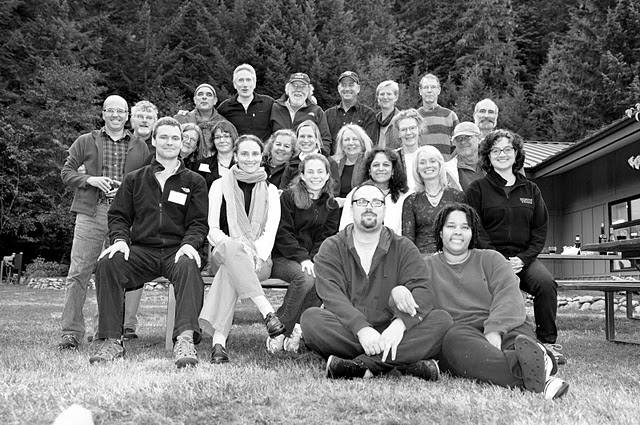
    A video of the gathering is available from OSU, and among many nice things it includes (from about 32min in) a reading of a draft of the Declaration by all the members of the Quorum (pictured above):

    J. Baird Callicott, Madeline Cantwell, Alison Hawthorne Deming, Kristie Dotson, Charles Goodrich, Patricia Hasbach, Jennifer Michael Hecht, Robin Wall Kimmerer, Katie McShane, Kathleen Dean Moore, Nalini Nadkarni, Michael P. Nelson, Harmony Paulsen, Devon G. Pena, Libby Roderick, Kim Stanley Robinson, Fred Swanson, Bron Taylor, Allen Thompson, Kyle Powys Whyte, Priscilla Solis Ybarra, Gretel Van Wieren, and Jan Zwicky.

    More pictures of the event are available here and here.