








KimStanleyRobinson.info

The reference site for Kim Stanley Robinson

  • Odds & Ends of July

    Kim Stanley Robinson was named a Muir Environmental Fellow from the John Muir College of UC San Diego on April 21, along with sustainability professor Lisa Shaffer and ocean scientist Paul Dayton. The Muir College names selected individuals whose work has contributed significantly to the cause of sustainability and environmental preservation. The first Fellows were selected in 2011, in connection with the 50th anniversary of UC San Diego.
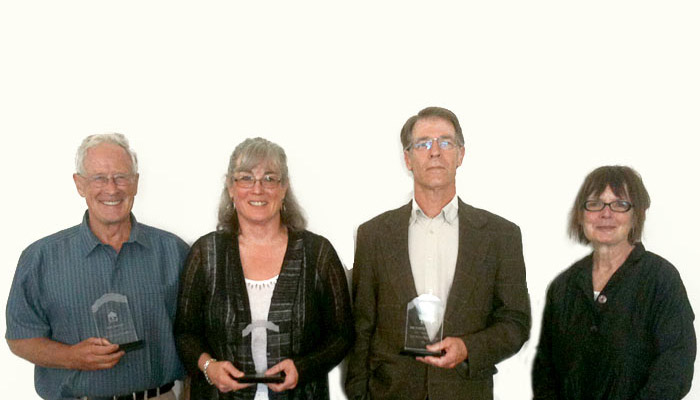
    Dayton, Shaffer, Robinson, and John Muir College Provost Susan Smith


    On the UCSD panel discussion on “World Building and Contemporary Art” on April 22 (announced previously here), Robinson talked about the Singularity. An article on this appeared on science20.com, but it seems to have been taken out. I’m reproducing it here:

    The Singularity? It’s Just A Metaphor

    I heard an interesting panel discussion over at UCSD today. One of the panelists was Kim Stanley Robinson. If you’re a sci-fi fan like me, you might recognize the name; he wrote the Mars trilogy, “Red Mars”, “Green Mars”, “Blue Mars”, about a fictional human colonization of the Red Planet. Anyway, I saw Robinson’s name on the panelist list, and it piqued my curiosity, so I went along. Good thing, too, because my curiosity was amply rewarded with what turned out to be a very interesting discussion.

    Robinson pointed out that young readers prefer fantasy to sci-fi — and have for some years, starting back in the late 1990s. Why? Well, by his way of thinking, it’s partly because fantasy is escapist. Most fantasy novels are set in mythic feudal worlds where heroes and villains wield magical powers and modern-day technology is conspicuously absent. In other words, it’s entirely divorced from our present reality. It looks to the past, whereas sci-fi looks to the future. And starting back in the 1990s, Robinson says, we have become ever more pessimistic about the future.

    Back in the 1950s, we were optimistic about where our world was headed, and (most) science fiction faithfully reflected that optimism, describing a society where the “engineer’s fantasy” of flying cars and smart homes had become reality. (Think The Jetsons.) Starting in the 1980s, however, sci-fi renounced this sunny vision in favor of a more dystopian take on our prospects. (Think cyberpunk). Now, Robinson says, if you say you believe we can survive the next century, some people label you a utopian. Think of that! it’s utopian to say we can make it, we can survive.


    On April 19, on the Australian radio ABC, Robinson appeared in “The Book Show” and talked about his favourite recent sci-fi novels for the ‘Off the Shelf’ segment:
    – Newton’s Wake by Ken MacLeod
    – Life by Gwyneth Jones
    – Air by Geoff Ryman
    – Yellow Blue Tibia by Adam Robertson
    – Red Plenty by Francis Spufford


    Speaking of reviews of other science fiction novels, Robinson participated in a Guardian article with various genre writers offering their views on past favourites: Robinson chose Ursula K Le Guin’s The Left Hand of Darkness. Lots of other good reviews on that article too.


    The above article was made on the occasion of the opening of the British Library’s exhibition on the history of science fiction, ‘Out of this World‘, where apparently Robinson’s works are also featured. The exhibition runs from May 20 to September 25 2011.


    Robinson was featured in Rick Kleffel’s Agony Column interviews site along with fellow writer Rudy Rucker. Apparently the interview (“Seeing the Future with Kim Stanley Robinson and Rudy Rucker”) was done as a ‘live’ session, from Santa Cruz on June 4, however only a preview from May 31 is online.


    Kim Stanley Robinson also made various appearances in California as of late:
    – At the Whole Earth Festival at UC Davis on “The Invention of Permaculture“, on May 7
    – With Terry Bisson on “The Politics of Science Fiction and the Left” at Sacramento, on May 9
    – At the John Muir Institute of the Environment (UC Davis) for the Education for Sustainable Living Program, on May 25: “Imagining Post-Capitalism“
    …but not much surfaced on this on the internets.


    Finally, like last year, Robinson is participating in this year’s Clarion UCSD’s Write-a-thon, from June 26 to August 6. With the writing of 2312 presently completed (more on that later), I wonder what he is writing there!…

    More odds & ends coming soon…
  • Upcoming publications: Rexroth in the Sierra

    Kim Stanley Robinson’s love for the Sierra Nevada is well known and permeates his work, as evidenced, among others, in the poems in The Martians or a trip to the Sierras in Sixty Days And Counting. He is now very excited to be editing the work of another lover of the Sierras, Kenneth Rexroth, one of Robinson’s favourite poets.

    Kenneth Rexroth (1905-1982) was an American poet whose biography is too rich and varied — to a newcomer like me — to be summarized in two-three lines for the purposes of this article. His poetry involved themes of love, sexuality, ecology, sociology, mysticism, he was involved in anarchism, communism, buddhism, taoism, dadaism, wobblies and all kinds of radical and free thinkers groups, he is considered as a founding figure of the San Francisco Renaissance of the 1950s, he influenced the Beat generation, he translated lots of poems into English and notably Japanese haikus, he mixed his poetry with jazz, he was a pacifist and conscientious objector of World War II, nearly published a guidebook for camping in the mountains… Lots of resources are available here, or even here and biographies here.

    Rexroth’s poetry was published by landmark poetry publishing house New Directions, founded by James Laughlin, with whom Rexroth camped and skied in the Sierras for many years.

    Kim Stanley Robinson is now gathering all of Rexroth’s Sierra-related poems, which were up to now scattered over dozens of publications over four decades of Rexroth’s life. Robinson is providing an introduction and notes to this collection, “Rexroth in the Sierra“, to be published by New Directions in fall 2011 or spring 2012.

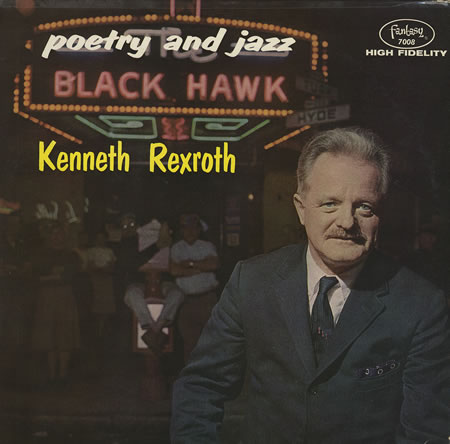
    (Photo: cover of Poetry and Jazz at the Blackhawk, a 1958 LP recording of Rexroth reading his poetry over jazz)


    Here follows a Kenneth Rexroth poem on the Sierras and on Sacco and Vanzetti, two Italian immigrants and anarchists who were executed in Boston on August 23, 1927, accused of a murder they did not commit (taken from the Bureau of Public Secrets):


    CLIMBING MILESTONE MOUNTAIN
    August 22, 1937

    For a month now, wandering over the Sierras,
    A poem had been gathering in my mind,
    Details of significance and rhythm,
    The way poems do, but still lacking a focus.
    Last night I remembered the date and it all
    Began to grow together and take on purpose.
    We sat up late while Deneb moved over the zenith
    And I told Marie all about Boston, how it looked
    That last terrible week, how hundreds stood weeping
    Impotent in the streets that last midnight.
    I told her how those hours changed the lives of thousands,
    How America was forever a different place
    Afterwards for many.
    In the morning
    We swam in the cold transparent lake, the blue
    Damsel flies on all the reeds like millions
    Of narrow metallic flowers, and I thought
    Of you behind the grille in Dedham, Vanzetti,
    Saying, “Who would ever have thought we would make this history?”
    Crossing the brilliant mile-square meadow
    Illuminated with asters and cyclamen,
    The pollen of the lodgepole pines drifting
    With the shifting wind over it and the blue
    And sulphur butterflies drifting with the wind,
    I saw you in the sour prison light, saying,
    “Goodbye comrade.”
    In the basin under the crest
    Where the pines end and the Sierra primrose begins,
    A party of lawyers was shooting at a whiskey bottle.
    The bottle stayed on its rock, nobody could hit it.
    Looking back over the peaks and canyons from the last lake,
    The pattern of human beings seemed simpler
    Than the diagonals of water and stone.
    Climbing the chute, up the melting snow and broken rock,
    I remembered what you said about Sacco,
    How it slipped your mind and you demanded it be read into the record.
    Traversing below the ragged arête,
    One cheek pressed against the rock
    The wind slapping the other,
    I saw you both marching in an army
    You with the red and black flag, Sacco with the rattlesnake banner.
    I kicked steps up the last snow bank and came
    To the indescribably blue and fragrant
    Polemonium and the dead sky and the sterile
    Crystalline granite and final monolith of the summit.
    These are the things that will last a long time, Vanzetti,
    I am glad that once on your day I have stood among them.
    Some day mountains will be named after you and Sacco.
    They will be here and your name with them,
    “When these days are but a dim remembering of the time
    When man was wolf to man.”
    I think men will be remembering you a long time
    Standing on the mountains
    Many men, a long time, comrade.

  • World Building and Contemporary Art @UCSD

    “The transreal: artworks that cross boundaries of multiple realities with a nuance for a multiplicity of worlds, using reality as a medium.“
    – Micha Cárdenas, Interim Associate Director of Art and Technology for Sixth College, UCSD

    Kim Stanley Robinson will be appearing in a panel discussion at the Culture, Art and Technology program of the Sixth College of UC San Diego, California, as part of the opening of the ARTifact art gallery exhibition “Many Worlds, Many Times” (April 6 to June 10, 2011). The exhibition is focusing on “a vision of a multiplicity of worlds and times, on many levels: the science fiction imaginary, phenomenological approaches to time and a world experienced through sound are just a few.“

    Friday, April 22nd, 3pm
    Panel Discussion, “World Building and Contemporary Art”

    Pepper Canyon Hall 257

    Featuring Kim Stanley Robinson
    Sheldon Brown, Professor of Visual Art
    Cauleen Smith, Professor of Visual Art
    Christopher Kardambikis, MFA Candidate

    The Culture, Art and Technology (CAT) program at the Sixth College of UCSD is proud to present the new ARTifact gallery exhibition for the Spring 2011 quarter, Many Worlds, Many Times, curated by Micha Cárdenas, Interim Associate Director of Art and Technology for Sixth College. The ARTifact gallery exists as a physical gallery in the CAT core offices as well as an online exhibition space at the CAT website, cat.ucsd.edu. The gallery acts as an integrated learning laboratory, transforming the working environment of CAT students, staff and faculty into a hybrid space in which contemporary art can be part of the dialog of interdisciplinary undergraduate learning curriculum in Sixth College.

  • Introductions & Prefaces by Kim Stanley Robinson, 2006-2011

    Over the last few years, on top of concentrating on his novels, his short stories and his appearances in various media, Kim Stanley Robinson has also lent his pen to writing introductions and prefaces to various books, mostly new editions of past science fiction greats. Let’s go over what’s been going on over the past 5 years and what’s in store for 2011:


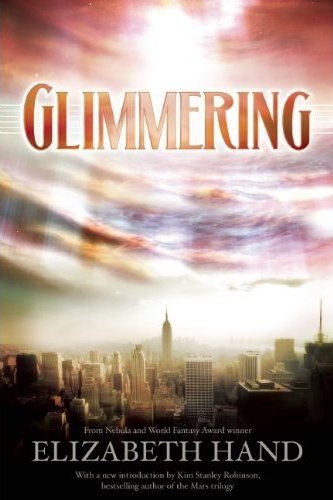
    The most recent one is Glimmering, by Elizabeth Hand, about a 1999 Manhattan plagued by climate, environmental and health disasters. This 1997 novel is re-edited by genre publisher Underland Press; it should be published in December 2011.

    Says Hand in an interview with Tor.com:

    There were such great environmentally-themed SF books from that time [1970s], stuff like Stand on Zanzibar, The Sheep Look Up, and Dune. I wrote Glimmering in that spirit, a novel that anticipated a lot of terrible stuff that actually did come to pass in the last decade. Unfortunately, it was published in 1997, at the height of the go-go 90s, and that terrible bleak vision of the near-future was not what anyone wanted to read about. But it’s being reprinted next year by Underland Press, with a new intro by Kim Stanley Robinson. So I’m very excited about that.

    Robinson and Hand both participated in the Summer 2009 Clarion Science Fiction and Fantasy Writers’ Workshop.


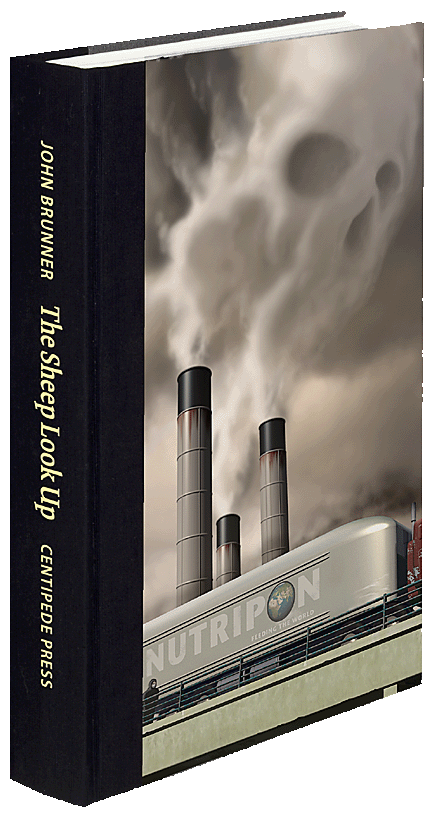
    Speaking about Stand on Zanzibar and The Sheep Look Up, both of these landmark John Brunner novels were re-edited by genre publisher Centipede Press in June 2010, with introductions by Stan.

    These are luxurious hardcover editions with original colour illustrations inside:

    [Stand on Zanzibar] With a printed cloth front panel, Japanese cloth on back panel, top-edge stain, ribbon marker, beautiful European endopapers, full color illustrations, 500 + pages, a bonus essay by Brunner, and a stunning and simple design. Each book is signed by John Brunner and Kim Stanley Robinson.

    [The Sheep Look Up] This is the first limited edition of The Sheep Look Up ever published. This edition features a fine introduction by Kim Stanley Robinson, one of science fiction’s best-known writers.
    The book also features an interview with Brunner, a column by Brunner, and a lengthy autobiography with photographs. Signed by Kim Stanley Robinson. The book has a printed cloth front panel, Japanese cloth on back panel, top-edge stain, ribbon marker, beautiful European endpapers, full color illustrations, and is over 350 pages.

    Stand on Zanzibar (1968) is the classic lengthy novel about an overpopulated future, which also experiments on narrative structure and with varied point-of-view chapters to enrich its wordbuilding.
    The Sheep Look Up (1972) is a tale of environmental disasters and social unrests in a future USA.

    Keep note of Robinson’s association with Stand on Zanzibar, as we will be referring to it again in the future (hint, hint!)…


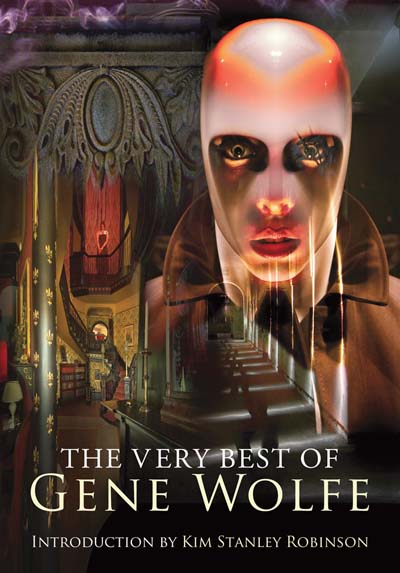
    Stan also wrote the introduction to the short story collection The Very Best of Gene Wolfe, published in 2009 by PS Publishing (UK).

    Careful though! According to this Strange Horizons review by David McWilliam, the US version of the book (called The Best of Gene Wolfe) is one story short and does not feature the introduction:

    [The UK edition features] a thorough introduction by Kim Stanley Robinson that significantly augmented my enjoyment of the book. Robinson’s boundless enthusiasm for Wolfe is infectious, though he occasionally verges on hyperbole, claiming that this is “one of the best story collections ever published, a masterpiece of American literature” (p. xix). Robinson’s articulate championing of the nuances of Wolfe’s style, mixing biographical details with literary analysis, makes the introduction a valuable addition to the collection.

    Stan has expressed his love for Wolfe’s prose time and again.


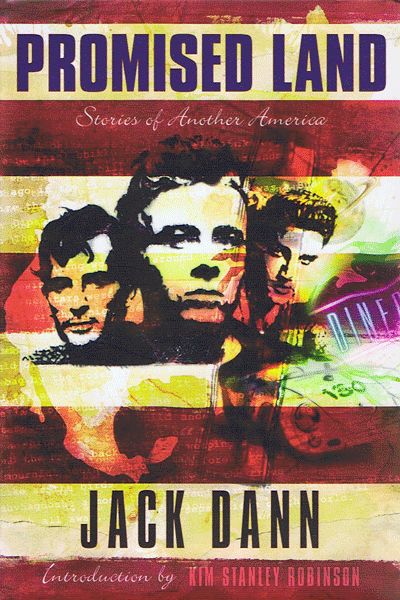
    Also by PS Publishing, in 2007, is Promised Land: Stories of Another America, by Jack Dann.

    This is a short stories collection of stories taking place in the same alternative history of the USA in the 1950s-1970s and features several of America’s cultural icons (James Dean, Robert Kennedy, Marilyn Monroe, Elvis Presley, Jack Kerouac, William Burroughs!…). It is a companion volume to the 2004 novel The Rebel: An Imagined Life of James Dean, in which James Dean survived his car crash in 1955 and went on to have a successful life and political ties with Bobby Kennedy.

    Jack Dann appeared with Stan last September in a panel of the Aussiecon 4.


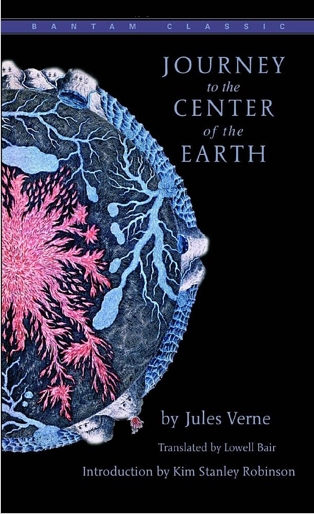
    In 2006, Stan wrote the introduction to a new edition by Bantam Classics of Jules Verne’s classic-of-the-classics Journey to the Center of the Earth (1864)!

    If you don’t know anything about this novel then I encourage you to check out the 1959 film adaptation, in all its James Mason/Bernard Herrmann/stop-motion effects glory!


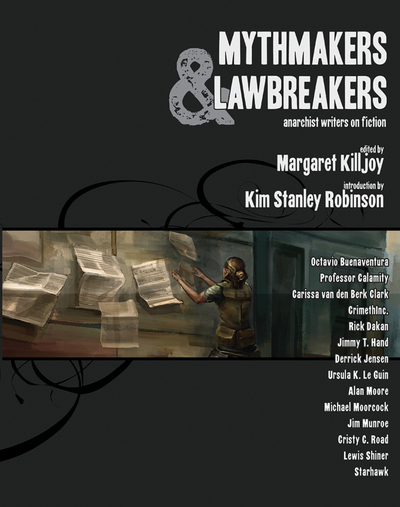
    Moving on to non-fiction, KSR.info already covered the 2009 release of the essays & interviews collection Mythmakers & Lawbreakers: Anarchist Writers on Fiction by AK Press, for which Stan provided the introduction.


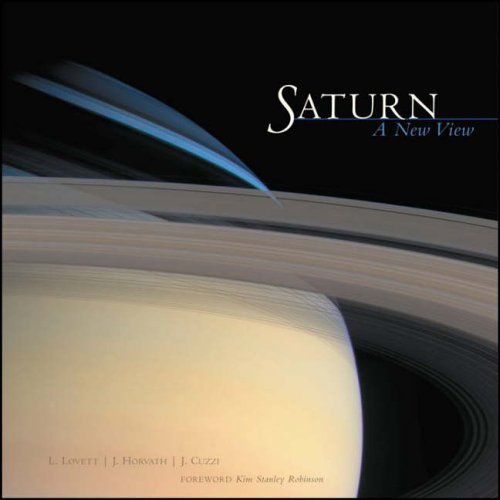
    Finally, Saturn: A New View by Harry N. Abrams Inc (2006) is a large-format hardcover book that features 150 glorious photos from the Cassini-Huygens mission by NASA/JPL, which reached Saturn in 2004. Stan wrote the foreword.


    That’s all for now folks!