


KimStanleyRobinson.info

The reference site for Kim Stanley Robinson

  • China Moon, West Moon, G2 Moon, Red Moon

    China Moon, West Moon, G2 Moon, Red Moon

    Are you reading RED MOON over the Christmas break? Or during the Chinese New Year? It must be one of the two, East and West looking at each other, progressively realizing they are not that different. Meanwhile, China has launched a probe, Chang’e 4, to explore The Dark Side of the Moon, and it should be landing in the first days of January 2019 — in a spot close to the location of Fang Fei’s refuge in Red Moon!

    Here are some Red Moon excerpts to whet your appetite: Orbit has the first chapters with Fred‘s landing on the moon (also on Facebook), Syfy has Ta Shu‘s first impressions of the moon, Hachette also introduces the Analyst and the quantum computer Little Eyeball, and at The Verge Ta Shu goes on a moonwalk with an Earthrise! You can also listen to Fed’s moon landing in this clip from the audio book version.

    KSR has wanted to write a China-themed novel ever since doing all that research to write The Years of Rice and Salt. Says Robinson (from Syfy):

    “I really loved reading Chinese history, Chinese literature. I had never been there but I wanted to write about it again, and what I didn’t realize was writing about China in the present and the near future was vastly harder than writing about it in the past.”

    “It’s different from when people ask me, because of my Mars Trilogy, if I’d go to Mars, and I always say no,” he revealed. “Because you’re talking about five years away from Earth stuck in little rooms and it’s not my thing. Now the moon is different! You get there in three days, you spend a while bouncing around looking at Earth and tripping on the strangeness of it and come back home.”

    He expands in an interview for Space.com:

    I went to China myself, because I’d never been there before. It was a very limited visit, or two visits actually. I saw only three cities. I saw Hong Kong, Beijing and a coastal city called Xicao. That at least gave me some personal information and some visual and sensory impressions of what I was writing about.

    Truthfully, I don’t think [Moon colonization] will change or shape humanity very much at all. I think it will end up being a whole lot like Antarctica.

    I think the main thing I want [readers] to take away from my book “Red Moon” is that China is really interesting and important and nobody understands it — and I mean not just Americans, who definitely don’t understand it, but even the Chinese people themselves.

    It’s a big, powerful society in rapid flux. It’s unstable and dynamic and it’s super interesting. 

    As he did with 2312, KSR presents his new novel in this nice little video with infographics from Orbit (which gives us little drawings of the protagonists!):

    Wired did an extensive piece on KSR, visiting him in his home town and communal garden and outdoors writing spot, concluding “In other words, Kim Stanley Robinson is living inside a Kim Stanley Robinson novel“! A great read, some excerpts below:

    [About cyberpunk vs other science fiction] “I’m gonna blow them away with infodumps. If it’s interesting, it’s fucking interesting.”

    Robinson respects the newest generation of sci-fi writers for being “forensic in taking apart capitalism,” he says, but thinks that for stories to stick—to make their way into the hands of congressional staffers (so they’ll tell their bosses) and think tanks (so they’ll turn into policy statements that turn into laws)—the stories have to have heart, too. “You can’t predict,” he says. “But you can push.”

    Because of a visa snafu, he had just 71 hours in Beijing, so his hosts careened him across town in a rush to compress, distill, purify an impression of the city—an experience echoed in one character’s mad dash across a Beijing gridlocked by a mass demonstration.

    For Goodreads, KSR provides his favourite non-fiction moon literature (maps, photos, and histories) as well as his favourite lunar fiction (from Arthur C. Clarke to John Kessel).

    WELCOME TO THE PEAKS OF ETERNAL LIGHT

    Two more interviews with KSR on Red Moon, this time audio and video:

    You might have seen the excellent National Geographic series “MARS“, which fuses fiction sequences with documentary interviews. It is essentially a Red Mars, however sans some more challenging themes (politics, ecology)… however that might be different in the series’ new season, which first aired in November-December. Indeed, things on/in Mars get more political, and KSR is interviewed in its second season!

    Finally, here is the recipe for a sake & vodka-based cocktail to go with your Red Moon!

    And as always, to wrap up this update, here are some reviews of Red Moon – but careful of spoilers!

    • Noted Tolkiendil Tom Shippey for the Wall Street Journal: “The insidious proposition that Mr. Robinson puts forward is that by 2047 both China and the U.S. will have become at bottom similar societies, despite all the superficial differences.” He also put it in his science fiction best of 2018! 
    • Gary K. Wolfe for Locus: “His inhabited moon seems less a frontier than a refraction of ideological, social, and environmental anxieties that are with us now. Perhaps that’s one reason he chose to set it in such an improbably near-term future, which is nevertheless as convincingly textured and observant as we’ve come to expect from one of the finest writers of his generation.”
    • Adam Roberts for the Weekly Standard
    • Niall Alexander for Tor.com
    • Rowan Hooper for New Scientist
    • Jeff Somers for Barnes&Noble: “As always, Robinson employs careful research and exacting worldbuilding as he traces current events into an entirely plausible future—it’s a novel that considers, among many other things, what role blockchain might play in our lunar colonial future.”
    • David Pitt for Booklist Online: “Another stellar effort from one of the masters of the genre.”
    • Noel Megahey for The Digital Fix
    • Josh Trapani for Science: “That the market dominates life regardless of whether the system of government is Chinese communism or American democracy is a central underlying theme.”
    • Oliver Moody for The Times
    • Jason Sheehan for NPR: “All the chasing, capturing and escaping becomes a kind of proxy battle between U.S. and Chinese intelligence agencies that ramps up into revolt and revolution throughout the course of the novel.”
    • Andrew Liptak for The Verge
    • Chris Beckett for The Guardian: “There are many pleasures to be found here, including the characters: solitary, geeky Fred, who has never learned that to get on with other people you have to play a part; sparky, entitled Qi; gentle Ta Shu, an elderly poet and feng shui expert.”
    • Alex Good for The Toronto Star: “Finding out what’s really going on when truth is so endlessly fragmented poses quite a challenge, even to nearly omniscient forms of artificial intelligence.”
    • Chris Heinz: “Kim Stanley Robinson For President of the Householders’ Union!”

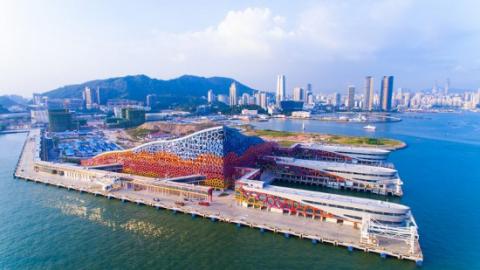
    (Photo: the new Shenzhou Ferry Terminal at Shekou inaugurated in 2016, which might be familiar to readers…)

  • Of podcasts, book clubs and interviews

    Of podcasts, book clubs and interviews

    Kim Stanley Robinson’s new novel comes out in barely a few days – RED MOON will be available from Orbit USA & UK in hardback, ebook and audiobook from October 23!

    But first I wanted to showcase two examples of a vibrant community-building readership of Robinson’s novels!

    “Marooned on Mars with Matt and Hilary” is an on-going podcast that looks at each chapter of the Mars trilogy in detail! They are more than mid-way through Green Mars, and it’s great to see these twenty year old books get the podcast treatment. In their latest podcast, Matt and Hilary meet Stan himself around a nice dinner! You can also support them with a small donation.

    Through the past summer, Bryan Alexander animated a book club around New York 2140, where they looked at each individual part! This generated a lot of discussion and a plethora of links and further reading suggestions, do check it out.

    More of these initiatives are sure to pop up in the future and we we are certainly going to cover them here!

    On to some recent interviews with Stan:

    As part of The Guardian‘s “Overstretched Cities” feature, Stan wrote a polemic article: “Empty half the Earth of its humans. It’s the only way to save the planet“. Taking inspiration from EO Wilson’s book, Half Earth.

    The idea is right there in the name: leave about half the Earth’s surface mostly free of humans, so wild plants and animals can live there unimpeded as they did for so long before humans arrived. Same with the oceans, by the way; about a third of our food comes from the sea, so the seas have to be healthy too.

    This vision is one possible format for our survival on this planet. They will have to be green cities, sure. We will have to have decarbonised transport and energy production, white roofs, gardens in every empty lot, full-capture recycling, and all the rest of the technologies of sustainability we are already developing. That includes technologies we call law and justice – the system software, so to speak. Yes, justice: robust women’s rights stabilise families and population. Income adequacy and progressive taxation keep the poorest and richest from damaging the biosphere in the ways that extreme poverty or wealth do. Peace, justice, equality and the rule of law are all necessary survival strategies.

    All this can be done. All this needs to be done if we are to make it through the emergency centuries we face and create a civilised permaculture, something we can pass along to the future generations as a good home. There is no alternative way; there is no planet B. We have only this planet, and have to fit our species into the energy flows of its biosphere. That’s our project now. That’s the meaning of life, in case you were looking for a meaning.

    In These Times spoke with Robinson about Mars, our own fragile planet and his hopes for a robust space science program. In case you were wondering:

    Elon Musk mentioned that having a reserve population in outer space—on the moon or on Mars—could be helpful in case World War III devastates humanity. Is this a viable solution? Or might the rich leave for space while the rest of us suffer?

    Billionaires moving to space is not just similar to a sci-fi plot—it is a sci-fi plot, and not very realistic. It has to be said: There is no Planet B. It’s here for us, or nowhere. But really, that is very obvious. Very few people actually believe that setting up a small settlement on Mars is an adequate safeguard or mitigation for the damage we are doing here on Earth. Those who do are fooling themselves.

    What does post-capitalist space exploration look like?

    It looks like NASA. It’s government, exploring a commons of sorts, doing it in the usual “of the people, by the people and for the people” way.

    Speaking of space exploration, Aurora got an unexpected increase in fame coming from a space/sci-fi-friendly reader: Tom Hanks, who tweeted about it to his large audience! “What a Saga! SciFi with honest, complex Humanity, Physics, biology, sociology. Never had the feeling I experienced on page 321. K. S. Robinson, you rocked our “world”… Hanx” Stan reacted for Sactown: “It was a total surprise. I once heard a rumor that he liked the Mars books. It was definitely a fun thing to see.“

    Back on Earth, Stan was also interviewed by the Italian SF&F site Nuove Vie, where he mainly talks about New York 2140 and his writing style. The interview is here in Italian, below is an extract in English:

    In this case, I told my editor Tim Holman that I wanted to write about global finance, and he suggested that to write a novel about something so abstract I should set it in a tangible place, and he reminded me of the drowned New York that appears briefly in 2312, and pointed out that a novel about finance could sensibly be set in New York, a world center of finance capitalism.  Then he also suggested the apartment novel format as a way of portraying all kinds of lives in this drowned city.

    There’s no better insight into Stan’s daily life than to get him to talk about gardening and preparing meals! In this article for Plymouth University’s Imagining Alternatives, he explains why “Enough is as good as a feast“

    I’ve lived in a small alternative community for the past twenty-seven years. 

    […] Organic gardening space is available to all who want it, and the landscaping is mostly edible in the form of fruit and nut trees.

    […] Taken all in all, it’s not paradise or utopia or the housing solution to the world’s ills, but it is nice, and for me it has proved the idea that urban design influences social reality, and that infrastructure helps to determine social and human relations.

    […] the loosely vegetarian orientation of our Village Homes potlucks felt good, for the reasons cited above, both environmental and animal-moral.  The variety of cooking styles at each meal was huge and made the absence of meat barely noticeable—really the meals were a treat for the senses.

    […] We were social primates doing a social primate thing.

    A funny little interview: ten years after the great environmental animation film “Wall-E” came out, Marketplace asked Stan’s impression of the film:

    “[WALL-E] begins to make all kinds of mature adult decisions. He falls in love, does radical things, joins a revolution and overthrows the social order that already exists,” Robinson said.

    Also of interest:

    Prose and music! “A Forest Unfolding” was a musical project in New Hampshire. “Novelist Richard Powers presides over a collaborative effort involving four composers, four writers, and an ensemble of instrumentalists and singers. […] Four writers—the environmentalists Bill McKibben and Joan Maloof, along with the novelists Richard Powers and Kim Stanley Robinson—selected prose passages and poems on the relations among people and trees.  They presented these selections to four composers—Eric Moe, Melinda Wagner, Stephen Jaffe, and David Kirkland Garner—who set these words into a linked sequence of recitatives and arias.  The resulting whole traces a narrative arc from human estrangement from nature to a glimpse of the endless cooperation that knits a forest together.“

    Stan was the judge of the second edition of “Everything Change Climate Fiction Contest” of short stories for Arizona State University’s Imagination and Climate Futures Initiative! Top winners will be published in a free digital anthology in fall 2018.

    Stan will be participating in an architecture-meets-science-fiction master’s program at UC Berkeley: “UC Berkeley architecture professor Nicholas de Monchaux and BLDGBLOG author Geoff Manaugh will teach a special, one-year graduate course, titled “Studio ONE,” focused on the intersection of architecture and science fiction.“

    2312 has been translated in Turkish, and its translator talks at length of all the issues with dealing with a novel that has such a varied and specialized vocabulary!

    Blue Mars‘s translation in Japanese was nominated for the 2018 Seiun Award for best translated novel.

    We will be back soon with news around Red Moon!

    (Top image from A Forest Unfolding)

  • Upcoming publications: RED MOON

    Upcoming publications: RED MOON

    Kim Stanley Robinson’s next novel, “RED MOON“, is set for publication in hardcover by Orbit in October 2018 (October 23 for US, October 25 for UK).

    Remember Ta Shu from Antarctica? Refresh your memory because he is back! Remember the quantum AIs from 2312? Prepare to meet their ancestors! You might also want to have a crash course in pinyin.

    The official synopsis reads:

    IT IS THIRTY YEARS FROM NOW, AND WE HAVE COLONIZED THE MOON.

    American Fred Fredericks is making his first trip, his purpose to install a communications system for China’s Lunar Science Foundation. But hours after his arrival he witnesses a murder and is forced into hiding.

    It is also the first visit for celebrity travel reporter Ta Shu. He has contacts and influence, but he too will find that the moon can be a perilous place for any traveler.

    Finally, there is Chan Qi. She is the daughter of the Minister of Finance, and without doubt a person of interest to those in power. She is on the moon for reasons of her own, but when she attempts to return to China, in secret, the events that unfold will change everything – on the moon, and on Earth.

    RED MOON is a magnificent novel of space exploration and political revolution from New York Times bestselling author Kim Stanley Robinson.

    And no, this is not the zany George “Freds” Frederickson from Escape From Kathmandu!

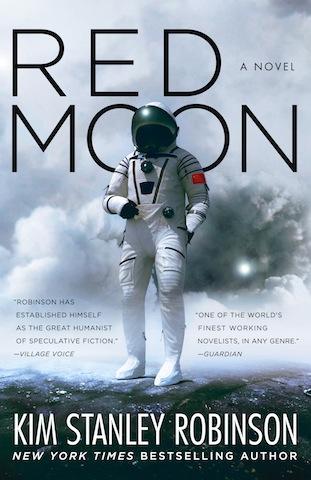
    The cover was revealed by Orbit in March, and was designed by Lauren Panepinto.

    And here is how the novel opens:

    Someone had told him not to look while landing on the moon, but he was strapped in his seat right next to a window and could not help himself: he looked. Quickly he saw why he had been told not to—the moon was doubling in size with every beat of his heart, they were headed for it at cosmic speed and would certainly vaporize on impact. A mistake must have been made. He still felt weightless, and the clash of that placid sensation with what he was seeing caused a wave of nausea to wash through him. Surely something was wrong. Right before his eyes the blossoming white sphere splayed out and became a lumpy white plain they were flashing over. His heart pounded in him like a child trying to escape. It was the end. He had seconds to live, he felt unready. His life flashed before his eyes in the classic style, he saw it had been nearly empty of content, he thought But I wanted more!

    The elderly Chinese gentleman strapped into the seat next to him leaned onto his shoulder to get a look out the window. “Wow,” the old one said. “We are coming in very fast, it seems.”

    The white jumble hurtled toward them. Fred said weakly, “I was told we shouldn’t look.”

    “Who would say that?”

    Fred couldn’t remember, then he did: “My mom.”

    “Moms worry too much,” the old man said.

    “Have you done this before?” Fred asked, hoping the old man could provide some insight that would save the appearances.

    “Land on the moon? No. First time.”

    “Me too.”

    Release in five months…

    In other news: New York 2140 has been nominated for both Hugo and Locus Awards!

  • From Cape Crozier to Mt. Thoreau

    From Cape Crozier to Mt. Thoreau

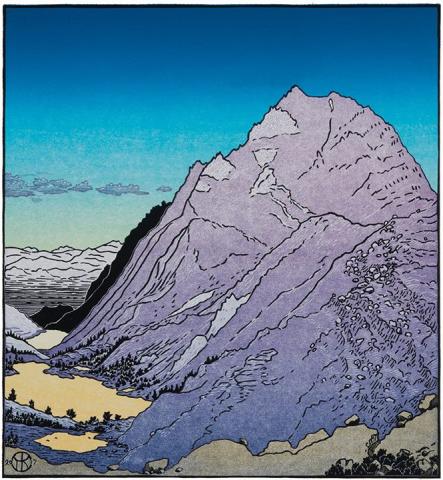
    In 2014, Kim Stanley Robinson had participated in an expedition to name a peak in the Sierra Nevada as Mount Thoreau! That feat and feast is now celebrated in “Naming Mt. Thoreau” (Artemesia Press; at Amazon) — a collection edited by Laurie Glover and with a cover by the great Tom Killion, illustrating this article (he also did the cover to Rexroth in the Sierra).

    Naming Mt. Thoreau is a collection of essays that arose from the simple undertaking of ascending a mountain; it is a meditation on friendship and influence, proximity and distance. Composed of a series of essays, poems, and photographs, this volume contains contributions from Michael Blumlein, Dick Bryan, Darryl DeVinney, Hilary Gordon, Tom Killion, Paul Park, David Robertson, Kim Stanley Robinson, Carter Scholz, Gary Snyder, and Christopher Woodcock.

    This compilation’s authors started out to rename USGS peak 12,691 Mt. Thoreau to honor Henry David Thoreau for his writing that has been so important to generations of Americans seeking to define their relationship to wilderness and nature. Taking their cues from Thoreau, they offer this collective set of texts and images as a call to close attention. Not just to what is present but to what is not, but still is.

    Here is also a video of a celebration of Mt. Thoreau at the Davis Arts Center from February 2017 with many contributors to that book.

    Halfway around the globe: Stan wrote about his experience of visiting Antarctica again (after that 1995 trip that inspired the novel Antarctica) in an article for the Smithsonian — “The Daring Journey Across Antarctica That Became a Nightmare” — which recounts the “Worst Journey in the World”, the Cherry-Garrard side-expedition within Scott’s failed journey to the South Pole in 1911, the amazing and proverbial feat of survival amid an Antarctic winter night, all done with a scientific purpose. The article features beautiful black and white photos by Shaun O’Boyle. Stan’s account ends with his own visit in these historical places, at the makeshift rock “hut” they made at Igloo Spur, Cape Crozier:

    The view from the ridge was immense, the sunlight stunning, the wind exhilarating. I tried to imagine keeping your wits about you in a wind like this one, in the dark; it didn’t seem possible. Confused and scattered though I was, I still felt sure we were at a holy place, a monument to some kind of brotherly craziness, a spirit I could feel even in the blazing sunlight. The wind brought it home to me, slapping me repeatedly with what they had done: Five days here in the howling night, in temperatures maybe 60 degrees lower than the bracing zero that was now flying through us. It was hard to believe, but there the stone ring lay before us, shattered but undeniably real.

    (Bonus: reader feedback on Emperor penguin eggs!)

    Now, change of scope: Stan was interviewed by Big Echo and discusses science fiction, politics, Marx, revolution, Braudel, history, race/gender/class, and all that — a very interesting read indeed! This is part of a series of interviews with SF writers on the occasion of the sesquicentenary of the publication of Marx’s The Capital. Some extracts:

    I definitely think there are two parts to Marx. In one, where he is analyzing the past, he is a historian and philosopher, and one of the best and most important ever to have lived. In the other, when he either predicts the future, declaring it is determined, or else calls for a particular future by way of choice and action, he is being a science fiction writer. Even a utopian science fiction writer. I say this because I think the future is radially unpredictable, and anyone who begins to talk about the future in any detail is by that very act doing science fiction of one sort or another.  No one is any good at prediction, but there can be interesting science fiction nevertheless. 

    So I was very lucky in my teachers, and I read widely, and I was part of the Sixties generation, including the California New Age hippie Buddhist mountaineering element. I am a very characteristic example of my place and time, greatly influenced by my friends and my era. […] My project is to be a novelist, and to try to write good novels, to be a good artist. That’s it for me, first and last. A very bourgeois romantic hippie Buddhist Californian goal in life, I know. But also, if trying for that means telling revolutionary stories, as so often it seems to me, then I do that. […] I’ve been trying to model a historical vision that sees science as utopian, and thus opposed to capitalism, rather than complicit with, and even a tool of capitalism.

    There is no such thing as a feminist capitalism, there is no such thing as a non-racist capitalism. Every leftist must needs be a feminist and anti-racist, it’s part of the definition of the left […] As a straight white American male artist, getting older, I have been interested to figure out how I can help make a better world, having lived a life of incredible privilege and luck when compared to most human lives so far. It’s not obvious how to do this, especially since my chosen art form, the novel, has historically been a form about the bourgeoisie and their problems.

    we make assumptions about the rate of change that will occur in the future. This is simple enough to be graphed: we often talk about “straight line extrapolation” in which the rate of change persists as it is, then there is accelerating change, and also decelerating change, less often mentioned, as change has been accelerating for a while now. But the logistic curve, a kind of big S in which slow change eventually accelerates and speeds up, but then hits various physical constraints or the like, and slows down again, is a very common phenomenon in nature. I find reasons to believe that the logistic curve will probably describe the rate of change in human history— but when will the curves in this big S graph occur? No one can say.

    KSR was also interviewed by The Source Code podcast about Mars colonization and the economics of space exploration!

    Along with five other science fiction authors, KSR shared his thoughts on his craft and the art of writing science fiction today in an article for Nature. Extract:

    Here’s how I think science fiction works aesthetically. It’s not prediction. It has, rather, a double action, like the lenses of 3D glasses. Through one lens, we make a serious attempt to portray a possible future. Through the other, we see our present metaphorically, in a kind of heroic simile that says, “It is as if our world is like this.” When these two visions merge, the artificial third dimension that pops into being is simply history. We see ourselves and our society and our planet “like giants plunged into the years”, as Marcel Proust put it. So really it’s the fourth dimension that leaps into view: deep time, and our place in it. Some readers can’t make that merger happen, so they don’t like science fiction; it shimmers irreally, it gives them a headache. But relax your eyes, and the results can be startling in their clarity.

    KSR was among those that sent their appreciations about the death of Ursula K. Le Guin, appearing in the March issue of Locus. More appreciation for UKL (before her passing) with KSR promoting “The Left Hand of Darkness” as one of his favorites, in an article for Science Friday.

    George R. R. Martin’s and KSR’s panel at the Arthur C. Clarke Center for Human Imagination from last May is now available as a podcast.

    More news — “Red Moon” and beyond — soon!…