Skip to content

KimStanleyRobinson.info

The reference site for Kim Stanley Robinson

  • Who is KSR?
  • Stan’s Favorites
  • About
  • Bibliography
  • Forum
  • Events

Category: news

  • Galileo’s Dream release + Readings in CA

    Happy new year! Galileo’s Dream has now been released in the USA (in hardback)! Oddly enough, several major bookstores in the UK (online at least) seem to be out of stock since before Christmas. Was the first print so conservative on sales figures?

    As reviews of the novel pop up, be they published or from random bloggers, I will be adding them to the site. Of course if you have a review and want to see it on the site you can send it to me or leave a link or post a comment in the book’s page here at KSRi.

    Also, Robinson will be making several appearances in Northern California for readings and discussions of his latest novel. So far three events have been organized, you can also find them on the calendar on the left.

    A reading with Robinson and Terry Bisson at Moe’s Books in Berkeley
    on Wednesday January 13, 2010, 7:30pm
    2476 Telegraph Avenue
    Berkeley CA 94704

    A discussion of Galileo and astronomy at the Explorit Science Center
    on Saturday January 16, 2010, from 7pm
    2801 Second Street, Davis, CA‎
    Tel: (530) 756-0191
    An event organized by the Davis Astronomy Club

    A reading at The Avid Reader in Davis
    on Friday January 22, 7:30pm
    617 Second Street, Davis, CA 95616
    Tel: (530) 758-4040

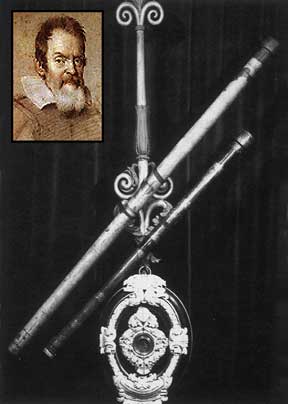
    Pictured: Galileo and his telescope as it is in exhibit at the Institute and Museum of the History of Science in Florence, Italy.

    9 January 2010
  • KSR signed for a three-book deal

    As hinted by last week’s update, Stan already has ideas brewing for further novels, and one of them is to be set in the future, where “human beings have fled Earth in favor of new homes within the solar system“. Along with his agent for the last twenty years, Stan Robinson just signed a deal for three books with the publisher Orbit. From Publishers Weekly:

    Orbit’s Tim Holman inked Kim Stanley Robinson to a world rights, three-book deal, with the first title in the agreement, 2312, slated to drop in 2012. Holman, v-p and publisher of the Hachette sci-fi/fantasy imprint, brokered the deal with agent Ralph Vicinanza. Robinson, who’s won various genre awards including the Hugo and the Nebula, is best known for his Mars trilogy, published in the 1990s by Bantam’s Spectra imprint. In the new novel, set 300 years in the future, human beings have fled Earth in favor of new homes within the solar system.

    Galileo’s Dream is not yet out in the USA and we know the title of Robinson’s next novel already: 2312. The round number between the novel’s title and its projected publishing date hints that its subject matter would of course be relevant to contemporary issues as well. Perhaps the same narrative device for linking different time periods in Galileo’s Dream will be used again. What is certain is that a three-book deal does not necessarily mean a trilogy. Still, the news is that apparently Stan moves back to the subject matter of the much-praised Mars trilogy: space colonization!

    Says Orbit publisher Tim Holman, on Orbit’s site:

    “Kim Stanley Robinson is a writer who can make the future credible, no matter how incredible it might seem. 2312 will be set in our solar system three hundred years from now; a solar system in which mankind has left Earth and found new habitats. This will be a novel for anyone curious to see what our future looks like – a grand science-fictional adventure in every sense – and I’m thrilled that Orbit will be publishing it in both the US and the UK.”

    Note: When Galileo’s Dream was announced end of 2006, the August 2009 release date was set and respected (the title of the novel, however, did change), so the 2012 publishing date and the book description for the above is quite reliable.

    Photo from the Cassini mission, depicting Saturn, Titan and other moons (via APOD).

    24 November 2009
  • New KSR interview: science fiction’s realist

    This week, the UK newspaper The Guardian published a new interview with Stan Robinson, by Alison Flood. The interview was appearantly conducted this summer, when Robinson crossed the Atlantic to attend the commemorations for the 400th anniversary of Galileo’s unveiling of his telescope in Venice (2009 was declared the year of astronomy by the International Astronomical Union).

    Among other things, Robinson talks about time and our perception of it, a recurring theme in his works, of his conception of Galileo’s Dream, and the love he developed for the historical character of Galileo.

    The germ of it began when he was researching his alternate history, The Years of Rice and Salt […] and needed to come up with an alternative scientific revolution. Studying our own, he found Galileo “right in the middle of it”. “I put that aside but thought ‘there’s an interesting story’,” says Robinson. “He seemed like such a confident guy, you might even say a brash guy – you could put him in any situation.” [A] “tremendous human story”. The result, all science fiction aside, is a wonderfully warm, accurate portrayal of the man. “I didn’t want to mess with that. His life is too interesting to disturb.”

    Galileo’s Dream is the first time Robinson uses time travel and aliens in his works, but that does not mean he departs from his trademark realism:

    “Essentially I sort of believe Stanislaw Lem. If we did run into an alien intelligence we’d be reduced to doing what Galileo suggests [in the novel] – drawing Pythagoras’s theorem and seeing if they’re in the same physical cosmos as us. And that’s about all you could say to an alien,” says Robinson. “So these aliens which proliferate in science fiction – well, I don’t think that’s the way it’s going to be.”

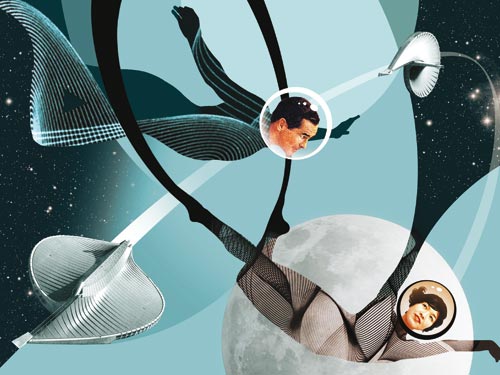
    Stanislaw Lem’s novel Solaris is well-known for his description of a being that is undoubtedly conscious but also unfathomably other, alien, different — far from the typical humanoid aliens abundant in SF literature and films (photo on the right from the film adaptation of Solaris by Andrei Tarkovsky).

    In line with his idea that technological evolution is going so fast that we are living in a science fiction novel of our own making, Robinson says of “the crisis for this tiny genre” of science fiction literature:

    “Depending what we do in next 20 years, it’s very hard to be plausible, to say this is what’s going to happen. At that point you can’t write science fiction, [so] the genre is in a little bit of a crisis, and all the young people are reading fantasy.” Robinson himself, however, presses on undaunted. He’s considering future novels set around Saturn or Mercury; he’s looking into a book about Herman Melville, who “after his career as a novelist crashed had another career as a customs inspector”; he’s keen to put what he learnt from Galileo – the work ethic, “the tenacity of the man”, into practice.

    The next Robinson novel to focus on Herman Melville? Or one with a setting of a Memory Of Whiteness-type colonized solar system?

    13 November 2009
  • Readings in October: the feedback

    The readings and Q&A sessions Stan Robinson conducted in October in various Californian cities for the launch of The Lucky Strike are now finished.

    Some of them were recorded:

    First, the Agony Column had an extensive coverage of the October 17th event organized by SF in SF, complete with readings, panel discussion and interviews. Present were also Eric Simons, who also did a reading of his novel on following the footsteps of Charles Darwin (literally), and Terry Bisson, who hosted the reading and discussion panel that followed. Stan’s reading was actually a selection of passages from the Lucky Strike that give you a feeling of what it’s about.

    In the excellent words or Rick Kleffel: “And with this reading from his novella, you get the best of both worlds. Robinson abridged his story while reading at SF in SF, off-the-cuff, so to speak, reading selections here and there that boil down the story and give a perfect verbal version of the much longer written version. What’s so nice is that when you listen to the reading, you can get the emotional and intellectual shock of Robinson’s story. You’ll feel the literal blast that he describes as he reads. But because Robinson has read a self-abridged version of his longer story, you can still go out, but the book and read the story to get the fully fleshed-out as well as the live reading audio experience. This is a very clever move on his part, and not just because he sells you a book. No, it’s much better than that. As a listener and a reader, you’ll get to experience the same set events from two equally powerful perspectives; the reading experience will enhance the audio and vice versa, but in a different manner. It’s a fascinating experiment for the writer and the reader.“

    The reading of The Lucky Strike was followed by a reading of A Sensitive Dependance On Initial Conditions, which is also part of the recent Lucky Strike publication by PM Press (I have/had not read it until now and I found it nothing short of amazing).

    Suitably enough, the two authors’ novels, one on Darwin and one on Galileo, fuelled the discussion that followed. The process of history, travelling (including a question on Escape From Kathmandu!) and writing. Robinson didn’t miss the opportunity to express his disbelief at the technological Singularity, something he sees as a bad recurring science fiction idea that as of lately has replaced the preceding fad, nanotechnology, in the minds of certain SF writers.

    Links: the reading; the panel; the interview.

    Second, the reading at Stan’s “favorite bookstore on this planet“: Moe’s Books, on October 22nd. The recording includes Terry Bisson’s reading from his parodic “The Left Left Behind“, a reading of “The Lucky Strike” similar to the above, and a reading of another of Robinson’s shorts, “Prometheus Unbound, At Last“!

    Also, Shareable has posted an excerpt of the interview Terry Bisson conducted with Stan for the Lucky Strike publication.

    Thanks to Ramsey from PM Press for the feedback (and, well, for making the books a reality in the first place!).

    If you attended these or another of the readings and have feedback or interesting tidbits to share, feel free to comment below.

    5 November 2009
  • Readings in October updated: California Tour ’09

    Apart from the two readings in San Francisco I posted previously, more readings in California with Stan Robinson and Terry Bisson have been announced, for their release of The Lucky Strike and The Left Left Behind from PM Press respectively. Each will give a presentation, then interview each other and answer questions from the audience.

    You can see the list of events in the all-new Upcoming Events calendar on the left. The complete readings list is as follows:

    The Variety Preview room for SF in SF in San Francisco on Saturday October 17, 7:00pm
    [reading with Robinson and Eric Simons]
    582 Market St. @ Montgomery
    1st floor of The Hobart Bldg.
    San Francisco, CA

    The Avid Reader at the Tower in Sacramento on Sunday October 18, 2:00pm
    1600 Broadway
    Sacramento, CA 95818
    Tel: (916) 441-4400

    Pegasus Books in Berkeley on Tuesday October 20, 7:30pm
    2349 Shattuck Avenue
    Berkeley, California 94707

    The Green Arcade in San Francisco on Wednesday October 21, 7:00pm
    1680 Market Street @ Gough
    San Francisco, CA 94102

    Moe’s Books in Berkeley on Thursday October 22, 7:30pm
    2476 Telegraph Avenue
    Berkeley CA 94704

    The Avid Reader in Davis (where Robinson lives) on Friday October 23, 7:30pm
    617 Second Street
    Davis, CA 95616
    Tel: (530)758-4040

    Borderlands Books in San Francisco on Saturday October 24, 3:00pm
    866 Valencia Street
    San Francisco, CA 94110

    Moe’s Books in Berkeley on Tuesday October 27, 7:30pm – event to be confirmed
    2476 Telegraph Avenue
    Berkeley CA 94704

    12 October 2009
  • Anthology of Interest

    The MangalaWiki, the Kim Stanley Robinson encyclopedia, has safely reached 120 articles and growing! You can drop by and browse around and contribute anytime.

    News from what’s happening in the world, touching upon themes that might be of interest to Stan Robinson readers. On the menu this week: some geoengineering, the economy crisis, prehistorical climate change, renewables investment and alien-like photos on Earth!

    More after the jump.

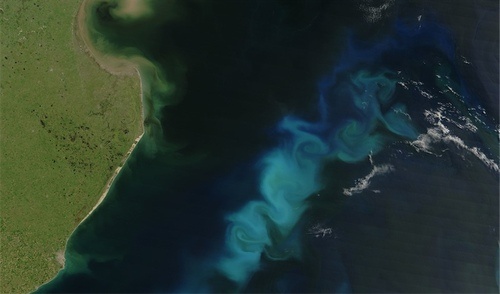
    Following the recent dust storm in Australia that made it look like Mars (we linked to pictures here), the dust had some interesting effects on the marine biota that could very well serve as proof-of-concept for geoengineering efforts. The dust that settled in the ocean provided nitrogen and phosphate to the plankton, whose population exploded and in turn expanded the population of local fish. At the same time, this ocean fertilization caused the algae to absorb carbon dioxide from the atmosphere and store it in their organisms and — arguably — store it in ocean depths for the long term.

    Ocean fertilization using iron dumping has been proposed before but as with any large geoengineering project its wider effects are a matter of debate. This is very akin to the salt dispersion effort championed by Frank Vanderwal and NSF in the Science In The Capital books to restart the thermohaline circulation of the oceans. (via io9)

    “Crisis management specialist and personal advisor” John Berling Hardy uses a Robinson quote from Green Mars (“That’s libertarians for you – anarchists who want police protection from their slaves”, from the anarchist character The Coyote) to argue for a more balanced regulation of the market in this article.

    William Ruddiman, professor at the University of Virginia, published a paper supporting the idea that humans first started altering the Earth’s climate when they first started farming some 5000-8000 years ago, burning forests to clear land and building rice paddies that release methane, an idea he has been supporting since 2003. The idea has met with criticism, for example that people were too few back then to have an effect, that they had no modern fertilizers or tools, to which Ruddiman replied that these early farmers had a lot of land and no means to control the fires they started, meaning they could farm the ground to a barren state and move on — effectively “those tens of millions (of people) had the impact of hundreds of millions, because per person, they had 10 times the impact“. Coincidentally, I got a similar feeling when I read Stephen Baxter’s Evolution: humans have been altering the environment extensively be it through bush fires, farming or wood and coal burning for thousands of years. A dangerous assertion from this would be to think that today’s climate change is not caused by fossil fuel combustion and that there is no need to move away from that: a point on which both Ruddiman and his critics agree needs to be acted upon.

    Speaking of which, the world is gearing up for the United Nations’ meeting in Copenhagen in December, where a follow-up on 1997’s Kyoto Protocol will be debated, with talks this week in Bangkok. This week also, the European Commission announced it would triple its research budget on clean technologies from €3bn to €8bn yearly following its 2007 Strategic Energy Technology (SET) Plan that would put it in a pathway to reduce its emissions by 80% by 2050 compared to 1990 emissions levels.

    And on a final note, here are some beautiful photos from alien-looking landscapes that are however very much Earth-based. This city in Yemen looks straight out of a fantasy novel!

    (photo by Jan Vandorpe)


    11 October 2009
  • The Lucky Strike and Mythmakers & Lawbreakers releases + readings in October

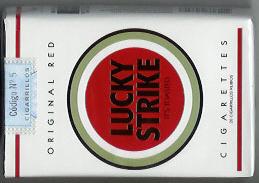
    “The Lucky Strike” by PM Press is now released in the USA. It contains the titular novella, another short story and an in-depth interview with Robinson. You can post impressions and reviews here. The release date for other territories seems to be 2010.

    On that occasion, Stan will be doing readings in October in San Francisco. He will be appearing with author Terry Bisson, who is also part of the “Outspoken Authors” series launched by PM Press and had participated in the Robinson-edited collection Future Primitive: The New Ecotopias in 1997 with “Bears Discover Fire” (also check out this excellent filmed short adaptation of Bisson’s classic short story “They’re Made Out Of Meat“!). Two readings are to be held:

    The first on Oct-21-2009, 7pm, at The Green Arcade:
    The Green Arcade
    1680 Market Street @ Gough
    San Francisco, CA 94102

    The second on Oct-24-2009, 3pm, at Borderlands Books:
    Borderlands Books
    866 Valencia Street
    San Francisco, CA 94110

    Also, Robinson has penned the introduction to “Mythmakers and Lawbreakers: Anarchist Writers on Fiction” (AK Press, an independent publisher specialized in radical and anarchist literature), also released on October 1st 2009. With interviews by Steampunk Magazine editor Magpie Killjoy of the likes of The Dispossessed writer Ursula LeGuin, ecotage partisan Derrick Jensen, V for Vendetta writer Alan Moore, “Multiverse” writer Michael Moorcock and many others, where they “reflect on the ways in which their personal politics have shaped their work“, this book gives a “specific focus on anarchist politics” in fiction. Magpie will be touring for it as well, and since it’s under creative commons a PDF should be available later on.


    2 October 2009
  • London tour + SF vs. lit “debate”

    Feedback from Kim Stanley Robinson’s book tour in London last week.

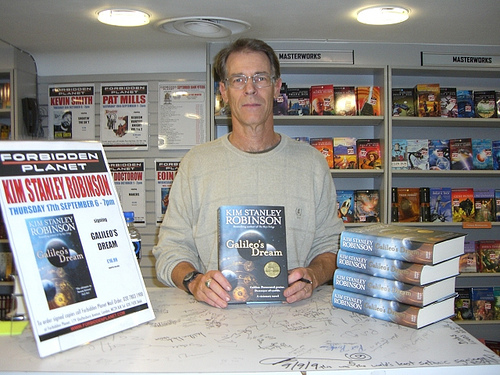
    First the signing at Forbidden Planet (photo via their photostream):

    More after the jump.

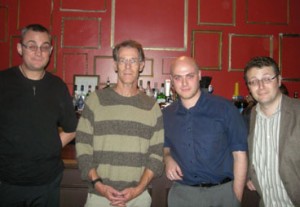
    And second, the New Scientist meeting in the Yorkshire Grey, of which we get a detailed account from Robert Gordon at Future Conscience. Also present were writers Geoff Ryman and Paul McAuley. There were readings (Robinson read out from the Virginia Woolf letter to Olaf Stapledon he uncovered for the New Scientist article), a Q&A session (surprisingly for the PKD uninitiated, Robinson’s favourite P.K.Dick novel would be Now Wait For Last Year and, less surprisingly, favourite SF novel in general Samuel Delany’s Dhalgren — if he had to choose) and general mingling of guests and attendees. Head over to Gordon’s article for more details (photo by him).

    Meanwhile, Robinson’s article in the New Scientist published last week sparked quite a debate as one would have expected from its clear-cut position. Are science fiction novels under-represented or excluded entirely from literary awards such as the UK’s Man Booker prize? Is there a literary genre that monopolizes literary awards? Are non-SF/fantasy/horror novels in general a genre in and of themselves that have their own prizes like SF has eg. the Hugo? Are the award jurys accountable or is it the publishers, who provide them with award candidates? Are award jurys and/or publishers snobbing SF, or is SF distancing itself from “mainstream” literature willingly? This is far from being the first time these things are being discussed, and SF as a literature has evolved and sophisticated itself a lot since the 1950s pulp era. Robinson himself has always described himself as a science fiction writer and been described by others as a literary science fiction writer in a milieu where many SF writers deny the branding of their work as science fiction in hopes it would be better regarded and not quickly categorized as non-literature.

    The New Scientist article was relayed by The Guardian, which gathered reactions from the accused Man Booker jury members James Naughtie and John Mullan, who argued that it greatly depended on what the publishers chose to submit to the jury but who also described SF as a genre that is now “in a special room in book shops, bought by a special kind of person who has special weird things they go to and meet each other“, which is hardly a non-discriminative comment. Academic and author Adam Roberts — whose new novel Yellow Blue Tibia should probably be this year’s Man Booker prize winner according to Robinson, and whose review of Galileo’s Dream was very positive — also argued in another Guardian article on these exact topics.

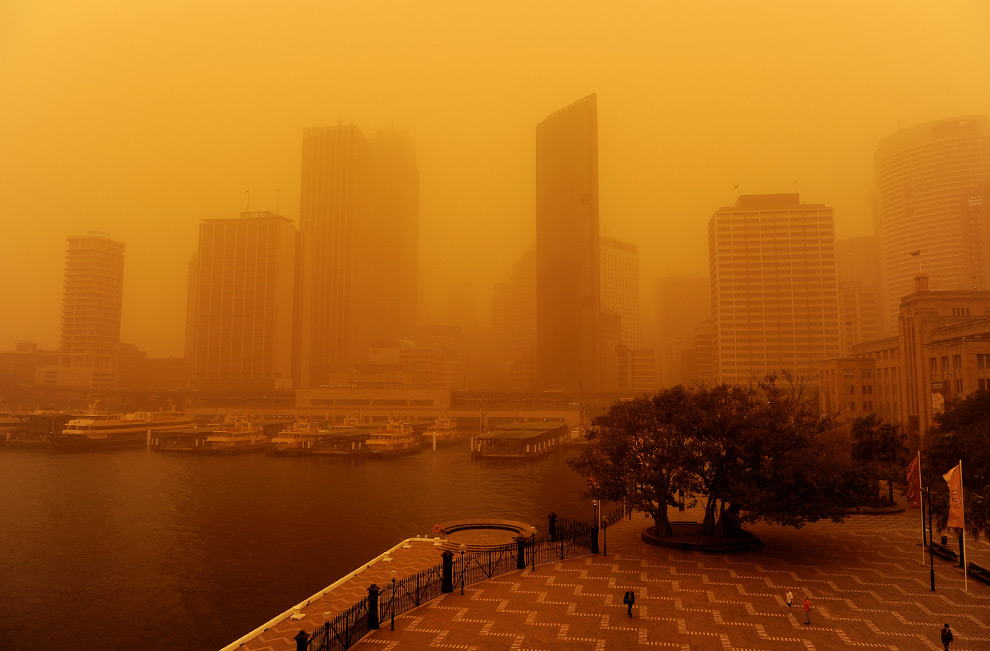
    In other news, Australia is plagued by a sand storm and as a result the Australians wonder whether they woke up in Mars. Judge by yourself: is this Sydney or Odessa?

    (photo by Greg Wood, via Boston.com)

    25 September 2009
  • New Scientist : guest editor + meet Robinson

    Today, Thursday 17, took place the K.S. Robinson signing at Forbidden Planet in London.

    Taking the opportunity of having Robinson on British soil, London-based science magazine New Scientist gives you the opportunity for a pub meet with Robinson himself, tomorrow Friday 18th, 7pm local time! The chosen pub (for it’s a pub, this is London after all!) is:

    Yorkshire Grey
    2 Theobald’s Rd
    London, London WC1X 8PN
    United Kingdom

    Details here.

    This week’s issue of New Scientist (#2726) also has a science fiction special and Robinson is a guest editor.

    More after the jump.

    The New Scientist‘s “The fiction of now” features an editorial by Robinson, in which he quotes from a 1937 letter by Virginia Woolf to Olaf Stapledon, praising him for Last and First Men (we already pointed out Robinson’s (and mine) fancy of Stapledon), and he goes on to develop his view on today’s British science fiction literature, “the best British literature of our time“, as being in a new golden age. Building on from Woolf’s letter and the lack of SF novels among ‘non-genre’ award winners, he urges people to be more open to reading science fiction.

    Also, for this issue Robinson “challenged eight leading British SF authors to write flash fiction about the world 100 years from now“. The flash fiction, each about 300 words long are accessible on the website; the writers are Stephen Baxter, Nicola Griffith, Ken MacLeod, Paul McAuley, Ian McDonald, Justina Robson, Geoff Ryman and Ian Watson.

    And if you’re up for it, New Scientist launches a Flash Fiction competition on that very theme, with the winner to be published.

    17 September 2009
  • Art corner: Ludovic Celle


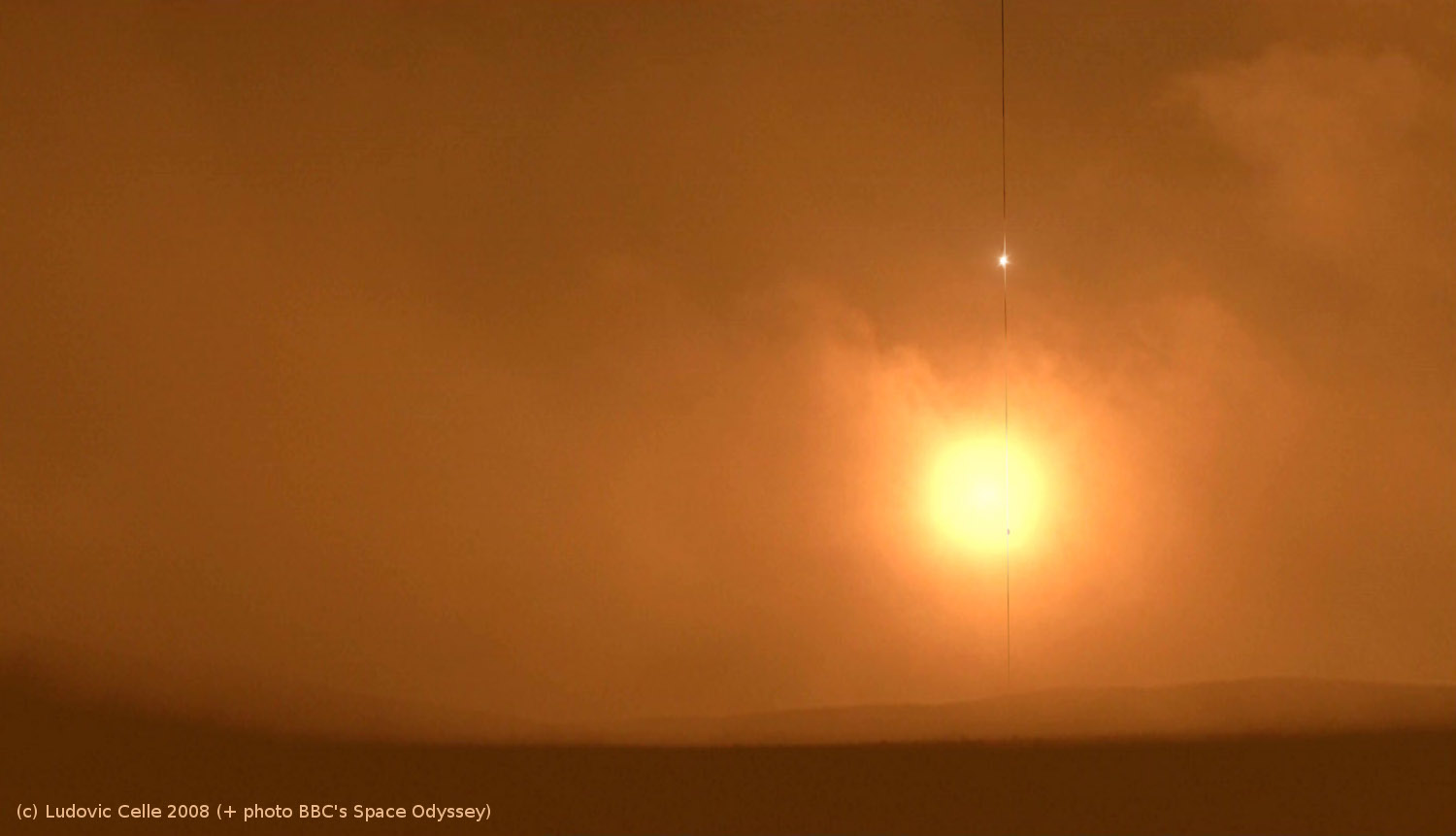
    KSR’s novels are very inspiring for both the intellectual and the adventurer. The Mars novels certainly give a lot of weight to majestic landscapes, virgin vistas and never-before-seen world-building. Who has read the novels and hasn’t spent time wondering what would Ann watching a copper-violet sunset over the Tharsis Buldge would look like? One who has is French KSR fan Ludovic Celle, who has dedicated an entire blog to Mars visuals which I urge you to visit (don’t be intimidated by the French, the focus here is the visuals): the aptly named Da Vinci Mars Design.

    More after the jump.


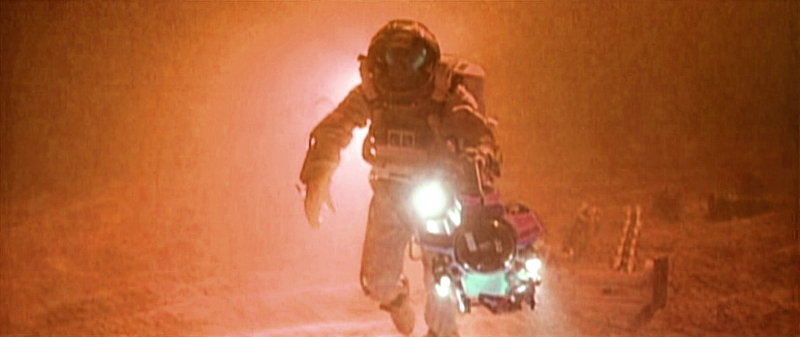
    Apart from collecting imagery from every film and documentary on Mars in existence, Ludovic shows a simple and efficient way to produce Mars imagery: by photoshopping (well, GIMPifying) images taken from elsewhere. A red filter over an image from James Cameron’s The Abyss takes you to Red Mars (see above).

    A silver line over a red sky gives you the space elevator:


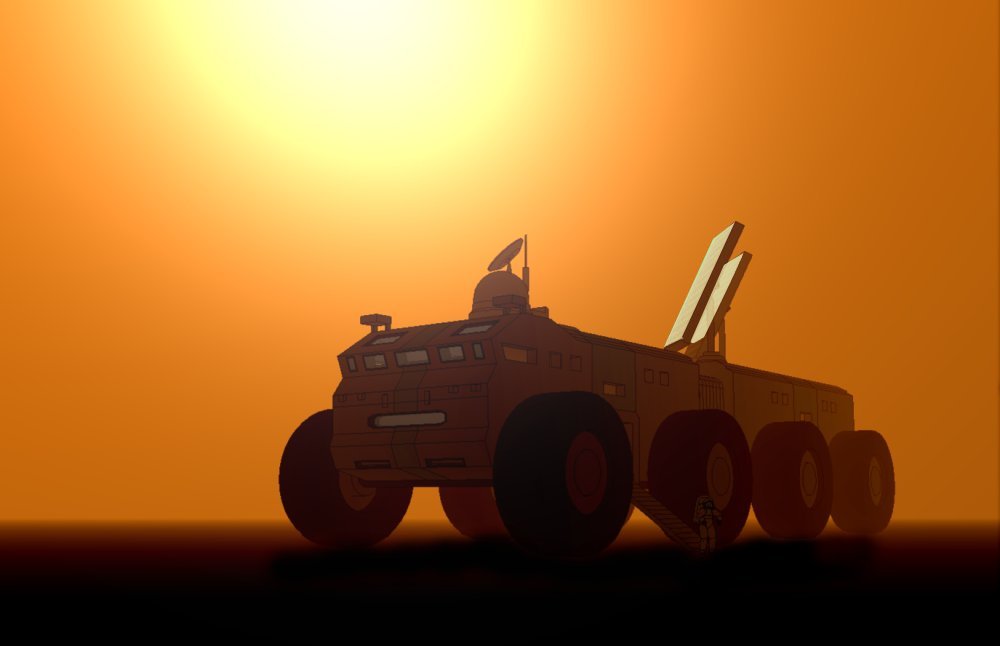
    There are many artists who have taken a pencil and drawn what Man on Mars would look like. Apart from Don Dixon (the Mars trilogy US cover artist), there’s John Harris, Peter Elson, Manchu, Carlos NCT and many others… Like T.E. Williams and his Ares model, Ludovic has gone from drawing to 3D model. Here’s a rover:


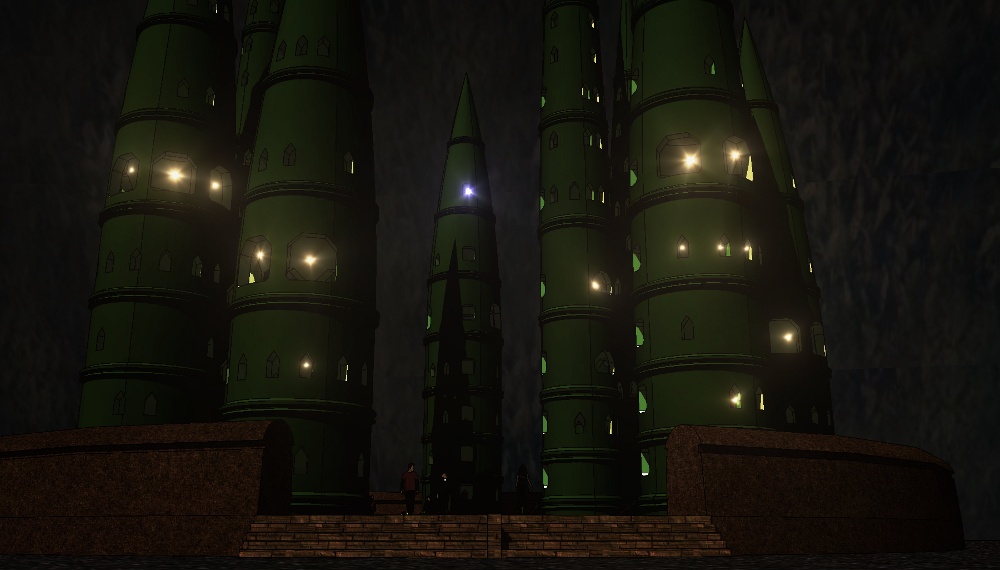
    Here’s an imressive view of Hiroko’s bamboo city of Zygote:


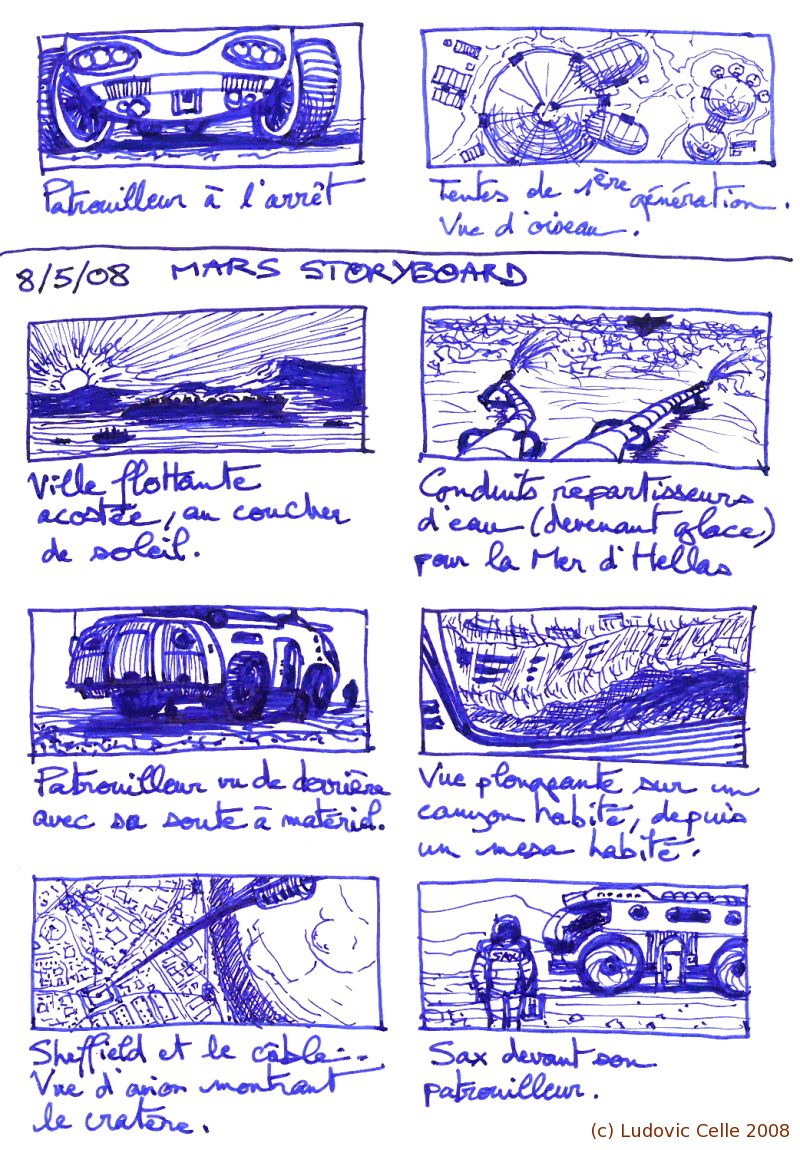
    And finally, some pen-drawn sketches or storyboards for some Mars trilogy scenes:


    No more of the blood-red sky of Ghosts of Mars. No more tents freely dangling in the toxic martian wind of Mission to Mars. Until we see the real thing. Any visual adaptation of KSR’s Mars novels would need to be very careful with photography and design in order to keep with the realism of his vision.

    14 September 2009
  • New KSR interview at Den of Geek

    Den of Geek has a new interview with K S Robinson, over here. Stan discusses Galileo’s Dream and gives some thoughts on his writing and what’s going on with the announced Red Mars TV series. Highlight:

    Is your work an expression of your credo or a place where you try to define your beliefs? In the Mars Trilogy, I sensed (in the characters of Ann and Michel particularly) that some of the characters were trying to resolve questions that remain issues for you personally.

    I think this is true for me, and I would hope it is true for all novelists. In the Mars trilogy I felt the appeal of both the Green and Red positions, and this was a big help in the writing of the novel, as I see-sawed back and forth from one position to the other, following the characters’ beliefs; I could believe them all while I wrote them, which gave them a certain conviction.

    Then the eventual Blue Mars synthesis was a kind of reconciliation in my own feelings as well as the projected situation.

    Glad you also mentioned Michel, whose homesickness and nostalgia is I think a pretty common condition, especially among those of us who for various reasons cannot ever get back home. In my case, Orange County California has been destroyed by an overlay of car-centered development that means the place I knew is no longer there. This is not an uncommon experience, especially since as years pass you can’t get back no matter what has happened to the home place itself.

    The people at Den of Geek are very keen to see a Red Mars TV mini-series and have written some articles on that in the recent past. But more on that from KSR.info shortly!

    2 September 2009
  • The Marsdreamers

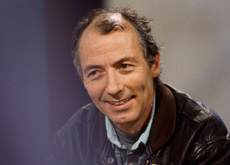
    The Marsdreamers is a new documentary on the efforts and dreams various people on Earth make about humanity’s future journey to the planet Mars, by veteran film-maker Richard Dindo (pictured right). And Kim Stanley Robinson, whose image is now indissociable with Mars, makes an appearance.

    More after the jump.

    A Swiss, Dindo has been operating from Switzerland and France and making documentaries since the 1970s, with titles such as Wer war Kafka? on the Austro-Hungarian writer, Ernesto Che Guevara, le journal de Bolivie on the popular revolutionary, Arthur Rimbaud, une biographie on the French poet, or on more local subjects such as Grüningers Fall on a Swiss policeman who helped Jews during World War Two or L’Exécution d’Ernst S., traître à la patrie on Switzerland’s relation with the Nazis during World War Two.

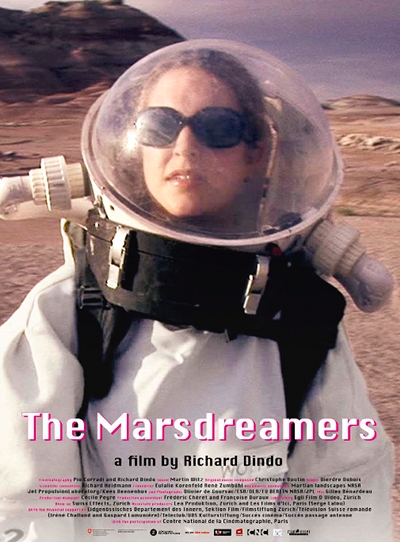
    The Marsdreamers (poster on the right) was mainly shot in the USA, showing scientists, engineers and architects presenting their view on Mars colonization, but it also focuses on common people with big dreams, people for whom that faraway place holds a special place in their lives, the whole presented not without a bit of humor and irony. The likes of science fiction writers Gentry Lee (Rama II with Arthur C. Clarke, also a NASA engineer), Gregory Benford (Timescape, also astronomy professor) and, well, Stan.

    The 83-minute documentary was presented recently at the 62nd film festival at Locarno, Switzerland (August 5-15). The French or German speakers among you can read the following reviews:
    – les francophones ici
    – die deutschen Sprecher hier

    The documentary should now make its way to a limited release, or potentially a television broadcast before a video release. The film’s press release can be read here.

    1 September 2009
←Previous Page
1 … 11 12 13 14
Next Page→

Upcoming Events

Notice
There are no upcoming events.
0 events found.

Events

Notice
There were no results found.
Notice
There were no results found.

Events Search and Views Navigation

Event Views Navigation

  • List
  • Month
Today
  • Today
  • Google Calendar
  • iCalendar
  • Outlook 365
  • Outlook Live
  • Export .ics file
  • Export Outlook .ics file

KimStanleyRobinson.info

The reference site for Kim Stanley Robinson

  • Who is KSR?
  • Stan’s Favorites
  • About & Contact
  • Bibliography
  • List of interviews
  • Forum
  • Events

This is not an official website for Kim Stanley Robinson. To contact this website, send an e-mail to postmaster [at) kimstanleyrobinson.info – To contact Robinson or his publishers, visit the official Kim Stanley Robinson Facebook page – To inquire about a speaking engagement with Kim Stanley Robinson, contact the Hachette Speakers Bureau

Twenty Twenty-Five

Designed with WordPress