You could say Red Mars‘s 20th anniversary is being celebrated in Grenoble, France, close to the Alps!
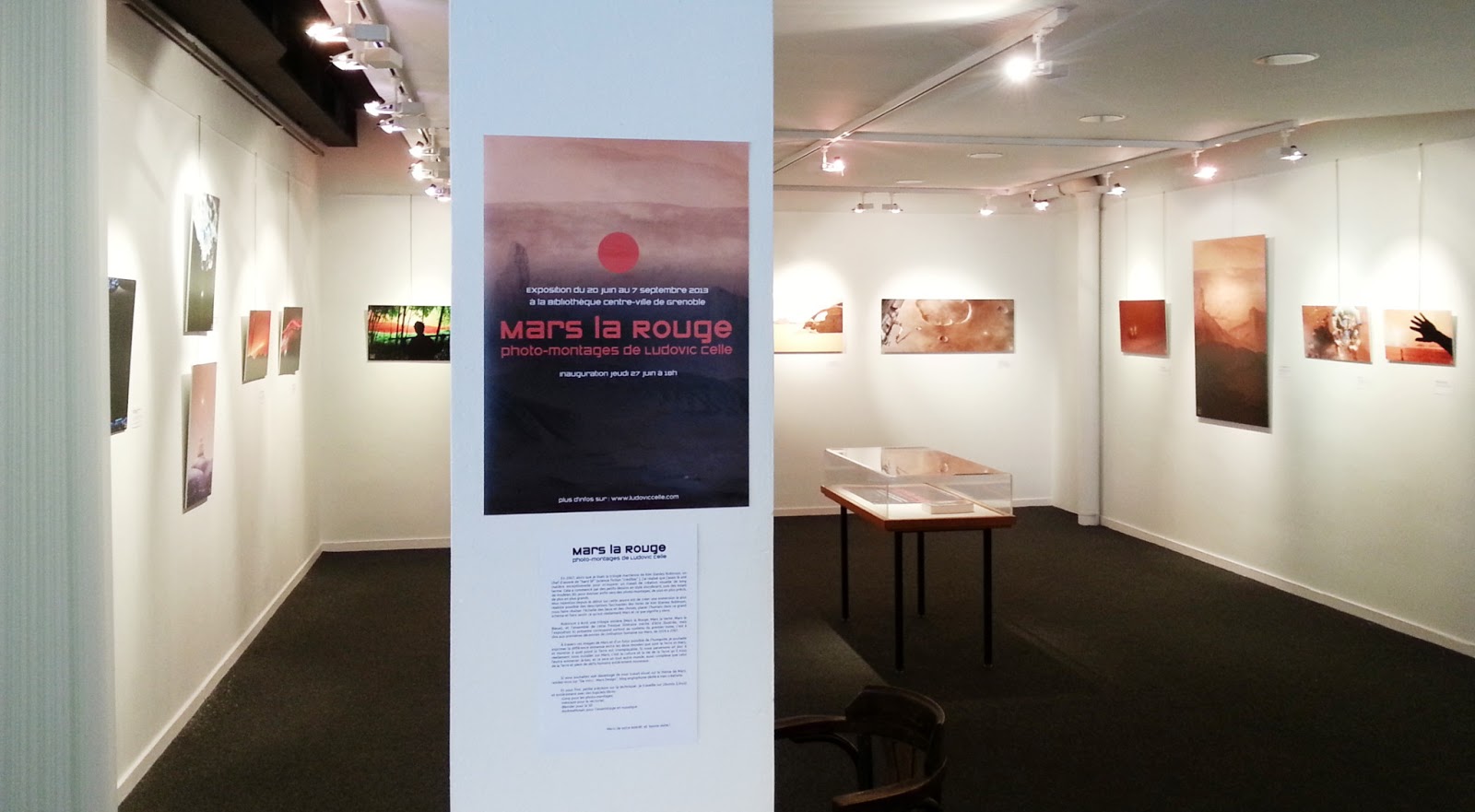
The public library of Grenoble hosts the exhibition “Mars la rouge” (“Red Mars” in French) with many of Ludovic Celle’s photomontages around the future colonization of Mars in general, and on the world of Kim Stanley Robinson’s book more specifically. The exhibition opened in June and (with a summer break in July) is still open for the world to visit and marvel until September 7th. So take your sailboats, space elevators and hyperloops, and come to Grenoble!
The work of Ludovic, a good personal friend of mine, have been featured on KSR.info before.
The montages — made on open source software and photos on the public domain (a very conscious choice on behalf of the artist) — are large and feature marvelous wild landscapes you should be able to see when exploring Mars, with the addition of the beginnings of a human presence, be it a rover dwarfed by the Noctis Labyrinthus canyons, a small tent holding some green inside, the plume of a distant mohole, or the thin line of the space elevator.
The images are accompanied by a short text explaining the artist’s inspiration from Robinson’s book, but there are many influences melding here: the crude realistic shots of NASA exploration missions and the ISS, the landscapes of Jordan or the United States, the modern efforts at urban agriculture, the process of discovering the very city you live in, and personal journeys. A book exhibit with several of Kim Stanley Robinson’s novels along with some quotes from Red Mars complete the expo.
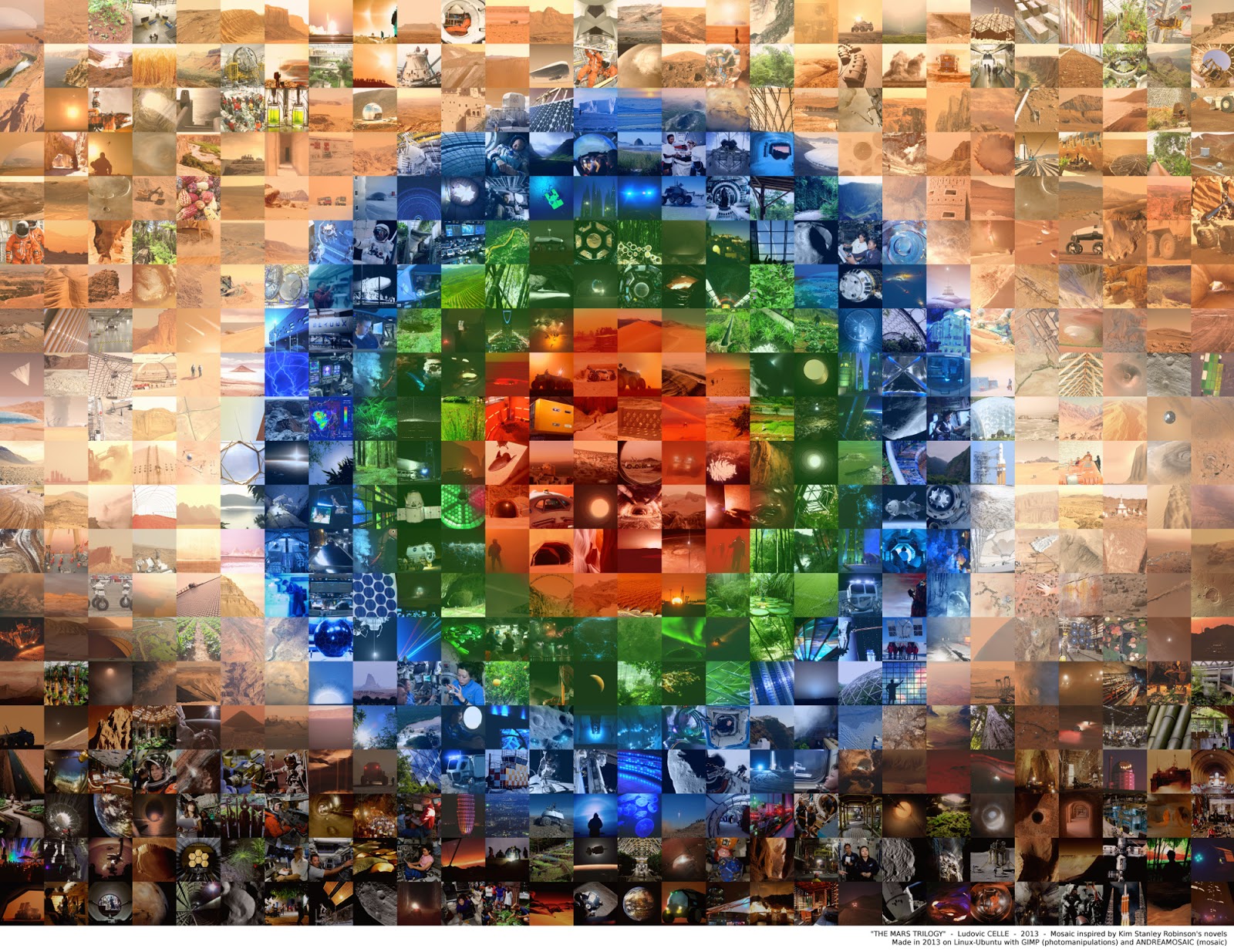
The largest exhibit is definitely the Mars trilogy photomosaic, at 2.50 m wide (about 8 feet) and featuring some 600 pictures, ranging from the technical engineering work to the entirely mundane of building a place to live in. More on the mosaic here.
Local media Cause Toujours also interviewed Ludovic Celle. The video in French has been subtitled in English and can be viewed below (subtitles can be turned on by clicking at the bottom right of the video); Ludovic talks about his inspiration, his work process, his feelings when reading Robinson’s books, his other ecology-focused interests that feed and at times can clash with his passion on the subject of space exploration.
More on the expo (with pictures of the expo and of the montages themselves):
SHAMAN just came out, September 3 2013; but before the host of interviews and readings that that one will involve, some non-Shaman material:
Adam Ford recently interviewed Robinson for 33rd Square (probably during the Humanity+ event last December). This resulted in a fascinating interview where Robinson discusses many of his ideas and worldviews, from science fiction, transhumanism and the role of technology to optimism, Buddhism and self-actualization. It is well worth your time and summarizes many of his interviews in the past few years. The interview is on YouTube in 5 short parts, below is Part 1:
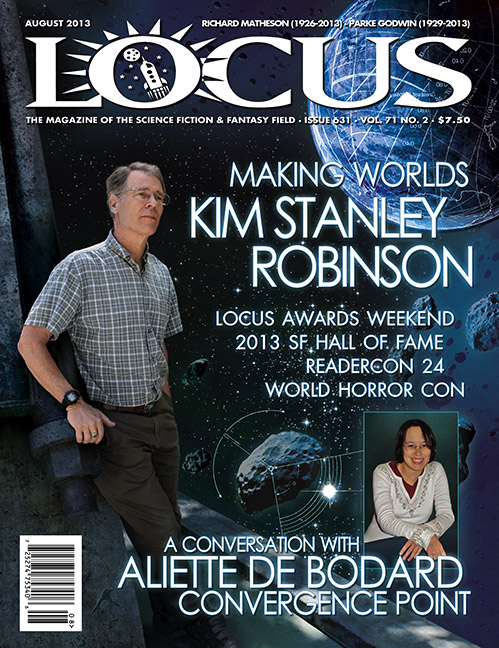
Kim Stanley Robinson is featured on the very KSR-focused cover of the August 2013 issue of Locus Mag. The magazine features a conversation with Stan, “Making Worlds“.
Excerpt:
From the beginning of my career, I’ve done the Solar System set a few hundred years in the future. So for this new one, I stole from myself: the city of Terminator on Mercury comes from The Memory of Whiteness. But when I tried to describe the rest of the Solar System, it began to get so detailed it was goofy. That was when I thought of Stand on Zanzibar by John Brunner, and how he had used John Dos Passos’s USA Trilogy methodology. My lists, extracts, and quantum walks all have their equivalent in Dos Passos. Using his method clarified things a lot. With it, I could tell the lovers’ story, and the mystery they’re involved in, and all the rest of it. Instead of using the typical expository lump, which is the famous problem of science fiction writing (and I’m often criticized for being a monster in that regard), I was able to chop the exposition into little bits, make it more something like little prose poems scattered through the text. It’s sort of an internet version of the Encyclopedia Galactica of the 1950s, which I think was one of the things people loved about science fiction, actually: learning about a far-flung civilization by way of direct description. But my impression now is that a lot of new readers don’t remember Stand on Zanzibar, and never read the USA Trilogy, so they think I’ve done something new and peculiar. Some have complained, but I feel those people are a little too narrow-minded about what the novel can be.
2312 was translated in Spanish by long-time KSR and SF publisher Minotauro. Robinson was interviewed by El Cultural, where he talks among other things of Mondragon, on course.
La primera vez que oí hablar de Mondragón y su sistema de cooperativas fue cuando estaba escribiendo mis libros de Marte, es decir, a finales de 1980 y principios de 1990. Mondragón es ampliamente conocido en las comunidades teóricas izquierdistas de todo el mundo, ya que representa un ejemplo vivo de una alternativa al capitalismo estándar. Es famosa en esos círculos, como el estado de Kerala en la India, la ciudad italiana de Bolonia, el experimento de autogestión en Yugoslavia, y algunos otros ensayos de alternativas. Ahora, tengo que confesar un intenso interés por lo que ha ocurrido en Mondragón en medio de la actual crisis del euro desde 2008, y la crisis de desempleo de los jóvenes en España, esta noción creciente en todo el Mediterráneo de que puede haber una “generación perdida”. ¿Cómo se ha desarrollado en Mondragón? ¿Se ha mantenido sólido en la crisis, o no? ¿Hay lecciones allí que el resto de España y del mundo pueden aprender? Espero aprender más de lo que he podido averiguar.
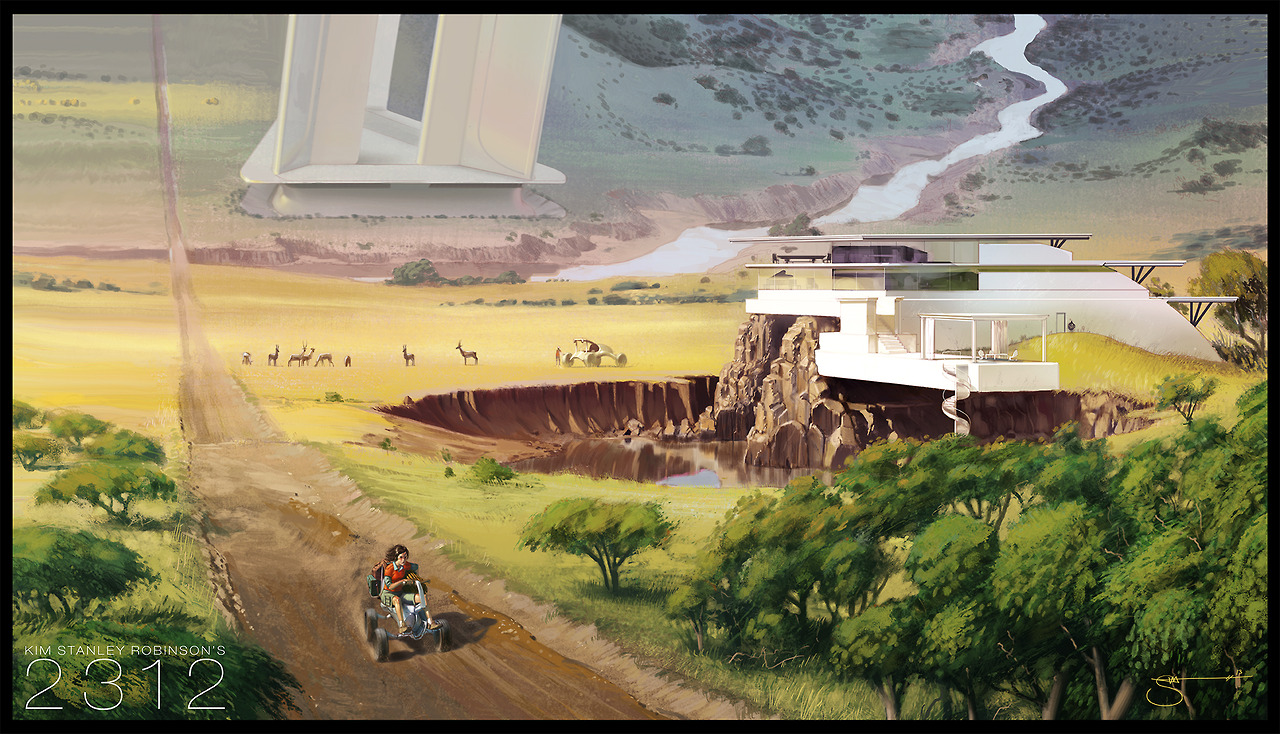
A great find: artist Stanley Von Medveydepicted a scene from 2312 (larger there), probably Swan in one of the savannah terraria! I don’t know if this was commissioned for some reason or whether the artist made it for his own enjoyment.
On the Huffington Post, Rabbi Lawrence Troster ponders about climate change activism (Climate Reality Project) and the historical period in 2312 that Robinson termed “The Dithering”, 2005-2060, during which political lockdown and behavioural inertia resulted in a lack of action against climate change.
Robinson was at the WorldCon in San Antonio, Texas, from August 29 to September 2, 2013: “LoneStarCon 3“. The Hugos were announced there, but 2312 did not take the win.
The New York Times bestselling author will make an appearance at Barnes and Noble San Pedro (321 NW Loop 410 suite #104) for his novel, “Shaman.” Robinson is most known for his Mars-trilogy which has won many awards including the Nebula Award and the Hugo Award.
Kim Stanley Robinson, the bestselling author of science fiction masterworks such as the Mars trilogy and 2312, will be joining us to discuss and sign his new novel Shaman, a powerful powerful coming of age story set 30,000 yrs ago. Come meet the author!
Wednesday September 04, 2013 7:00 PM
Lincoln Park, 7700 West Northwest Hwy. Ste. 300, Dallas, TX 75225, 214-739-1124
Robinson will be a speaker at the Library of Congress in Washington DC on September 12 2013, on “The Longevity of Human Civilization: Will We Survive our World-Changing Technologies?
Will human civilization on Earth be imperiled, or enhanced, by our own world-changing technologies? Will our technological abilities threaten our survival as a species, or even threaten the Earth as a whole, or will we come to live comfortably with these new powers? Baruch S. Blumberg NASA/Library of Congress Chair in Astrobiology David Grinspoon convenes scientists, humanists, journalists, and authors to explore these questions from a wide range of perspectives, and to discuss the future of human civilization in an anthropocene world.
Full event
Date: Thursday, September 12, 2013 from 8:30 a.m. – 4:30 p.m.
Place: The John W. Kluge Center, Room 119, Thomas Jefferson Building, Library of Congress, Washington, DC, USA
Robinson will also be participating at A Science Fiction Symposium at Williams College in Massachusetts on October 24:
Please join us on October 22nd, 23rd, and 24th for a Science Fiction Symposium that will include readings, panels, and lectures by leading writers and thinkers from across the United States. October 24th will include a panel discussion as well as a 4pm Reading. Participants will include Samuel R. Delany, Kim Stanley Robinson, Elizabeth Kolbert, David Hartwell, Paolo Bacigalupi, William Gibson, Terry Bisson, and John Crowley. More information will be coming soon. Sponsored by the English Department, The Margaret Bundy Scott Fund, American Studies, Environmental Studies, Africana Studies and the Oakley Center.
Full event
Date: Thursday October 24 2013, 4pm to 9pm
Place: Griffin Hall, 3 844 Main St, Williamstown, MA 01267, USA
“There are a lot of people who say, ‘If we have to change capitalism, well, OK, we’re doomed, because we can’t change capitalism.’ But we can. It seems to me that science and democracy together are actually capable of changing the laws for the sake of our survival and the sake of our kids and their descendants.”
Robinson said that he disagreed with scientists resolved that the best tack is adapting to climate change, rather than trying to halt it or reverse course.
“They look at me like I’m an old hippy utopian idiot and say, ‘No matter what you think, we’re at 400 parts per million. Nobody is stopping using carbon at any successful rate. In fact, it’s going faster than ever. We’re just being realistic, and you’re the one being unrealistic.’
“And then I say, ‘No, no, no, you’re the one who is being unrealistic. You’re being pseudo-realistic, because you’re saying the future is certain.’ I’m saying as a science fiction writer, nothing is certain.”
Most importantly, Robinson and Buckell did a joint panel on climate change, as covered by Steven Rose’s blog: “Kim Stanley Robinson: Back to the Prehistoric Past for a Greener Future“, which serves as a nice introduction to SHAMAN:
Robinson read an excerpt from his novel, Shaman, set in a prehistoric ice age. But this is no pulp-/Hollywood-/ One Million Years B.C.-inspired novel. Robinson takes his science fiction seriously; he writes hard science fiction. Strangely, however, Shaman does not seem to be his typical hard sci fi. In fact, with references to tribal magicians and mystic journeys one would think it’s closer to fantasy. But, after the reading, Robinson used the tribe from his this alternate (pre-) history novel as a model for how modern day humans are capable of planning ahead to save themselves from future ecological disaster such as an arctic meltdown. He explained how we can collectively come to solutions to prevent the disastrous effects of global warming.
During the two authors’ dialog on the subject of climate change and science fiction, one phrase Robinson kept bringing up was “utopian societies”. He referred to the primeval tribal society of Shaman as a model for a more communal future society that can plan ahead to prevent, or at least reduce, ecological disaster such as a global meltdown of the ice caps. Robinson explained how such a society could work in a high tech age: by utilizing clean energy technology and reforming capitalism to make it more socially just (though not necessarily communist). Through this idea, Robinson explained the economic implications and necessary reform for an environmentally responsible society.
In the meantime, Robinson is participating in Clarion’s Write-a-thon.
In related news, the literature and science fiction world recently mourned the loss of one of the best writers of the field and personal friend of Robinson, Iain M. Banks. His last novel, The Quarry, was published barely days after his death in June 2013.
Kim Stanley Robinson visited the Museum of Modern Art in New York in June for a panel discussion, as part of the MoMA PS1’s series of talks “Speculations: The Future is _”.
Each did a keynote address. Stan’s talk, “What Is the Future For?“, greatly summarizes all his latest ideas on science, (post-)capitalism, the utopian process, climate change, the paleolithic way of life, our relation to the physical world… Watch it below!
The City Atlas provides a summary of Stan’s talk, with a particular focus from the Q&A on cities’ role in participating in a better planned, more sustainable future.
I have often framed this problem as science versus capitalism…For me, science is the effort to try to reduce suffering, the effort to try to make life more comfortable for human beings, to understand the world better and to manipulate it for various human goods…I think of science as a utopian good that can make things better.
[…] I think cities are important because they are so densely populated…and I think that a lot of city life is fairly paleolithic in a strange way because it gets away from the automobile. Cities encourage face-to-face interactions with other individuals, so I like it for that. And I think that rooftops need to be used for urban gardens and that cities need to be greened, less for the auto and more for people and public transit.
Earlier, in May, Stan participated in a talk organized by the newly-opened Arthur C. Clarke Center for Human Imagination and the Helen Edison Lecture Series at UC San Diego: “The Literary Imagination“. Fellow writer Jonathan Lethem, A C Clarke Center Director Sheldon Brown and Stan discussed the writing process and each other’s writing. This event marked the opening of the Arthur C. Clarke Center for Human Imagination at UC San Diego.
The long discussion includes both writers reading from each other’s works, a highlight of the talk and a joy to watch and hear! Lethem read three “Lists” from Robinson’s 2312, and Robinson read Lethem’s hilarious list “Proximity People” (direct mp3 link).
The discussion also included a very interesting part, separate from the above video, in which both writers discussed a common influence of theirs: Philip K. Dick (direct mp3 link): Dick’s social realism, Dick’s fantastic elements, Dick’s adaptation in films, favorite novels. Robinson famously wrote his PhD thesis on Dick’s works, which has been expanded and edited separately as The Novels of Philip K. Dick.