



KimStanleyRobinson.info

The reference site for Kim Stanley Robinson

  • 2312 interviews & reviews VI

    Developing themes touched upon in his Science In The Capital trilogy and 2312, Kim Stanley Robinson wrote an article for the onearth online magazine, “Earth: Under Repair Forever“, dealing with…terraforming of Terra! i.e. geoengineering.

    For the rest of history, we will be required to work at repairing the damage we’ve already done to the biosphere. Geoengineering, then, has become our ongoing responsibility to life on this planet, including all human generations to come. All of which leads to the question: can we actually design and accomplish any geoengineering projects that would mitigate or reverse climate change? Putting aside issues of political capability, are any of these projects physically possible?

    Stan was even more strong on his choice of words when he visited the Mount Shasta Library recently. One of Stan’s short stories is called “Muir on Shasta” (it appears in “Remaking History” and “The Best Of Kim Stanley Robinson“). He spoke on various subjects:

    In response to a question on GMOs, Robinson said that an extended family member had developed a new strain of rice. “Global warming has meant the monsoons are much greater than before,” Robinson said. “The rice can survive under water for two months instead of two weeks. I think that’s good.” Robinson acknowledged that when scientists from the companies that produce foods with GMOs say it is safe, they are greeted with suspicion. “When you are mad at science, you are really mad at capitalism,” Robinson said. “The danger is when it becomes private for profit, like a Monsanto. The world should be a public utility. We should have public source genetic engineering.”

    UK literary magazine Structo also featured Stan with an interview in its #8. Released in July 2012, it is now available online to read here. The interview, focusing on 2312 but not exclusively, is very enjoyable!

    Stan was also extensively featured on literature journal Puerto del Sol, v.47 #2, an issue dedicated to “Utopias!” featuring original poetry and prose, reviews and a roundtable Q&A. The issue can be ordered from the magazine’s website, however the KSR-related material is also available as pdfs:

    A roundtable Q&A with authors Jacqueline Dutton, Daniel Heath Justice, Kim Stanley Robinson and Lorenzo Veracini.

    If I understand the term, settler colonialism describes my own situation as a person of European ancestry living in California, and so I suppose it has an impact on me implicitly, as I, like so many others, have to consider what it means “to become native to this place,” as Wes Jackson named the project. In my case, the central valley of California is now my home. It’s important to remember how it was here before the Europeans arrived—”the Serengeti of North America” as it has been called—and what it is now, a space of industrial agriculture, with a manipulated water system and greatly altered ecosystems.

    And an in-depth review of 2312 by Joe Epstein:

    The hospitable world seems endless to our intuition—why else would so many dismiss climate change flatly?—yet our home is only a gossamer sheet on Earth’s surface, and even there only under specific conditions, and virtually the entire rest of the universe is unlivable without improbable technological feats. On a cosmic scale, our civilization is as fragile as the biofilm in a shower drain. Robinson manages, with Terminator, to convey awe at the fact that anything should exist in the first place, and the pleasure of exploration for its own sake.

    In addition to his thorough stage setting, Robinson continues to celebrate—more than most sci-fi authors—the actual humanity of his characters.

    One doesn’t have to work very hard to see the present in 2312, with half the world impoverished, the disparity between those with personal aircraft and those who dig their toilets unyielding, and so many denying we can ruin things for ourselves, even as libraries of evidence mount to the contrary.

    Ultimately, 2312 is an update, a continuation, and a condensation of Robinson’s themes: the importance of sustainability and stewardship; the sheer difficulty of any space activity, an incredible challenge still not sufficient to dissuade human ingenuity; and the joy of mindful experience at all, of being a person who can feel, think, wonder, and love. Consider how often Robinson’s characters, almost all inhabitants of futuristic science fiction, adjourn for coffee and pastries, or head to cook, dine, and clean at a communal kitchen, or relax by hiking, examining flowers, spotting birds. Robinson centers aggressive, progressive sci-fi stories, covering incomprehensible distances, on humans doing human things. In this way, Robinson is among the most humane of writers.

    Speaking of reviews, Bookbag on 2312.

    The thoughts above on the fragile nature of our ecosystem and its small size compared to the enormity of the universe is referenced in an article in Nature as well, where Stan discusses the ever-growing list of exoplanets that have been discovered:

    The stars exist beyond human time, beyond human reach. We live in the little pearl of warmth surrounding our star; outside it lies a vastness beyond comprehension. The solar system is our one and only home.”

    (Pictured above: illustration for Structo #8)
  • Floods, Interviews, Beethoven and Reviews!

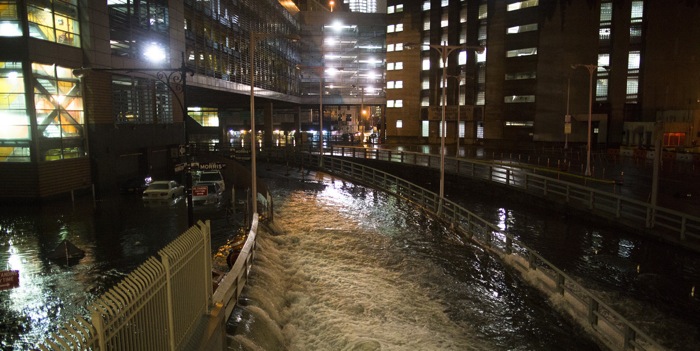
    Pictured above: New York flooded by Hurricane Sandy, October 2012. These images should ring a bell in two different ways to KSR readers. First, there’s the close-future Science In The Capital trilogy, wherein in Forty Signs Of Rain Washington DC is tragically flooded in the midst of undeniable climate change; an unhappy event like Hurricane Sandy. And then there’s the far-future 2312, where climate change and rising sea level has made of New York City and Manhattan island in particular a Venice of the future, where tall buildings directly emerge from the water and the scenery is full of overhead bridges and piers; a description that is far away from the flooding as it was lived by today’s New Yorkers, but a description of a city of which its inhabitants are very much proud of on 2312! Photo by John Minchillo.


    In a short video interview for io9, Kim Stanley Robinson evoked the novel that got him into science fiction: Clifford D. Simak’s The Goblin Reservation. It’s relatively unknown, but it was a 1969 Hugo Award nominee; interestingly, John Brunner’s Stand on Zanzibar won that year, and that novel had a much more obvious influence on Stan’s 2312!

    Stan was also interviewed by PrintAsia on 2312 and writing:

    What is the basic difference between the Kim Stanley Robinson who compiled the Mars Trilogy and the KSR who wrote 2312?

    Twenty years or so!  As a writer, I think that has made me less patient, and more interested in trying different structures and narrators.

    Further on 2312: A stellar review by popular blogger and writer Cory Doctorow:

    2312 is an epic story of political intrigue among the many worlds. To call it epic is to do it a disservice. It’s the kind of book that makes you realize that the ambition of Red Mars was just a warm-up; that books like Years of Rice and Salt, which reimagined millennia of history, were just a kind of mental exercise for Kim Stanley Robinson. 2312 paints an absolutely credible and astonishingly beautiful picture of the centuries to come, of the sort of schism and war, the art and love, the industry and ethics that might emerge from humanity going to space without conquering it and without solving all its problems.

    In lukewarm news, full videos of four panels from last year’s Worldcon (Aussiecon 4) surfaced on YouTube! They are:

    Kim Stanley Robinson’s panel on Utopia and Climate Change

    Kim Stanley Robinson, Gregory Benford, Tom Wigley, Sam Scheiner on Geoengineering: A Short Introduction

    Kim Stanley Robinson, David D. Levine, Jim Benford on Race to the Red Planet

    Kim Stanley Robinson, Sean McMullen, Grace Duncan, Tiki Swain, Jonathon Cowie on Climate Change: Possible Futures for Planet Earth

    Starship Sofa’s podcast #249 has a recording of Stan’s short story “The Timpanist of the Berlin Philharmonic, 1942“, narrated by Diane Severson. The story appeared in 2010’s The Best Of Kim Stanley Robinson.

    Finally, Kim Stanley Robinson will be appearing at the Humanity+ conference on “Writing the Future” in San Francisco, on December 1-2. He is scheduled at 10am on Saturday December 1. The subject of his talk?

    Science as a Utopian Project

    I want to explore the relationships between science, science fiction, and society, with a view toward seeing where science fiction might help us to shape our efforts in the present to make a better future.

    Humanity+ @San Francisco
    San Francisco State University
    Seven Hills Conference Center
    800 Font Boulevard

  • 2312 interviews & reviews V

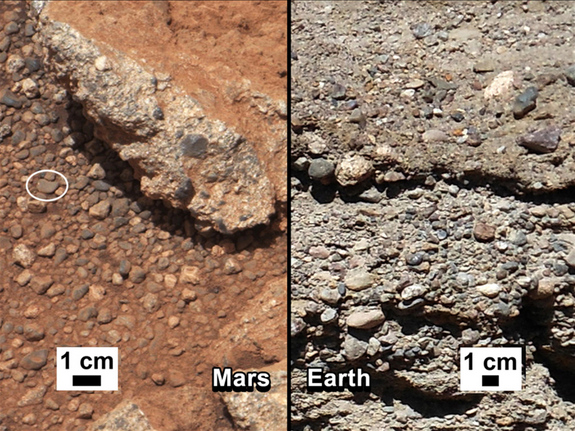
    Pictured above: comparison of Martian rock outcrops with their Terran equivalent, proof of water on Mars by NASA’s Curiosity rover!

    A whole summer’s worth of catching up with 2312 and Kim Stanley Robinson press coming up!

    FDL Book Salon hosted a live web chat with Stan, where he interacted with members at length on a huge number of subjects! Highly recommended!

    Blue Mars and the Mars trilogy is more utopian in many ways, and 2312 shows the darkening of the last 15 years of global history, the sense that things will stay a mess for a long time. But this may be true at the same time that progress is made in other areas, which ultimately may prevail. So I feel like 2312 also is utopian, but in the ongoing redefinition of utopia I have long been suggesting that it’s a name for a particular kind of struggle, and that it will go on for a long time and been pretty painful throughout. But with some good results!

    My research these days is mostly on the internet, but also I phone scientists I know often, and I got Chris McKay to convene a lunch group at NASA/Ames in Mountain View and I went down and asked the eight or nine people there a couple hours of questions, it was great help.

    SF Signal interviewed Stan on 2312, Mars and climate change:

    One change I can say for sure, since the writing of the Mars trilogy:  I need always to say very clearly that Earth is and always will be the center of the human story, that Mars and the rest of the solar system can be helpful and interesting (even just as thought experiment  setting) but Earth has to be our focus for the next two centuries for sure, and really, for all history to come.  We all should remember that and act on that.

    The About SF podcast interviewed Stan at length, with two episodes available totalling over an hour! Part 1 and Part 2 available. He discusses his research about the planet Mars for his trilogy, his inspiration for writing the novels, and his ambitions for writing science fiction.

    Stan was interviewed for UK literary magazine Structo, Issue Eight, you can order it on their site.

    Stan also presented 2312 on Google Talks, and answered audience questions.


    Marina Abramovic, performance artist and inspiration for the character of Swan in 2312, mentioned Swan in an interview for the Wall Street Journal!

    I also want to create a platform to work with scientists and with new technology. I had lunch a few months ago with Kim Stanley Robinson, a science-fiction writer who gave me a new book he wrote called “2312.” I’m one of the characters in the book. He said, “I saw you at MoMA, and you are great for creating galactic troubles.” So I am now doing performances on an asteroid near Mercury, just so you know.


    With over four months in bookstores around the world, 2312 keeps getting reviews and reviews.

    io9:

    If this novel sounds like your typical post-human epic, however, it isn’t. Absolutely it has space battles and AI orgies and moons being chopped up and hurled at planets. But it’s also full of strange prose-poems about science and consciousness. And every few chapters, Robinson gives us a history lesson in fragments of text that hint at all the ways humanity has changed over the 300 hundred years between now and the year when the story takes place. In this way, 2312 is able to be more than just a simple story. It’s a future history, a dream of all the complicated ways we might muddle through as a species, spreading out into space without ever really fixing all the old problems that have nearly extinguished us again and again.

    West Coast Science:

    It is a real rarity in contemporary fiction – especially genre fiction, but also in TV and movies – to find characters who are totally actualized, who speak with their own voice instead of the author’s voice, who are not just robots built to drive the machinery of the plot. Instead, each character is unique and together they interact in ways that totally make sense given this uniqueness.

    And then there are even more reviews around for your reading pleasure! Moon and Back, Blog Critics, Wind City Times, Experts Column, Portland Book Review, Cross Roads, Yatterings, Otago Daily Times, Dansville Online, Sunny Reads, George Kelley, Fill Your Bookshelf, Paper Droids, Pease Exchange, Omnivoracious, MC Reviews, A-Kon, and a video review by Olivier’s Book Club (part 1, part 2)….!


  • 2312 interviews & reviews IV

    Kim Stanley Robinson, like last year, is participating in the Clarion Write-a-thon!

    What is a write-a-thon, anyway? It’s just like a walk-a-thon. But instead of walking, we’re writing, and instead of making pledges per mile, we’re making pledges per word, chapter, or story. Writers get support, encouragement and motivation, and the option of joining a team with a writing mentor! Those who care about the writers in their life get a way to show their support. And money is raised for a literally fantastic cause — the Clarion Science Fiction & Fantasy Writers’ Workshop.

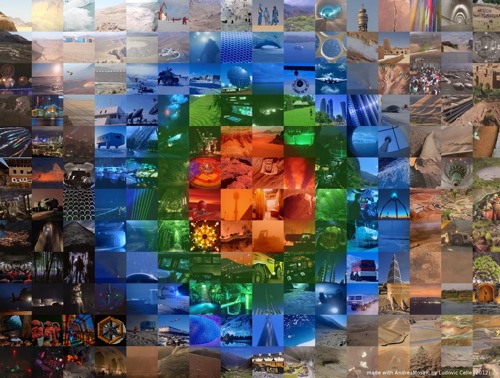
    Pictured below: a Mars trilogy-inspired mosaic by the awesome Da Vinci Mars Design! A much higher resolution is available there.

    Another wave of 2312 material!

    First, the interviews:

    Once more, Kim Stanley Robinson was interviewed by Rick Kleffel of the Agony Column, at Stan’s appearance at the Capitola Book Café on June 16 (direct mp3 link). Very entertaining and informative!

    Stan was also interviewed by Wired’s Geek Guide to the Galaxy (direct mp3 link). At their site you can also read a transcript of the whole thing. Lots of topics are touched upon: the Mondragon Accord, Jimmy Carter in Nepal, whistling Beethoven, the technological singularity, science fiction history, science fiction novels references in 2312, …

    Stan was also interviewed by Far Beyond Reality, in text form. A soundtrack for 2312?

    All of these might work as a kind of soundtrack for a reading of 2312, as they often served as soundtrack for writing it.  In particular I guess I would recommend the fourth symphonies of Brahms and Tchaikovski, and the late string quartets of Beethoven, and Satyagraha.


    And the reviews:

    One of the very best reviews I’ve read comes from Gerry Canavan, writing for the Los Angeles Review of Books:

    The wonderfully inventive 2312 is, in this way, Robinson’s most aesthetically reverent work to date. Science, engineering, history, politics, philosophy, parenting, love — in this novel all are reimagined as essentially artistic practices, as the sorts of ecstatic creative pursuits people might devote themselves to once liberated from the drudgery capitalism inflicts on us. It might, therefore, be Robinson’s most nakedly utopian novel, his most ambitious attempt to show us just how good life after capitalism could be. Finally: a time for play.

    But at the same time, 2312 could be Robinson’s least utopian novel — beginning, as it does, from the rejection of the “Mars Trilogy”’s happier historical trajectory in favor of a world(s)-system in which the ongoing historical struggle between the residual (feudalism), the dominant (capitalism), and the emergent (none dare call it communism) never crests, but just goes horribly on and on and on. Indeed, there is a suggestion late in the novel as pessimistic and unhappy as any I can recall Robinson making: that perhaps some people are just bad, that (worse still) perhaps true evil will only exist after scarcity.

    An interesting though odd review comes from Strange Horizons; it’s actually more of a critique of the pro-technology ideas underlying Robinson’s approach to the future:

    So much of Robinson’s playfulness with the broad canvas of the solar system reminds me of a remark made by J. Robert Oppenheimer about the US building of the H-bomb—i.e., that it was “so technically sweet” that it could not be foresworn. So, as a political ecologist, I mourn for the domineering technological command over the planets and the moons envisaged by this fictionally realized blueprint of the cosmos. […] Perhaps Robinson’s book may yet inspire another SF writer to think beyond the technological sublime into other realms and other plausible futures more firmly grounded in the ecological imagination and our corporeal existence and recognize that in that imagined paradisal future, et in Arcadia ego.

    Jeff VanderMeer for the Los Angeles Times (“Perhaps Robinson’s finest novel, “2312” is a treasured gift to fans of passionate storytelling; readers will be with Swan and Wahram in the tunnel long after reaching the last page.“) and Rick Kleffel are massively supportive of the novel


    The Canberra Times/Sydney Morning Herald place 2312 in the context of the science fiction genre:

    This particular vision of the future – an environmental catastrophe on Earth, followed by a rapid and transformative expansion into the solar system – is common to much contemporary science fiction. And while Robinson’s version is perhaps less plausible (and certainly less densely imagined) than that explored in Paul McAuley’s stunning The Quiet War series, or Alastair Reynolds’s recent Blue Remembered Earth, it nonetheless presents a future that is in turn awe-inspiring, unsettling and challenging, not least in its preparedness to demand that the reader thinks seriously about the possibilities of using technology to make other planets habitable by humans. […] These are not small criticisms, nor is it coincidental that they are criticisms that might also be made of sci-fi’s golden-age writers such as Robert Heinlein and Isaac Asimov, both of whom shared Robinson’s belief in the transformative nature of scientific rationality. Yet nor do they detract significantly from 2312’s real achievements, in particular its power as a reminder not just of the possibilities of science, but of sci-fi’s importance in opening our minds to those possibilities.