








Kim Stanley Robinson, as the Guest of Honor in this year’s Worldcon, is travelling to Australia and has a very busy schedule!
First, he appeared in the Melbourne Writers’ Festival on August 29, where he was interviewed by Lucy Sussex and spoke about his passion for writing, landscapes, Galileo and history — and his dislike of cyberpunk. Accounts of the speech can be found in the blogsphere here and there.
He was also a speaker in the Monash University academic series of conferences “Changing the Climate: Utopia, Dystopia and Catastrophe“. He did a lecture with Tom Moylan on utopia and climate change on August 31st, and chaired a speech by Kohn Clute on “Truth is consequence” (this one sounds very intriguing) on September 1st. There were also many lectures on science fiction and utopia which sound extremely interesting, including several focused on Robinson’s work — Tom Moylan, Adeline Johns-Putra, Jenn Martin, Anne Melano, Chris Palmer — the abstracts for the lectures and associated papers can be found here. I hope some of these papers will be available in some format in the future!
He was also interviewed by ABC’s Book Show, on, once more, utopia and climate change. The interview can be found here (direct mp3 link).
The Worldcon — Aussiecon 4, the 68th World Science Fiction Convention — began yesterday Thursday September 2nd and will last till Monday September 6th, in Melbourne, Australia.
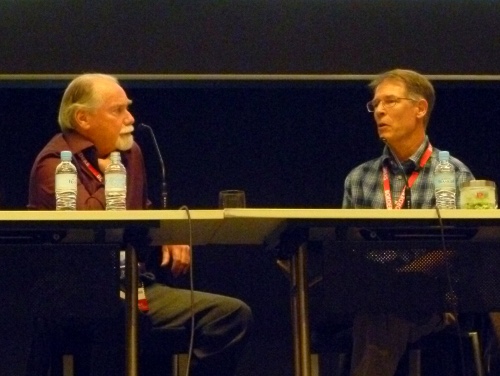
Stan and fellow SF writer Robert Silverberg just had a discussion in the Worldcon (see picture on the right — picture by Cory Doctorow).
Stan’s solo lectures are set to be about Virginia Woolf’s correspondence with Olaf Stapledon correspondence and time in the novel more generally (he wrote about it last year in New Scientist); and one about the way climate change is forcing the work towards utopia upon us (after Copenhagen, Cancún, anyone?). Actually he is making a huge number of other appearances, panel discussions, interviews in the Worldcon in the coming days (wow, I didn’t know Worldcons were so busy!), namely:
Time and the novel
The mutual admiration of Virginia Woolf and Olaf Stapledon for each other’s novels will serve as a start for a
comparison of the very different treatments of time in their books, which will then lead to a discussion of the many
ways novelists can portray the passage of time, often in ways unavailable to the other arts. The impact of these
formal methods on the reader’s sense of pace and meaning, therefore crucial questions of readerly pleasure, will be
explored by way of examples from Joyce, Proust, Golding, Garcia Marquez, and other great fantasists.
Kim Stanley Robinson
Saturday 1000 Room P3
The future is overtaking us
Science fiction used to be a means of extrapolating today’s technology and society, and predicting the future. More
and more often, however, our ideas of the future simply aren’t turning true. What happens when the real world starts
advancing faster than the imaginations of science fiction writers?
Kim Stanley Robinson, John Scalzi, Mike Scott, Norman Cates
Saturday 1200 Room P3
Shaping the world: The possibilities of geoengineering
“Geoengineering” refers to the deliberate engineering of the planet, most often as a means of averting catastrophing
climate change. What sort of things would we be likely to do if the world’s governments pursued a geoengineered
solution? What could you do to a planet through geoengineering – and what would be the potential risks?
Kim Stanley Robinson, Tom Wigley, Greg Benford
Saturday 1600 Room P3
Climate change and Utopia
In the last thirty years utopia has gone from a nice idea to a survival strategy. In the coming era of climate change
we will not be able to muddle through in our current system, because the bio-physical base of our existence will not
support it. Social change is therefore inevitable; and the work of all the sciences together now suggest an emerging
plan for change in a positive direction, and a resulting sustainable civilization. Enacting that plan will be both the
history of the twenty-first century and the best utopia yet. The talk will explicate this argument.
Kim Stanley Robinson
Sunday 1100 Room P3
The race to the Red Planet
Ever since the Apollo moon landings, it always seemed Mars was the next target for human space exploration. It’s
been 41 years and we still haven’t been there. As the debate over a human mission to Mars continues, we ask the
questions: should we go? What is stopping us? What will we need to do, and consider, to make a human mission to
the red planet a success?
Kim Stanley Robinson, David D. Levine, James Benford
Sunday 1300 Room P3
The bioethics of terraforming
Let’s say we colonise Mars, and develop the technology to terraform its environment and create a warmer,
breathable atmosphere for humans to breathe. Let’s also so that we discover bacterial life on Mars – life that cannot
exist if the planet’s atmosphere changes. Do we have a responsibility to leave Mars intact, or simply try to save the
bacteria the best we can. What are the bioethics of terraforming worlds?
Kim Stanley Robinson, James Benford, Sam Scheiner, David D. Levine
Monday 1000 Room P1
Climate change: Possible futures for planet Earth
Climate change is real — there’s no serious question about that, but just about everything else you read about it is
open to dispute by serious, knowledgeable people. Is it actually bad? (It’s change, but is change necessarily bad?) It
will cause habitat change, (But how much and how serious?) It will cause changes to the weather. (But for better or
for worse?) Assuming it can be stopped or slowed, which approaches are most likely to work? A discussion of what
we know, as well as what we don’t.
Kim Stanley Robinson, Sam Scheiner, Sean McMullen, Tiki Swain, Grace Dugan
Monday 1200 Room P1
Counterfactuals: Science fiction vs historical analysis
What role can alternate history fiction play in historical analysis? By examining the potential after-effects of a
fictionalised course of events, do we gain a fresh and valuable perspective on what actually happened? If so, what
requirements exist for alternate history fiction to achieve this aim? A look at alternate history fiction from two
perspectives: as science fiction readers, and as historians.
Kim Stanley Robinson, Gillian Polack, Dena Taylor, Jonathan Walker
Monday 1400 Room P1
This is happening right now!
I am working on gathering material from all this slew of events, and you are more than welcome to contribute! If you are attending the Worldcon and have your own word to say about the events, the topics discussed, the guests or the weather in Melbourne, do leave a comment or a link below.