Skip to content

KimStanleyRobinson.info

The reference site for Kim Stanley Robinson

  • Who is KSR?
  • Stan’s Favorites
  • About
  • Bibliography
  • Forum
  • Events

Category: news

  • 2312 is out!

    2312 is now available in stores!

    The “official site” for the book from Orbit is here. One of the chapters has been converted into a great little animation! Head over there to read and see the recipe on how to make a terrarium!

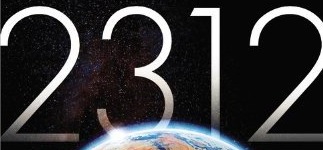
    People at Orbit have been blogging on 2312. If you want 2312 wallpapers and 2312 HQ design elements, here they are! If you want the story behind the design of the cover for 2312, Kirk Benshoff explains it all! If you want to read the first praise the novel has got, here it is! If you want to read the prologue, it’s over here!

    “The sun is always just about to rise.”

    The book counts 576 pages. It is split in many chapters of several types:

    • The main story itself, which follows Mercurial Swan Er Hong and Saturnine Fitz Wahram.
    • Lists: KSR has been accused (or praised) of too many infodumps, here he takes that comment and runs with it with chapters that are just that, lists of things!
    • Excerpts: Think of browsing through a scientific journal full of abstracts, only that you only concentrate on small snippets of text.
    • Places: Bodies in the solar system that have been settled by humans.
    • …and another one that would be spoilerish to reveal here!

    Many readers of the Mars trilogy will sometimes feel that 2312 takes the solar system of Blue Mars and runs wild with it!

    The 2312 page on this site is here, where I will link to all reviews and related material as they appear. You can leave your own review in the comments there! The 2312 MangalaWiki page is here.

    Stay tuned as the 2312 promo tour kicks in full gear!

    21 May 2012
  • Countdown to 2312

    In less than a month, Kim Stanley Robinson’s next novel 2312 is being released! May 22 in the USA and Australia, May 24 in the UK. Get ready for a wild ride in the solar system!

    The first official review of the novel comes from Publishers Weekly:

    Robinson (Galileo’s Dream) delivers a challenging, compelling masterpiece of science fiction. In a spectacularly depicted future of interplanetary colonization, humanity has spread across the entire solar system, from miniature biomes in hollowed-out asteroids to a moving city racing the fatal rays of the sun on Mercury. Mercurian artist and biome designer Swan Er Hong is struggling to cope with her grandmother’s death and an unexpected meteor strike when she gets caught up in a scientific conspiracy that touches on both the political and economic schemes of space-based humans, including Saturn’s ring-surfing moon dwellers and the secretive factions controlling slowly terraforming Venus, as well as the quasi-independent quantum computers called qubes. As Swan, the saturnine diplomat Fitz Wahram, and interplanetary investigator Jean Genette delve into the possible connections among a series of mysterious incidents, Robinson’s extraordinary completeness of vision results in a magnificently realized, meticulously detailed future in which social and biological changes keep pace with technological developments. Agent: Ralph Vincinanza, Ralph Vincinanza Agency (author now represented by Christopher Schelling, Selectric Artists). (May)

    The review came with an interview with Robinson: “The Future Is Fun“. Extract:

    What was your starting point for a work that explores so many different areas of future culture and technology?

    I usually start with ideas that are simple, then things get complicated as I try to make those ideas work. In this case, I began with the idea of the romance at the center of the novel, between two people from Mercury and Saturn who were (surprise!) mercurial and saturnine in character, and thus a real odd couple. But to make that story work I needed there to be people on Mercury and Saturn, which implied a solar system–spanning civilization, which in turn suggested the time of the story had to be pretty far off in the future. The project of describing this high-tech future civilization became a major component of the novel, but it all began by trying to give the central romance its proper setting. So I guess you could say it’s a process of following the implications of ideas and seeing where they lead.

    What didn’t make it on the magazine did make it on their blog here. Extract:

    SDG: What drew you to the “collage” structure?

    KSR: The book was clearly going to have a big information load, and as I was planning it, Jerad Walters of Centipede Press asked me to write introductions for new editions of John Brunner’s novels Stand On Zanzibar and The Sheep Look Up, classics from 1968 and 1973. I agreed to do that, and rediscovered the way Brunner had portrayed a complex global culture, which was by adapting the technique invented by John Dos Passos for his great U.S.A. trilogy of the 1930s. So I finally actually read the Dos Passos trilogy, which had been sitting on my shelf for thirty years, and I was amazed at how good it is—truly one of the great American novels. I decided to follow Brunner’s example and adapt the Dos Passos method, which in essence is a weave or collage of different kinds of writing, including songs, newspaper articles, stream-of-consciousness passages, impressionist pocket biographies of famous Americans, and so on. My lists, extracts, planet biographies, and quantum walks are my variations on the Dos Passos technique.

    I’ve always liked lists, and I hope that the lists in 2312 will be seen as a new way to handle exposition, in effect squishing it down to something like word association games, or prose poems.

    There’s another reader review at Mysterious Galaxy and here (some plot spoilers).


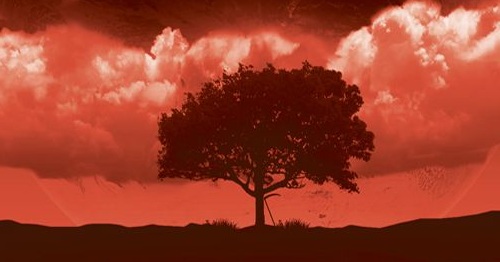
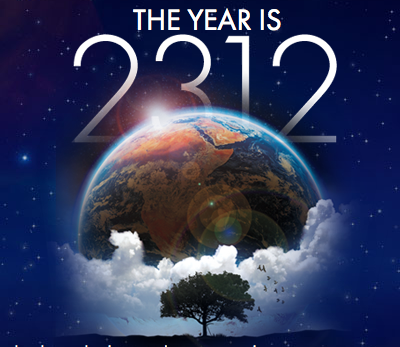
    Teasing the book, Orbit offers a Kindle sampler for their April-May 2012 releases over on Amazon.com, which includes an excerpt from 2312. The Orbit marketing continues to feature 2312 prominently, with a variant of the 2312 artwork featured as the cover for the sampler (picture above).


    Expect an intense Robinson tour for the promotion of 2312 in the coming months!

    The first is tomorrow (!) in Robinson’s city of residence, Davis, California.

    Davis Enterprise: Robinson talks about his latest novel, ‘2312’
    Saturday April 28, 2012, 7pm
    Davis Astronomy Club
    Explorit Science Center
    3141 Fifth St., Davis, CA

    Apart from the Rexroth-related events on May 6 and May 15 (see previous article and calendar), there is much more planned.

    • May 23: Planetary Society, Los Angeles, California
    • May 24: Mysterious Galaxy, Redondo Beach, California
    • May 25: FiRE conference, Laguna Beach, California
    • May 26: Avid Reader, Davis, California
    • May 29: Mysterious Galaxy, San Diego, California
    • May 30-June 2: Spacefest, Tucson, Arizona
    • June 5: Book Passage, Corte Madera, California
    • June 7-11: Tour in the UK (includes June 8: Bath)
    • June 16: Book Cafe, Capitola, California

    Details and links will be added as they become available. Make sure you follow the calendar!


    Finally, online science fiction magazine Lightspeed published the short story “Our Town” in its April issue, available here (for free). The story is accompanied by a short interview with Robinson! Extract:

    In May of 2012, Orbit will publish my novel 2312. By coincidence, this novel has a bit of a relationship to “Our Town,” in that one of its protagonists is an artist, but instead of the expensive and exploitative art form described in “Our Town,” my character Swan Er Hong practices landscape art and body art, in both cases using “found materials” to make art that speaks to her time. These new art forms are based on the current work of the landscape artist Andy Goldsworthy, and the performance artist Marina Abramovic. They are in effect inventing, or vastly expanding, new genres. This is interesting in itself, a great pleasure to watch, and also extremely suggestive for a science fiction writer. So I guess I’ve come back to a question that “Our Town” explored, as well as my novel The Memory of Whiteness: What will new art forms of the future be like?

    Their May issue will include an excerpt from 2312.

    27 April 2012
  • Releases: In The Sierra: Mountain Writings

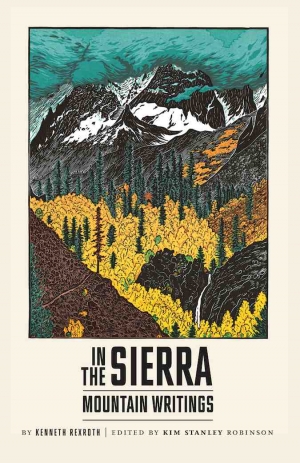
    In The Sierra: Mountain Writings has now been released! A work of love by Kim Stanley Robinson, this is a collection of Sierra-themed poems by Kenneth Rexroth, edited by Robinson, with his introduction and notes. The beautiful cover is by illustrator Tom Killion; the book also includes a ‘Rexroth’s Sierra’ map designed by Robinson and drawn by Killion.

    Over the course of his life, Kenneth Rexroth wrote about the Sierra Nevada better than anyone. Progressive in terms of environmental ethics and comparable to the writings of Emerson, Thoreau, Aldo Leopard, Annie Dillard, and Gary Snyder, Rexroth’s poetry and prose described the way Californians have always experienced and loved the High Sierra. Contained in this marvelous collection are transcendent nature poems, as well as prose selections from his memoir An Autobiographical Novel, newspaper columns, published and unpublished WPA guidebooks, and correspondence. Famed science-fiction writer Kim Stanley Robinson has compiled a gift for lovers of mountains and poetry both. This volume also contains Robinson’s introduction and notes, photographs of Rexroth, a map of Rexroth’s travels, and an amazing astronomical analysis of Rexroth’s poems by the fiction writer Carter Scholz.

    The release is by prestigious publishing house New Directions.

    Two events have been planned so far related to this new release, of course in California.

    Kenneth Rexroth Celebration at Book Passage in Corte Madera

    Link 1 | Link 2

    May 6, 7 pm

    Book Passage
    51 Tamal Vista Blvd
    Corte Madera, California, 94925
    United States

    A Celebration of Kenneth Rexroth’s Mountain Writings at City Lights Bookstore

    Link 1 | Link 2

    May 15, 7 pm

    City Lights Bookstore
    261 Columbus Avenue at Broadway
    San Francisco, CA 94133
     

    23 April 2012
  • Writing Climate Change discussion + more

    Over at Strange Horizons, a round table discussion between seven writers was published in February on the issue of climate change in fiction. Kim Stanley Robinson, notably with his Science in the Capital trilogy, was among them.

    Excerpts (also relevant to 2312!):

    Thinking about this composite epic we make, it occurred to me that it is thin in the middle. What I mean is that there is lots of near-future SF, and lots of space opera, but in between the near future and the far future is a much emptier zone—from say a century to a millennium after our time. Maybe this is just a difficult period to imagine, or maybe it forces the writer to include history, always a challenge to the novel as a form. Whatever the reason, that’s also the time when climate change will be impacting us, so if science fiction writers shy away from that time zone, an unintended result is there is no easy way to write about climate change.

    I like all three of these zones. Near future stuff is a way of talking about now as a kind of moving target—it’s the best current realism. Space opera reminds us that we live in a big universe, and could become “cosmic engineers” if we were to hold on for the long haul. But maybe we need more of the in-between, which we could call “future history,” if science fiction is to be really robust. That mid-zone knits together near and far futures, and helps SF to say interesting things about what humanity should try to do. Climate change might be an aspect of many stories set in that zone, as simply the likeliest future we face.

    I am often called a political writer, but since I don’t believe in art for art’s sake, I can’t really complain. Novels should have politics in them, but they should also try to be beautiful, which is not something we usually say about politics. Really the novel is a very big, capacious form, and I put my faith in readers who are generous and open-minded. They do the work of bringing stories to life, so they can say what they want, and all the writer can do is try to learn.

    Indian SF author Vandana Singh also provided some positive thoughts on the Science in the Capital books.


    2012 will also mark the celebration of the 20th anniversary of the release of Red Mars! A NASA astrobiologist offers his thoughts on these pressurized lava tubes that were used as settlements so memorably in Green Mars (Dorsa Brevia), in “Ask an Astrobiologist“:


    There are certainly many lava tubes on both the Moon and Mars. More are being discovered all the time with high-resolution photos we are taking from orbit. Lava tubes form when a lava flow begins to congeal and forms a roof of rock over the flow. When the hot lava eventually subsides and drains, a tube is left behind. I have watched lava tubes form in Hawaii, and once I accidentally walked across a tube with a roof only a few inches thick and a major river of lava still flowing inside (not an adventure I would recommend to anyone). The only problem is that lava tubes tend to form many “sky-lights” where sections of the roof collapse. Looking down from above, we see lava tubes only when there are such openings. Thus we really don’t know how many tubes there are or how easy it would be to seal them. I think that Robinson’s idea remains a good one, however. His Mars Trilogy is practically required reading for astrobiologists.


    Still on Mars, the fictional mathematician and physician that revolutionized the field in the twenty-second century in the Mars trilogy (Blue Mars), Bao Suyo, is mentioned in “A Wealth of Numbers: An Anthology of 500 Years of Popular Mathematics Writing“, an anthology that was just published by Princeton University Press! A full seven pages of Blue Mars are reproduced within.


    In other news, the 1986 short story “Our Town” is going to be released on April 24 in the online SF&F magazine Lightspeed, for its April 2012 issue.

    More soon!

    16 April 2012
  • Kim Stanley Robinson turns 60!

    Happy birthday to our favourite writer, who today safely and healthily reaches the honourable number of 60 solar circumnavigations! May he see many more!

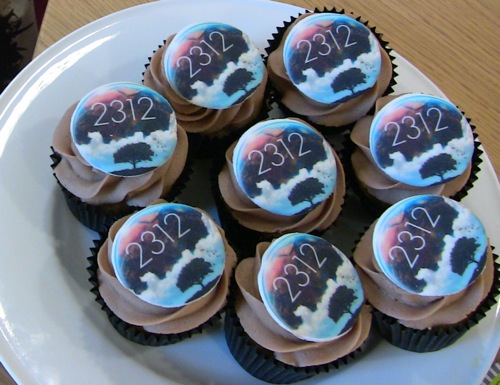
    (Pictured: 2312 cupcakes. Yes, you read correctly: 2312 cupcakes!)

    23 March 2012
  • Thinking Community + Blue River Quorum

    Last October, the “Eye of the Storm: Re-imagining Ethics for Changing Times” project gathered in a “Thinking Community” event, close to Oregon State University.

    Our premise is that old, human-centered moral systems have allowed us to damage the Earth, to our own peril and the peril of countless ecosystems and species. This cannot continue. We must find new ways to understand our moral responsibilities to one another, to the Earth, and to the future. Can these perilous times prompt us to discover and create a new set of ideas about how we ought to live?

    The gathering was sponsored by Oregon Humanities, Oregon State University’s Environmental Humanities Initiative and the Spring Creek Project for Ideas, Nature, and the Written Word.

    Among the many participants was Kim Stanley Robinson.

    Along with the gathering, the Blue River Quorum was also convened.

    We were philosophers, scientists, writers, poets, students, and professors of various bents. Over four intense days we thought collaboratively and open-mindedly, we learned from one another, and we worked hard to create something together none of us could create alone.
    (Blue River Quorum member Michael P. Nelson, in Minding Nature, Vol. 4, No. 3)

    The Quorum resulted in the Blue River Declaration: Ethics for a Changing Planet, a manifesto on the individual, the community, and the interconnectedness with the rest of the Earth.

    It is available as a pdf document or a printer-friendly 3-panel brochure. Well worth reading, pondering and spreading around!

    The necessity of achieving a concordance between ecological and moral principles, and the new ethic born of this necessity, calls into question far more than we might think.  It calls us to question our current capitalist economic systems, our educational systems, our food production systems, our systems of land use and ownership. It calls us to re-examine what it means to be happy, and what it means to be smart.  This will not be easy.  But new futures are continuously being imagined and tested, resulting in new social and ecological possibilities. This questioning will release the power and beauty of the human imagination to create more collaborative economies, more mindful ways of living, more deeply felt arts, and more inclusive processes that acknowledge the ways of life of all beings. In this sheltering home, we can begin to restore both the natural world and the human spirit.

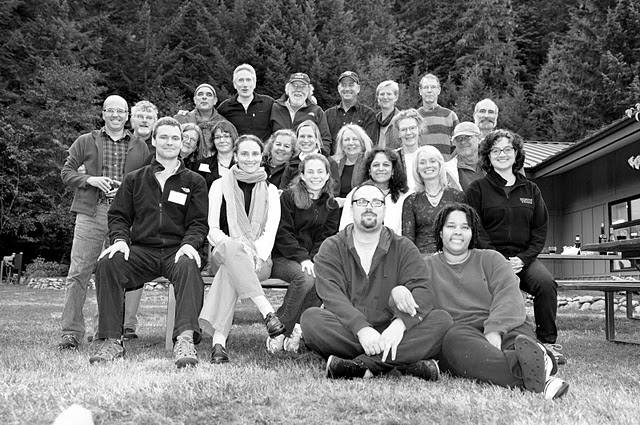
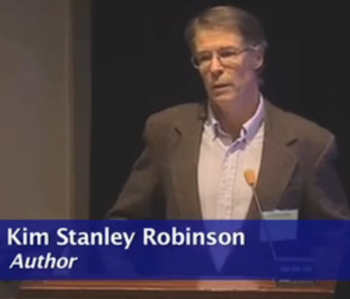
    A video of the gathering is available from OSU, and among many nice things it includes (from about 32min in) a reading of a draft of the Declaration by all the members of the Quorum (pictured above):

    J. Baird Callicott, Madeline Cantwell, Alison Hawthorne Deming, Kristie Dotson, Charles Goodrich, Patricia Hasbach, Jennifer Michael Hecht, Robin Wall Kimmerer, Katie McShane, Kathleen Dean Moore, Nalini Nadkarni, Michael P. Nelson, Harmony Paulsen, Devon G. Pena, Libby Roderick, Kim Stanley Robinson, Fred Swanson, Bron Taylor, Allen Thompson, Kyle Powys Whyte, Priscilla Solis Ybarra, Gretel Van Wieren, and Jan Zwicky.

    More pictures of the event are available here and here.

    21 March 2012
  • The Martian Connection: John Carter of Mars

    With Disney releasing the blockbuster film John Carter, based on Edgar Rice Burroughs’ classic pulp series Barsoom/John Carter of Mars, there are several articles on Mars in fiction popping up. You can say what you like about the fact that the vision of Burroughs’ Mars is now extremely dated (and you can say even more things for today’s film still choosing Mars as the setting!), but it left an undeniable mark in the history of science fiction.

    Inevitably given the Mars trilogy, Kim Stanley Robinson offered some thoughts on Mars for some of those articles.

    For SF Signal:

    The appeal of Mars is that it’s real. We can see it in the night sky, and we know it’s the next planet out. And now we know a great deal more about it than that. Its surface looks like parts of Earth, and has huge features, much bigger than equivalent features on Earth (volcanoes, canyons). It’s possible it still harbors bacterial life underground. It’s also possible we could visit it, and set up stations to inhabit and study it.

    So: it’s real but empty, beautiful and remote, but within our reach, just barely. It’s this combination of qualities that gives it its appeal. We want to fill that emptiness with stories.

    For Space.com:

    “because of the Percival Lowell hallucinations, educated people from all over the planet from about 1895 to about 1935 could in good conscience believe there might be life on the next planet out, and maybe even intelligent life,” said science fiction writer Kim Stanley Robinson, who has won Hugo, Locus and Nebula awards for his Mars trilogy (“Red Mars” in 1992, “Green Mars” in 1993 and “Blue Mars” in 1996) and is author of the forthcoming novel “2312.”

    The first major works to deal with Mars were Kurd Lasswitz’s “Two Planets,” an 1897 German novel that imagined a technological utopia on the Red Planet, and H.G. Wells’ “War of the Worlds” (1898), in which Martians invade Earth.

    “‘Two Planets’ had this powerful influence on the German Rocket Society and rocket pioneers such as Wernher von Braun — we might not have been able to reach the moon if weren’t for this science fiction about Mars,” Robinson said.

    For the Los Angeles Times:

    “Mars has this secret, sneaky, almost mystical pull on people’s imagination,” says Kim Stanley Robinson, the Central California science-fiction writer who’s penned several important Mars novels.

    […] “It was a zeitgeist thing,” says Robinson. “The whole science-fiction community said, ‘We have to get beyond the Lowell-Burroughs vision.’” And though a number of writers — Frederik Pohl, Philip K. Dick — rendered distinctive visions of the Red Planet, the first and most enduring was Ray Bradbury’s.

    The magazine stories that were collected in “The Martian Chronicles” in 1950 were poetic and mythical and showed a planet with a graceful, tragic race on the verge of fading out, just as mankind is showing up. “As a kid he must have loved Burroughs,” says Robinson. “In ‘The Martian Chronicles,’ he realized that Martians would be ghosts inside our minds. By the ’40s, we knew there was no oxygen, almost no water…. He was saying, ‘They may be hallucinations, but they will still haunt us.’”

    And these Martians, as Newitz points out, were truly alien — not even humanoid. “The Martians are unknowable. To live on Mars you will have to become a Martian.” This, and the stories’ flashes of environmentalism, showed thinking about colonial conquest maturing past the Manifest Destiny model, she says.

    A little later, the dream died unambiguously. The Mariner 4 spacecraft flew by Mars in 1964 and sent back the first detailed photographs: No canals, no seas, no aliens. “This is actually a dead world,” says Newitz. “How do we cope with that? We thought these were people we could be friends with.”

    It took until the ’90s for a fictional masterpiece to adjust to the idea. Robinson’s Mars trilogy — “Red Mars,” “Green Mars,” “Blue Mars” — looked at the slow process of terraforming a dry planet by an international team and kept a focus on what the planet did to the humans who transformed and settled it. The books, Newitz says, are about “the horror of meeting ourselves — all our bad qualities are transported there.”

    But even after these visions of a civilization on a sister planet teeming with life died, the shimmer of Mars hasn’t entirely dimmed.

    It may be hard to move forward: Robinson’s Mars trilogy will be a tough act to follow, and the writer himself has little interest in going back. “It’s a closing-down story space,” says Robinson, “compared to Earth and climate change, or Earth and overpopulation, and so on. Earth is gonna be intensely interesting. It’s also pretty clear with the space program’s budget that we’re going to be on this planet for a while.”


    Following up on the film-and-Mars topic, Alyssa Rosenberg, who had moderated a Red Mars book club reading recently, wrote a piece on“Towards Smarter Politics In Art, As a Means to Better Art“, which tackles the representation of politics in films through narrative, aesthetics and the power of images in such films as Avatar, Iron Man, The Triumph of the Will, The Ides of March, Primary Colors, and eventually tails into Robinson’s Mars trilogy:

    Like Avatar, Robinson’s Mars trilogy has its artistic flaws, particularly a tendency to lapse into overly technical prose that explains everything from the way time works on Mars to the composition of Martian soil. And like Avatar, the Mars trilogy’s novel and refreshing engagement with politics more than makes up for those lapses. Simply by asking us what we’d dare to make new if we freed ourselves from of our gravity and our political system, Robinson’s performing a valuable service, removing some of the heaviest constraints on our thinking about everything from corporate power to energy consumption to living in multi-faith communities. His characters experiment with a barter-based economy, integrate Islam and Buddhism, and learn what it means to live beyond the normal human life-span. We may never reorganize our society so dramatically, but that doesn’t mean it’s not worth considering what we’d do with the knowledge and concepts that we have if we were given an opportunity to radically realign them. Fiction can suggest juxtapositions that may not occur to us. Scenarios that seem impossible now may suddenly become pressingly important. And as his characters experiment with everything from architecture to monogamy, Robinson manages to affirm that some essential principles of humanity will carry into the future with us, making the prospect of heading off towards it less frightening.


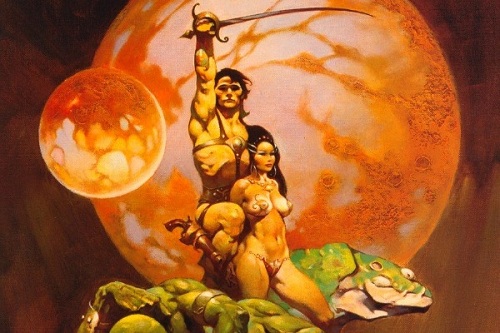
    (Image: cover for the 1970 Doubleday edition of “A Princess of Mars” by Frank Frazetta)
    19 March 2012
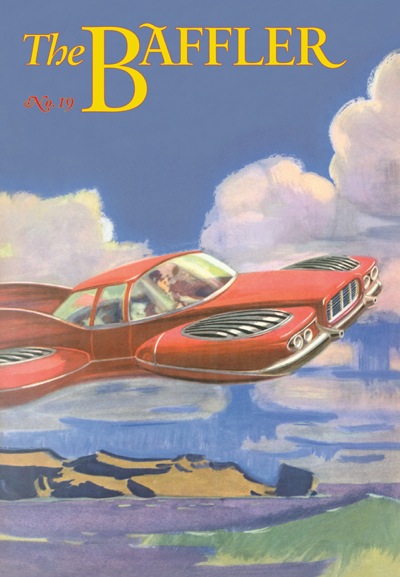
  • 2312 in The Baffler 19

    The upcoming issue of The Baffler will feature an excerpt from Kim Stanley Robinson’s upcoming novel 2312! This is an exclusive look before the novel’s publication in May!

    The Baffler, a magazine of cultural, art, political and business criticism, has been published since 1988 and has featured articles from some prestigious contributors. Since 2010, The Baffler has been relaunched with new editor John Summers and new publisher MIT Press.

    On the contents of Issue 19:

    In March, after a two-year hiatus, The Baffler will return with a dazzling new issue. Behold its cover! Contained therein are thundering new salvos from Thomas Frank, Barbara Ehrenreich, Rick Perlstein, and David Graeber, fiction from Kim Stanley Robinson and Ludmilla Petrushevskaya, plus a scintillating assortment of poetry, photography, and satirical art. Both print and digital subscriptions are now available.

    The Baffler Issue 19 will be available in select bookstores but especially on subscription, on March 6.

    1 March 2012
  • Of interviews, panels and hyperlinks

    It seems that anything you do nowadays will end up online! Videos or texts around a number of older conferences where Kim Stanley Robinson participated found their way on the internets. A great thanks to frequent contributor Albinoflea for a great deal of the links!

    First and foremost, Stan has reworked the talk he gave at the 2010 “Changing the Climate: Utopia, Dystopia and Catastrophe” conference in Melbourne. The resulting article, “Remarks on Utopia in the Age of Climate Change“, was published in the Arena Journal and it is fully accessible online.

    In 2010, Stan also participated in a workshop by the Space Studies Board, “Sharing the Adventure with the Public: The Value and Excitement of ‘Grand Questions’ of Space Science and Exploration”. The full video of the panel “What Could the Future Hold for Humans in Space?” is online (or at least I only found it now). The participants were:

    • Elizabeth Cantwell, National Research Council Decadal Survey on Biological and Physical Sciences in Space
    • Kim Stanley Robinson, spoke of distinguishing when speaking about the human presence in space between a decade-view, a century-view, a millennium-view
    • Jeff Bingham, US Senate Committee on Commerce, Science and Transportation (Republican), gave a view of how space exploration programs are voted and funded
    • Marc Kaufman, Washington Post journalist
    • Linda Billings, George Washington University School of Media and Public Affairs
    • Q&A

    A text summary of this panel along with all the other panels of this workshop is also available online.

    In 2011, Stan spoke at the Center for Values in Medicine, Science and Technology at the University of Texas Dallas. His talk, “Valuing the Earth and Future Generations: Imagining Post-Capitalism“, is also online.

    Speaking of post-capitalism, that was one the topics in the 2011 Rethinking Capitalism conference at UC Santa Cruz, and Stan wrote up a few thoughts following his participation in the conference for the Rethinking Capitalism newsletter.

    An interview with Stan also appears in “The Gothic Imagination: Conversations on Fantasy, Horror, and Science Fiction in the Media“, by John C. Tibbetts, professor of film at the University of Kansas, a hardcover book published in October 2011 (review). It looks like it includes a revised interview of a 1994 interview, “Footprints on the Sands of Mars: Science Fiction Writers Explore the Red Planet”, which by the way is available on Tibbetts’ site.

    Stan, a Californian, also appeared in a recent documentary for KVIE, a public television channel, “California Heat“, on issues of water and extreme heat, climate change and water over-exploitation in California. Stan’s segment is available online (there’s even a transcript of the whole documentary!).

    And finally, the novella “A Short, Sharp Shock” has received the audio book treatment by Blackstone Audio.

    That should keep you busy till 2312!

    23 January 2012
  • 2312 in 2012

    To kick of 2012, an article on 2312, Kim Stanley Robinson’s next novel that will be a kind of sort of sequel to the acclaimed Mars trilogy!

    Last November, Kim Stanley Robinson did a reading for SF in SF, the first public reading for 2312. He read several extracts to give a taste of the patchwork style of the novel, and fellow writer Cecilia Holland joined him for a chapter, Stan and Cecilia reading for the main character and her sentient (?) computer discussing on revolution — very entertaining and very topical for our times!

    Agony Column, as always, provides a podcast for the event: full reading, and the Robinson/Holland Revolution part only.

    2312 is also mentioned in a short and sharp interview for the radio station KPCC done on the occasion of the publication of the anthology I’m with the Bears (review), in which is featured “Sacred Space”, an extract from Sixty Days And Counting.

    Alistair Reynolds lists 2312 as one of his most-awaited SF novels for the year in the Guardian books podcast.

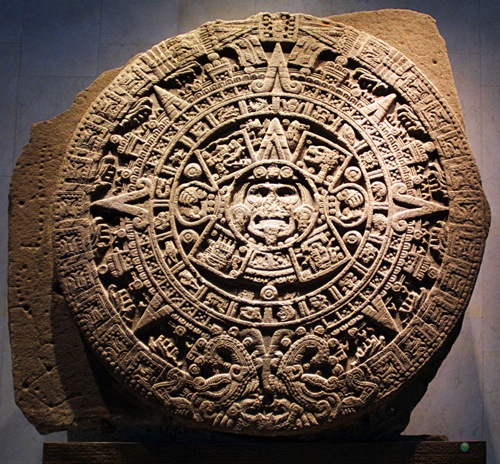
    (Pictured: A Mayan calendar. Of course.)

    9 January 2012
  • Upcoming publications: 2312

    After Galileo’s Dream in 2009, Kim Stanley Robinson’s next novel is 2312, which will present the world three centuries from now. Robinson’s writings have often been concerned with imagining a future that is not as pessimistic as most futures commonly depicted in the media or our collective (un)conscious: a future that can become all the more possible because representations of a better world would form part of our mental relationship with what could possibly come tomorrow.

    2312 was originally planned to be published in the beginning of 2012 — fittingly enough, February 3 (2.3.12) for the USA and March 2 (2/3/12) for the UK were aimed! But eventually, the publication date was pushed back to May 2012: May 3 for the UK, May 22 for the USA and basically the world. It is Robinson’s first novel with Orbit Books, and is being published in hardcover.

    The official description reads:

    The year is 2312. Scientific and technological advances have opened gateways to an extraordinary future. Earth is no longer mankind’s only home; new habitats have been created throughout the solar system, on moons, planets, and in between. Humanity itself, augmented and modified, has changed. But in this year, 2312, a sequence of events will force mankind to confront its past, its present, and its future.

    The first event takes place on Mercury, on the city of Terminator, itself a miracle of engineering on an unprecedented scale. It is an unexpected death, but one that might have been foreseen. For Swan Er Hong, it is an event that will change her life. Swan was once a woman who designed worlds. Now she will be led into a plot to destroy them.

    2312 is a bold and brilliant vision of mankind’s future and a compelling portrait of those individuals who will shape its events. It is a major new SF novel from one of the most important and gifted writers in the field.

    ‘If I had to choose one writer whose work will set the standard for science fiction in the future, it would be Kim Stanley Robinson’ New York Times

    The NY Times quote is generic and is from Red Mars (I think).

    The Fall 2011/Winter 2012 catalogue of Orbit Books included extensive coverage of that release:

    With the front and back cover dedicated to 2312, it looks like it is considered a flagship item in their catalogue!

    You can click for larger versions. I’m pretty sure the Borg are not featured in the novel.

    Between 496 (amazon.co.uk), 592 (amazon.com) and 800 pages (Orbit catalogue), there is some confusion as to its final length.

    Stan referred to 2312 in several recent interviews, most significantly in the Coode Street podcast which was released recently. After the down-to-earth Science in the Capital books, he seems to be eager to have some fun with science fiction concepts that he had not touched upon much previously. In Galileo’s Dream, he touched upon extraterrestrial intelligence and time travel. In 2312, we can find some Robinson ideas explored in the latter parts of the Mars trilogy — human expansion in the gas planets, terraforming of Venus, hollow asteroids, the Terminator city on Mercury — but also some new territory: new technologies, groups of genetically modified humans, starships, artificial intelligence, the solar system as humanity’s new playground… with the memory of a damaged ecosystem on Earth. 2312 sounds effervescent, all over the place, full of vitality!

    Also, 2312 will be written with a similar structure to John Dos Passos’ USA Trilogy (The 42nd Parallel, 1919, The Big Money, 1930-1936), which was adopted decades later by John Brunner in his landmark science fiction novel Stand on Zanzibar (1968): chapters focused on the ‘main’ characters alternating with newspaper clippings, radio show transcripts, fictional book excerpts, speeches, vignettes from other characters’ lives… This ‘collage technique’ helps give a fuller view of the richness, complexity and contradictions of the world at hand. Robinson wrote an introduction to a recent edition of Stand on Zanzibar. In 2312, parts of these chapters will focus on narrating the history that has elapsed from our 2012 to 2312.

    This is an exclusive excerpt of the book:

    The sun is always just about to rise. Mercury rotates so slowly that you can walk fast enough over its rocky surface to stay ahead of the dawn; and so many people do. Many have made this a way of life. They walk roughly westward, staying always ahead of the stupendous day. Some of them hurry from location to location, pausing to look in cracks they earlier inoculated with bioleaching metallophytes, quickly scraping free any accumulated residues of gold or tungsten or uranium. But most of them are out there to catch glimpses of the sun.

    2312 is just five months away!

    5 December 2011
  • LA Review of Books: Three Californias interview & Best Of review

    The Los Angeles Review of Books recently featured a long column on Kim Stanley Robinson, “Pacific Overture“, combining a very interesting interview by Istvan Csicsery-Ronay with Stan and a review by Mark Bould of the recent short story collection The Best Of Kim Stanley Robinson. The interview focuses on the Three Californias/Orange County trilogy (The Wild Shore, The Gold Coast, Pacific Edge): how they were conceived and written, and how he views them twenty or more years later.

    Some extracts:

    Development all around it has been extensive, and a few years ago I went to the Orange Hill restaurant on the next hill over, and had a look around, and it was amazing to see all the mansions studding the surrounding hills and overlooking the coastal plain, still often very smoggy. It had a very Gold Coast look. […] So in a way the landscapes of all three alternatives can still be seen. But The Gold Coast dominates. As with the books, it is the center of the triptych. It will take hundreds of years to restore that landscape to something decently livable. The Pacific Edge project is a long-term effort.

    I would like to see more Californian utopian novels join Pacific Edge, Ecotopia, and the many real-world utopian efforts that were made in California in the nineteenth century. The potential exists, both locally and globally, for huge improvements in human life and our fit to the planet. They involve not just technologies but laws and economic systems; they need to go beyond capitalism and its disconnect from ecology, and that next step has to be imagined and envisioned repeatedly, no matter the literary and conceptual difficulties, to give us a better sense of how it might feel and how we might take the first steps.

    What we built so fast is not a sustainable infrastructure or social structure, so it’s going to have to be extensively rebuilt in the centuries to come. It may remain a kind of test tube for experimenting, and if so I hope my Three Californias helps a little in terms of cognitive mapping.

    The review of The Best Of is also very insightful in Robinson’s recurring themes and writing influences.

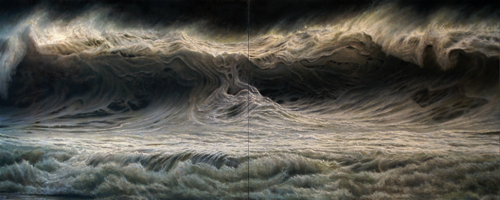
    At first, I thought that the great image that accompanies the article (pictured here too) was some NASA photo of the Jupiter atmosphere… it turns out it’s a painting! Storm No.2, by the awesome Ran Ortner!


    In other news, the release date for the “Rexroth in the Sierra” collection, edited by Robinson, has been announced: April 10, 2012. The cover art is by Tom Killion, “Horse Creek Trail, Hoover Wilderness”.

    25 November 2011
←Previous Page
1 … 6 7 8 9 10 … 14
Next Page→

Upcoming Events

Notice
There are no upcoming events.
0 events found.

Events

Notice
There were no results found.
Notice
There were no results found.

Events Search and Views Navigation

Event Views Navigation

  • List
  • Month
Today
  • Today
  • Google Calendar
  • iCalendar
  • Outlook 365
  • Outlook Live
  • Export .ics file
  • Export Outlook .ics file

KimStanleyRobinson.info

The reference site for Kim Stanley Robinson

  • Who is KSR?
  • Stan’s Favorites
  • About & Contact
  • Bibliography
  • List of interviews
  • Forum
  • Events

This is not an official website for Kim Stanley Robinson. To contact this website, send an e-mail to postmaster [at) kimstanleyrobinson.info – To contact Robinson or his publishers, visit the official Kim Stanley Robinson Facebook page – To inquire about a speaking engagement with Kim Stanley Robinson, contact the Hachette Speakers Bureau

Twenty Twenty-Five

Designed with WordPress