Skip to content

KimStanleyRobinson.info

The reference site for Kim Stanley Robinson

  • Who is KSR?
  • Stan’s Favorites
  • About
  • Bibliography
  • Forum
  • Events

Category: news

  • “Sacred Space” & “The Lunatics” in collections + TRSF

    Two Kim Stanley Robinson stories were included in collections in October 2011.

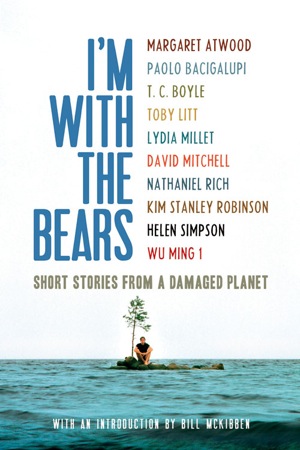
    The first is Verso Books’ I’m With The Bears: Short Stories from a Damaged Planet, a collection of stories from science fiction writers focusing on the impacts of climate change. Between David Mitchell and Paolo Bacigalupi, Robinson’s contribution is “Sacred Space“, an excerpt of Chapter 6 of Sixty Days And Counting (part of the Science In The Capital trilogy), where Frank and Charlie go on a hiking trip in the Sierra Nevada. The book says “the story here is adapted from the third novel“, so there might be differences in the text.

    The book features an introduction by Bill McKibben, notorious American environmentalist who has written extensively on climate change and sustainability.

    Interestingly, the book mentions: “Royalties from the sale of I’m with the Bears will go to 350.org, an international grassroots movement working to reduce the amount of CO2 in the atmosphere.” 350.org was founded by McKibben. With the world Conference Of Parties on climate change negotiations in Durban approaching and with alarming warnings coming even from traditionally conservative institutions, that is very timely!

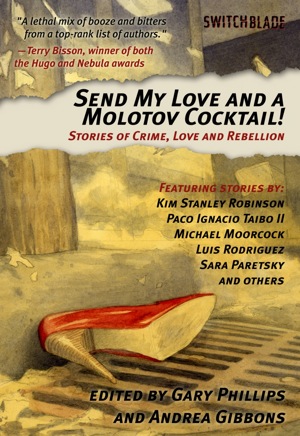
    The second is Send My Love and a Molotov Cocktail!: Stories of Crime, Love and Rebellion by PM Press, which had previously published the chapbook The Lucky Strike with the eponymous story and more in 2009. The collection includes Robinson’s short story “The Lunatics“, which is described as “a story of oppression and struggle deep in the bowels of the baleful Moon“.

    Thirdly, as a complement, the MIT’s acclaimed Technology Review published a special science fiction issue “inspired by today’s emerging technologies” with hard SF contributions from various SF authors like Ken McLeod or Cory Doctorow. The editor of the issue Stephen Cass had previously made a list of the kind of hard SF that inspired TR:SF, and included in it Robinson’s Mars trilogy.

    19 November 2011
  • Robinson in SF in SF

    Kim Stanley Robinson will be appearing with Cecilia Holland to be interviewed with fellow SF writer Terry Bisson in San Francisco for a reading and a Q&A later today (!).

    Details follow:

    Saturday, November 12th

    Kim Stanley Robinson & Cecilia Holland

    Each author will read a selection from their work, followed by Q&A from the audience moderated by author Terry Bisson. Booksigning and schmoozing follows in the lounge, and books will be for sale, courtesy of Borderlands Books

    6:00PM – doors and cash bar open
    7:00PM – event starts

    Suggested $5-$10 donation at the door – benefits Variety Children’s Charity of Northern California – to date, we’ve helped raise over $25,000 for the kids in our community!

    The Variety Preview Room Theatre
    The Hobart Bldg., 1st Floor — entrance between Quiznos and Citibank
    582 Market Street @ 2nd and Montgomery
    San Francisco, CA 94104


    12 November 2011
  • Coode Street interviews Kim Stanley Robinson


    Jonathan Strahan (editor of The Best Of Kim Stanley Robinson) and Gary K. Wolfe (professor and critic) conducted an interview with Kim Stanley Robinson during the last World SF Convention Renovation last August.

    The interview is available from their Coode Street Podcast (direct download).

    Robinson talks candidly about attending these annual Conventions, gives quite a bit of information on his next novel 2312, discusses writing his short stories, the themes he writes about, science fiction figures like Asimov and Wolfe (Gene, that is!), and writing in general. Well worth your time!

    Pictured: Strahan and Wolfe

    9 November 2011
  • Kim Stanley Robinson talk at University of Texas Dallas

    Kim Stanley Robinson will be giving a talk on “Valuing the Earth and Future Generations: Imagining Post Capitalism” at the University of Texas Dallas as part of a five-lecture series on Science, Policy and Cultural Values.

    When: 7:30pm, Wednesday November 16, 2011
    Where: Jonsson Performance Hall, UTD

    This public lecture is free and open to the public. You are also invited to join the Center for Values Fellows for this lecture for $45. Center for Values Fellows will have reserved priority seating, will receive the speaker’s recent book in advance, and will be invited to an exclusive reception and book signing after the lecture. Sign up for this lecture or you can sign up for the entire series.

    Climate change and population growth will combine in the twenty-first century to put an enormous load on humanity’s bio-infrastructural support system, the planet Earth. Kim Stanley Robinson argues that our current economic system undervalues both the environment and future human generations, and it will have to change if we hope to succeed in dealing with the enormous challenges facing us. Science is the most powerful conceptual system we have for dealing with the world, and we are certain to be using science to design and guide our response to the various crises now bearing down on us. A more scientific economics – what would that look like? And what else in our policy, habits, and values will have to change?

    As a photo for this article, the writer being a green European, it would have been too easy to put an oil rig. Instead, I’ve put an image from the Pickens Plan, an initiative by Dallas resident T. Boone Pickens towards a greener economy via renewables, energy conservation and natural gas. A solid and economically sound initiative!

    3 November 2011
  • Book event with Stan Robinson & Rudy Rucker: Podcast

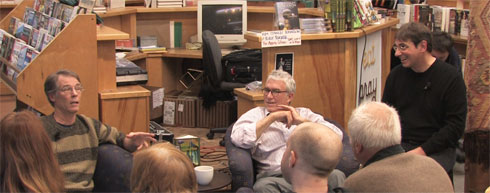
    As reported previously here, Robinson was featured in Rick Kleffel’s Agony Column interviews site along with fellow writer Rudy Rucker: “Seeing the Future with Kim Stanley Robinson and Rudy Rucker“. The live event at Capitola Book Café took place on June 4 at Santa Cruz. Says Rick Kleffel:

    The event actually started before the event, when we all gathered upstairs at the very low-key pizza joint next to the Capitola Book Café. My son, Dietrich, who was taping video of the event, joined Rudy, Stan, myself and a number of Rudy’s and Stan’s friends for a very nice, talkative meal. It set the tone for the evening.

    Setting up the event at Capitola Book Café is a different experience every time. Sometimes we sit on stools, sometimes on chairs behind as desk, but this time, Rudy and Stan literally made themselves at home in easy chairs, while I took a stool. It made for a very relaxed conversation.

    The hour-long full recording of the event, including both writers reading from their novels (Stan reads from the end of Galileo’s Dream), can be found here.

    8 October 2011
  • Art corner: Loruvani: Songs of the Maasai Steppe

    There is so much music out there! Man-made, of course, but so much of it sounds alien or even science-fictional to our Western, mass-media-fed ears.

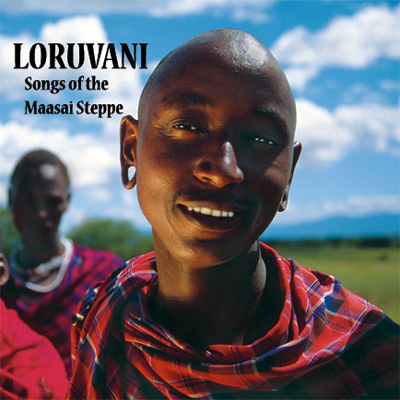
    Take for example traditional music from Tanzania, choral singing from tribes living in African savannahs, songs passed down orally and never put on record — until very recently! Impossible Music has released a CD of recordings of the “Loruvani Choir: Songs of the Maasai Steppe“.

    As CS says (he helped produce the record, and met Robinson when he was in Antarctica), a Westerner might not think of that music when he thinks “classical”, but it is certainly classical to the ears of the Maasai culture! Think twice of that when you read The Memory Of Whiteness and try to conceptualize its Orchestra!

    From the CD insert:

    Spiritual and uplifting, Maasai and Swahili gospel songs, based on ancient and traditional tribal tunes which float out of the heart of the sweeping African grasslands, are the roots of rhythm which will affect East African music for decades to come.

    These songs from the origin of the world will be as important and defining to East Africa as the Delta Blues were to America.

    They will combine with sounds coming out of the Congo to form something we haven’t yet imagined.

    It is possible to hear samples and purchase here.

    8 October 2011
  • Publication: Arena Journal: Changing the Climate

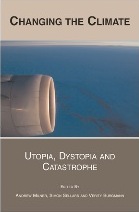
    Last year, Stan Robinson participated in the conference “Changing the Climate: Utopia, Dystopia and Catastrophe” at Australia’s Monash University. One year later, several of the talks given there have resulted in a publication by the Arena Journal: Issue 35/36 (2011) is dedicated on exactly this topic.

    Changing the Climate explores nature and environment, power and society, narrative and image in meditations on ecology, ecocriticism, science and speculative fiction, film and contemporary art. With a chapter by Kim Stanley Robinson.

    The paper in this issue cover a wide range of contemporary art, from literature to film. There is an entire section dedicated to Kim Stanley Robinson, appropriately entitled “Science in the Capital“! Apart from Robinson’s contribution, “Remarks on Utopia in the Age of Climate Change“, this part also includes a paper by Tom Moylan, “N-H-N’: Kim Stanley Robinson’s Dialectics of Ecology“, and another by Chris Palmer, “Free Exchange and Dark Secrecy in the Capital“. All three papers must be reworkings of some sort of the speeches they gave at the conference. The abstracts are accessible via the above links.

    The Arena Journal has massively published on utopias and the future previously: Issue 25/26 (2006) was dedicated to “Imagining the Future: Utopia and Dystopia” and Issue 31 (2008) was dedicated to “Demanding the Impossible: Utopia and Dystopia“.

    8 October 2011
  • The Davis Enterprise interviews KSR

    The Davis Enterprise, the local newspaper for Davis, California, the city where Kim Stanley Robinson lives, recently interviewed Robinson.

    On Galileo’s Dream, “I had this image of him [Galileo] flying through a telescope to Jupiter. In a sense, I came to Galileo almost backwards, because I didn’t know about him 20-30 years ago. But I got to be very fond of him.“

    On 2312 that’s coming out next year, “It’s an attempt to discuss the human world 300 years from the publication date“.

    On e-books vs physical books, “I personally prefer to read physical books“, but “I’ve talked to people who’ve said they’ve read ‘Galileo’s Dream’ on their iPhone. It’s all text, and it really doesn’t matter what the format is.“

    …and various other topics.

    Photo of the Arboretum at Davis by Allan Jones

    2 August 2011
  • In Galileo’s footsteps

    Recently, a few days of holidays brought me to Firenze, better known as Florence, in Tuscany, Italy. It is well known to be a city full of art and history, however this touristic title does not prepare you for the wealth and beauty to be found in every street, in every carved door, in every Renaissance building. Or you might just find the Catholic imagery too repetitious. In Galileo’s time, Florence was also famous for its lenses and optics!

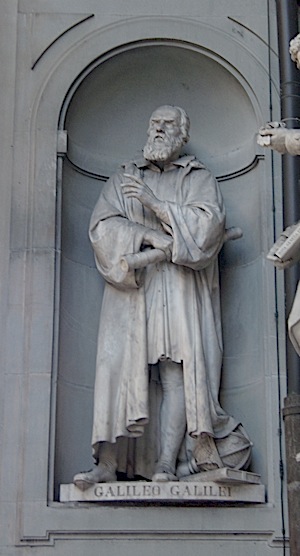
    If we’re talking about it here, it’s because Florence is famous for having hosted Galileo Galilei during the greater part of his life, as seen in Galileo’s Dream. Galileo is everywhere in Florence; statues and busts of him and other famous Florentines are abound. The statue on the right is from the loggia of the Uffizi Gallery.

    ~

    Galileo was born in adjacent Pisa, which was also part of the Duchy of Florence, and received his education in the Florence region. At age 28 he moved out to Padua. He returned 18 years later, in 1610, when his observations with his telescope earned him a patronage by the Medici, the great ruling family of Florence.

    “In Florence, Galileo had hastily rented a house that was a bit too near the Arno, but it had a little roof terrace for his night viewing, what the Venetians called an altana, and he figured he could find a more suitable establishment later.” — Galileo’s Dream, Ch.IV

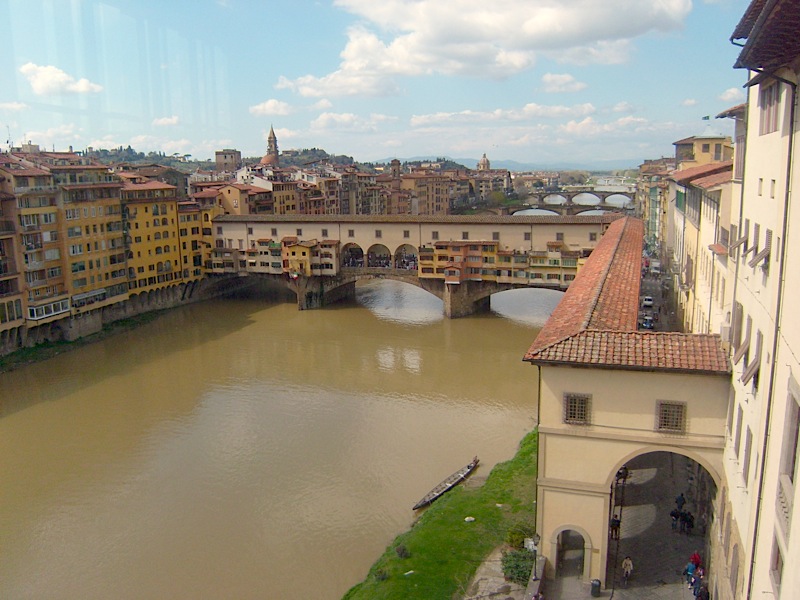
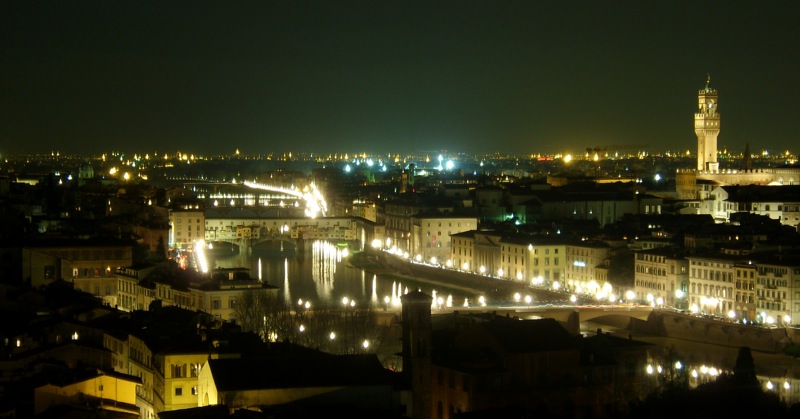
    The Arno runs through Florence and many narrow bridges cross it in the city centre. The old shops on Ponte Vecchio have been kept, like shops on bridges that existed in Paris, although they no longer trade meat but expensive jewels.
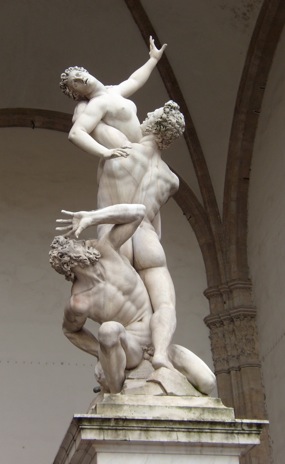
    Next to Ponte Vecchio is the Uffizi Gallery, the Palazzo Vecchio, the Piazza della Signoria with its many statues — all of them from the Medici period immediately before Galileo’s time — out on the open air, giving the place a magnificent otherworldly feeling. Below, Giambologna’s “Rape of the Sabine Women”.
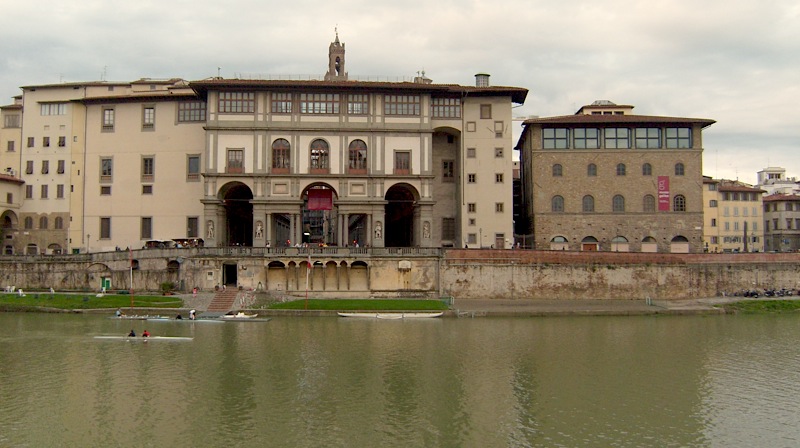
    Adjacent to the Uffizi Gallery (left) is the Institute and Museum of the History of Science (right), known since its renovation in 2010 as Museo Galileo. Galileo’s original telescope and manuscripts are there! Far from covering only Galileo, through objects collected by the Medici and the Lorense, the museum traces centuries of scientific discoveries and evolution in scientific instruments. No pictures allowed.
    In 1617, Galileo moved to the Villa di Bellosguardo (known as Villa dell’Ombrellino since 1815). He lived there till 1631.

    “On its hill, with a good prospect down onto the city, one could sit and rest, and observe the valley of tile rooftops and the great Duomo that appeared to sail east in the midst of a fleet.” — Galileo’s Dream, Ch.X

    Indeed, the view to Florence is wonderful.
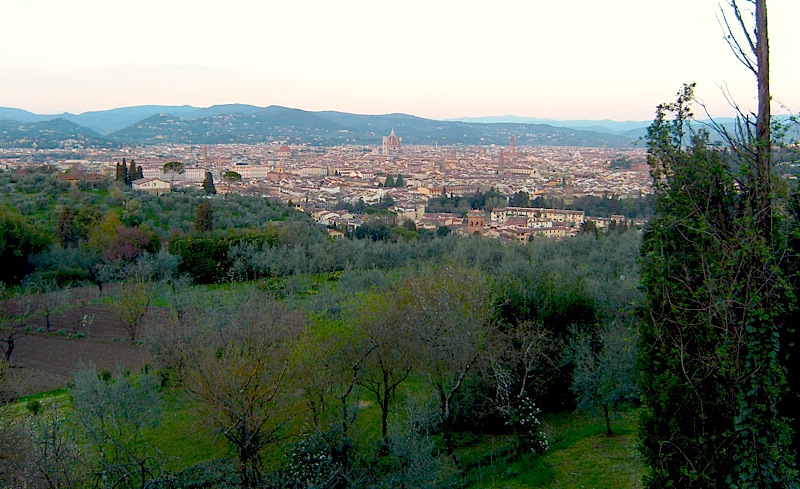
    Approaching Bellosguardo, one can see the mix of urban and rural, typical of many italian cities. Right next to a dense urban centre, hillsides are still cultivated. The Bellosguardo villa can be seen on the hilltop.
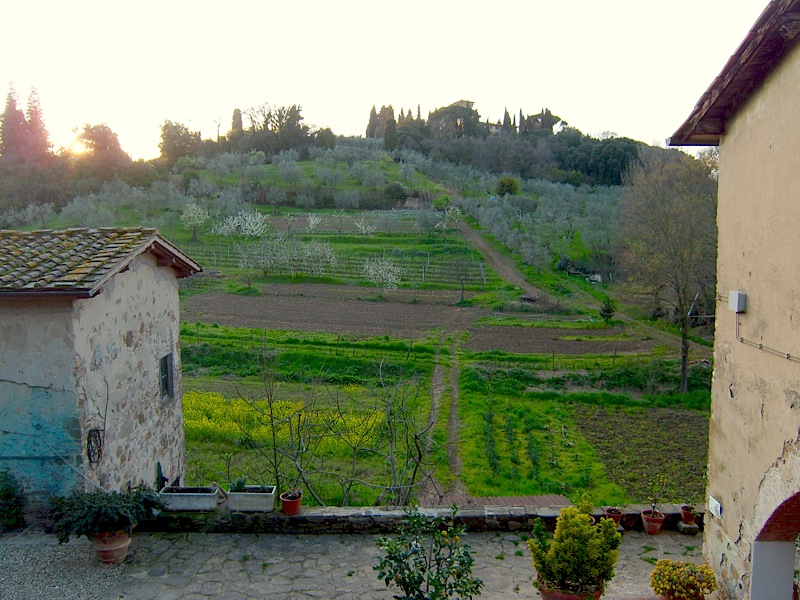
    The villa was host to many other historical figures, such as James Fenimore Cooper and Ugo Foscolo. The villa itself, presently a hotel and events centre, is closed to the public.

    In 1631, Galileo moved to Arcetri, now a suburb of Florence, at the time a different village altogether, in the hills west of the city. He was to be confined there till the end of his life.

    “While he was gone, Maria Celeste had found a suitable villa for rent in Arcetri, called Il Gioiello, the Jewel. The rent was only thirty-five scudi a year, much less than Bellosguardo’s hundred, because it was so much smaller, and in a less convenient location. […] Galileo was particularly happy with the new house. From his bedroom window on the second floor he could look down the lane and see the corner of the convent of San Matteo. He could visit every day, and he did.” — Galileo’s Dream, Ch.XV
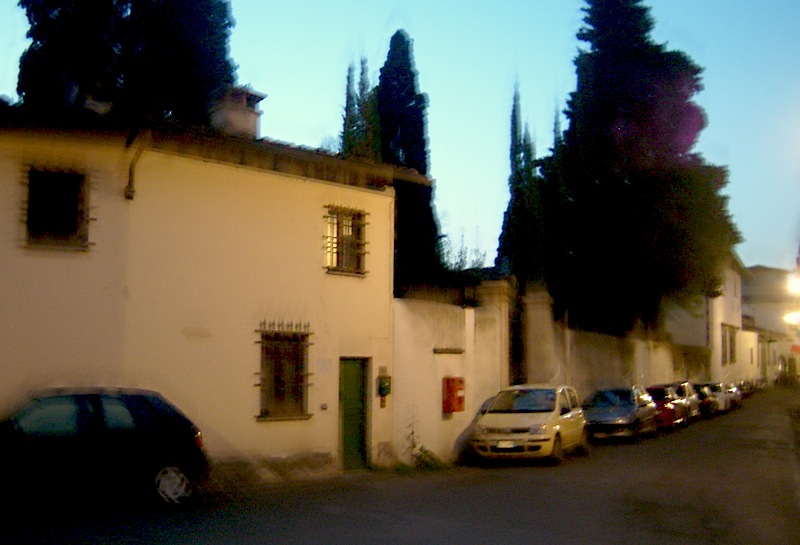
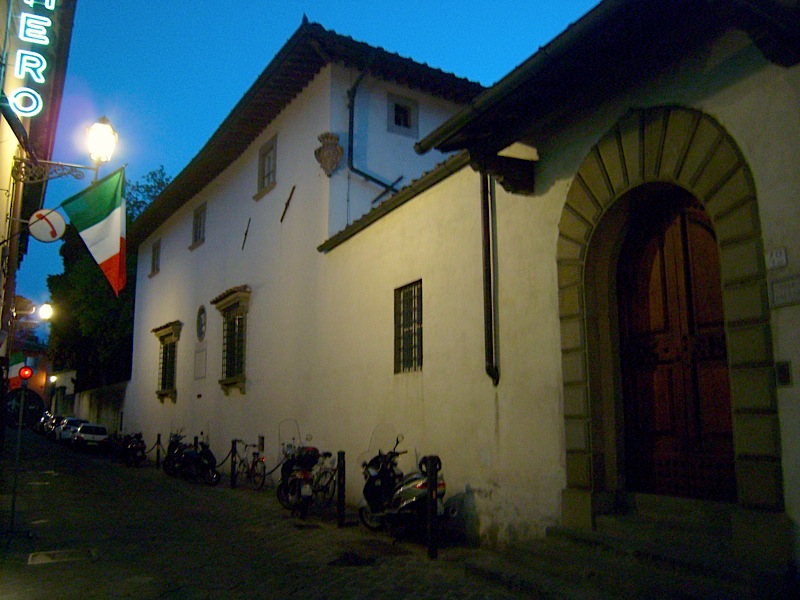
    These views are from the street; on its front side, the villa is complete with a garden and a hillside view. The convent of San Matteo, where Galileo’s two daughters were, is literally around the corner. The convent has since been rebuilt and no original buildings survive. “Il Gioello” is inaccessible because it still is a private property (!) but a visit can be obtained with the municipality, it seems. In 1872, an observatory was built in Arcetri, because of the clear view and because of the symbolic proximity to “the Jewel”.

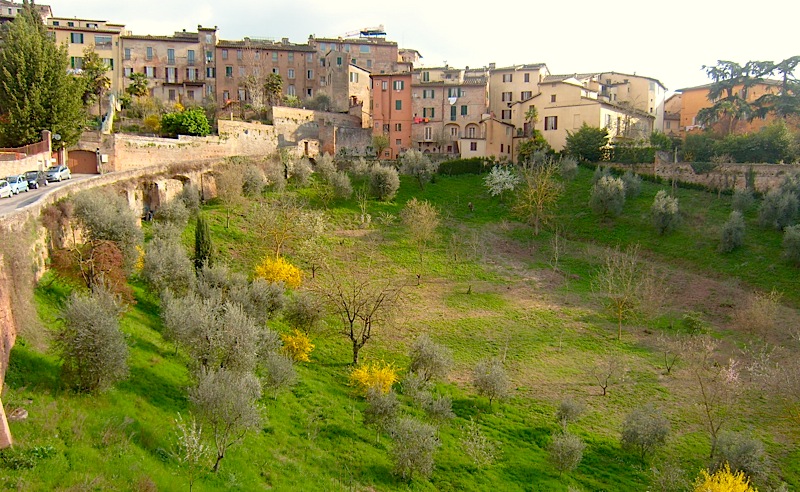
    Siena is only some 70km from Florence towards Rome. Travellers would stop there on their way to the powerful city. After his trial in 1633, Galileo stayed there at the hall of an ex-student of his, Ascanio Piccolomini. Siena, in the middle of a wine-producing region, exhibits that same mixture of urban and rural as many parts of Tuscany.
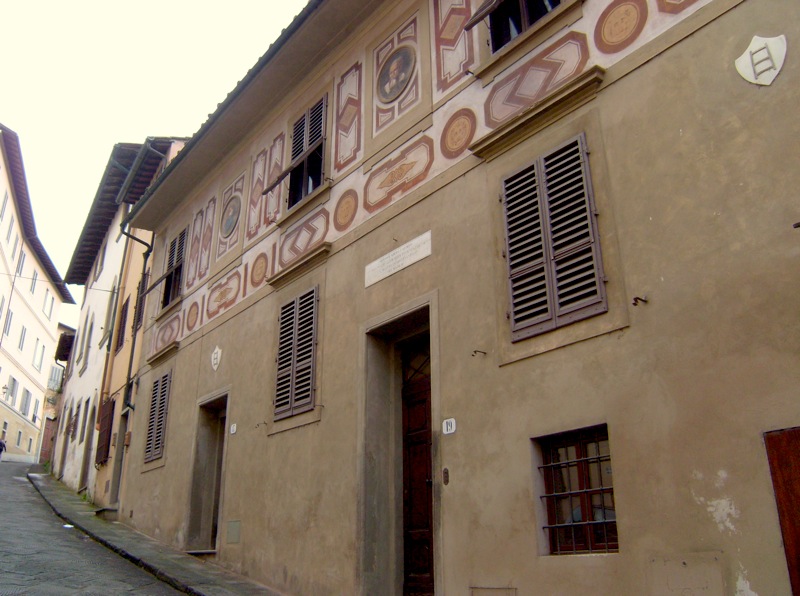
    In Florence, closer to the Arno, is a house presently called Casa di Galileo, complete with portraits of him and his daughters on it, although Galileo himself lived there for a very short time in the last years of his life, when he had to go to Florence to be visited by doctors. His son Vincenzo and his family lived there.
    Galileo died in 1642 in his house in Arcetri. He was buried in the church of Santa Croce, which hosts the remains or dedications to many other famous Florentines, such as Dante, Macchiavelli, Michelangelo, Marconi, Fermi…
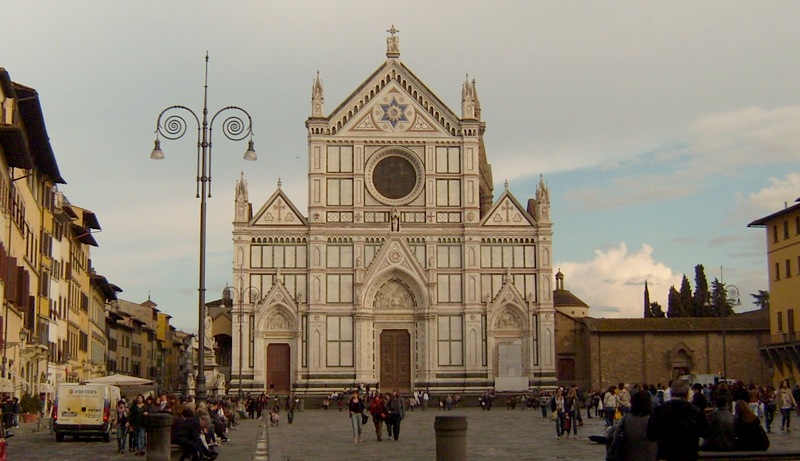
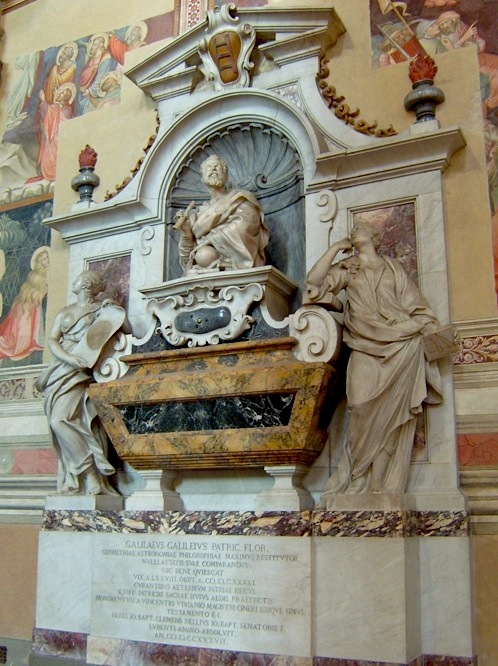
    Galileo’s tomb was erected in 1737 with funds of his disciple Vinenzo Viviani, also buried there (so is Galileo’s daughter Maria Celeste, though this is not mentioned).

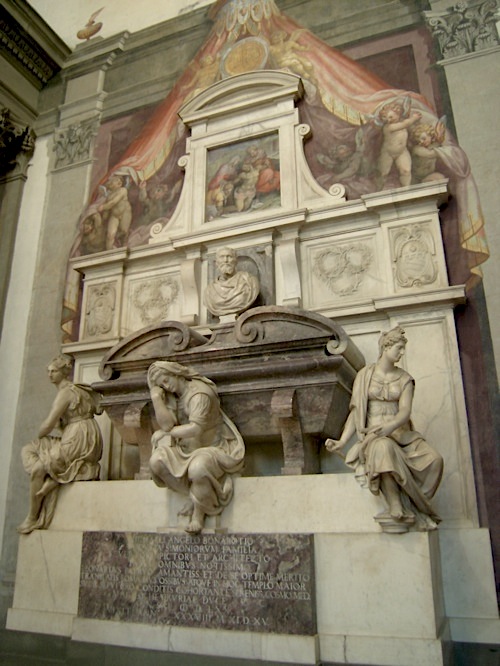
    “He paid for the design of a monument, to be located in San Croce across from the tomb of the great Michelangelo; their tombs would then make a matched pair, Art and Science together holding up the Church.” — Galileo’s Dream, Ch.XX

    Galileo’s tomb is bordered by two female statues, representing Astronomy and Geometry.
    Across from him is indeed Michelangelo.
    There is a huge number of text and photographic material around Galileo and Florence available on the internet. These photos are personal, but I’m sure more and better can be found. There are also other Galileo-related sights in Florence too: Villa delle Selve (his friend Saliviati’s villa); the church of Santa Maria del Carmine (where his mother lived and is buried); Villa of Marignolle (a Medici villa where he was often a guest); churches where friars denunciated Galileo’s work; Florence’s National Library (with the biggest collection of Galileo manuscripts)… It’s nice browsing through this material, and other artwork from the period, to immerse oneself in the period. See these itineraries here; the Italian version is fuller; the Museo Galileo (with a virtual museum for those who can’t make it) and its Galileo Portal (with a big photo gallery and Galileo’s works in scanned format).

    “I want to know everything!” — Galileo’s Dream, Ch.IX
    2 August 2011
  • Kim Stanley Robinson in Renovation

    Kim Stanley Robinson will be participating, along with a host of other people, in “Renovation“, the 69th World Science Fiction Convention, taking place from Wednesday Aug 17 to Sunday Aug 21, 2011, in Reno, Nevada, USA.

    In the ‘Worldcon’ is awarded the annual Hugo Award, among others. Candidates for the Best Novel Hugo this year are:

    • Blackout/All Clear by Connie Willis
    • Cryoburn by Lois McMaster Bujold
    • The Dervish House by Ian McDonald
    • Feed by Mira Grant
    • The Hundred Thousand Kingdoms by N.K. Jemisin

    Kim Stanley Robinson was the Guest of Honor in last year’s WSFC in Australia, “Aussiecon 4“, extensively covered on KSR.info (here and here and here and yet here and here again!).


    UPDATE Aug-14-2011

    Kim Stanley Robinson’s appearances in Renovation

    • Friday 19/08

    Autographing

    Robin Hobb , Lucienne Diver , Carol Berg , Sharon Shinn , Sean McMullen , Patricia Briggs , Kim Stanley Robinson , Martha Wells

    Reading: The Future of Cities

    Ian McDonald , Gary Ehrlich , Cory Doctorow , Lauren Beukes , Kim Stanley Robinson

    Our panel discusses the challenges facing urban populations around the world and how they translate into interesting story settings.

    • Saturday 20/08

    Appreciating Nature in Fiction and Non-fiction

    Kim Stanley Robinson , Laurel Anne Hill , Scott Slovic , Takayuki Tatsumi , Ty Franck

    Science fiction can often treat nature, even an intriguing alien environment, in a very sterile manner. By contrast, both fantasy and nature writing often celebrate nature and make the reader want to run outside and explore. How can writers use the language of nature writing to help bring alien countrysides to life? What are some of the good and bad examples of writing about the great outdoors in science fiction, fantasy and nature narratives?

    Ursula K. LeGuin at 80

    Eileen Gunn , Sheila Williams , Jo Walton , Kim Stanley Robinson

    Ursula LeGuin, one of the most important SF and fantasy authors of the last 50 years, is now in her 80s. The panel discusses and celebrates her contributions.

    • Sunday 21/08

    KaffeeKlatsch: The Sierra Nevada Mountains

    David Brin , Tim Powers , S. M. Stirling , Kim Stanley Robinson

    Just outside of Reno are some of the most beautiful mountains in the world. Kim Stanley Robinson shares some of his adventures of mountain climbing in the Sierra Nevadas.

    28 July 2011
  • KSR in deutsche “Gen-ethischer Informationsdienst”

    Für unsere deutschen Freunde und Leser: ein spezielles Interview von Kim Stanley Robinson für die zweimonatlich erscheinende deutsche Zeitschrift “Gen-ethischer Informationsdienst” (GID 206, Juni 2011), die eine breite Palette von biotechnischen, landwirtschaftliche und medizinische Themen in Bezug auf Wissenschaft, Politik, Forschung, Wirtschaft und Ethik behandelt.

    In der Science in the Capital-Trilogie (die noch nicht in deutscher Sprache noch nicht übersetzt!), der Charakter Frank Vanderwal beobachtet das Alltag, Frank beobachtet das menschliche Tier-und Zootiere sowie, und wundert sich über die menschliche Natur. Er vertieft sich in Soziobiologie und Evolutionäre Psychologie und entscheidet auf der Grundlage dieser Theorien handeln.

    Die Verwendung dieser Theorien in ein Werk der Fiktion war der Grund für dieses Gespräch.

    Das Interview ist online verfügbar, und es ist auch nur erhältlich in Deutsch. So viel Spaß!


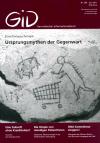
    An interview with Stan on sociobiology and evolutionary psychology (see the Science in the Capital trilogy) for the bi-monthly German journal “Gen-ethischer Informationsdienst” (“Gene-ethical informations service”) is available on-line — but only in German! There are always online translators, however perfectible… The magazine covers biotechnical, agricultural and medical topics and how they relate to science, politics, research, economy and ethics.

    The image is the lovely cover of the issue: cave paintings-like “primates in a supermarket” (to illustrate another article by Dr. Uwe Wendling, who also interviewed Stan).

    28 July 2011
  • Gerry Canavan/Kim Stanley Robinson: Call For Papers + Polygraph 22

    Call For Papers for a collection edited by Duke University’s Gerry Canavan and UCSD’s Kim Stanley Robinson:


    CFP for edited collection: Green Planets: Ecology and Science Fiction
    Editors: Gerry Canavan and Kim Stanley Robinson (ecologyandsciencefiction@gmail.com)
    Abstracts due August 31, 2011

    Final essays due Summer 2012

    We are seeking proposals for an edited collection tentatively titled Green Planets: Ecology and Science Fiction, with completed essays due in Summer 2012. We seek contributions that touch on any aspect of the relationship between ecological science, environmentalism, and SF, with particular attention to such topics as:

    * ecological futurity and ecocriticism in SF
    * visions of eco-disaster, eco-catastrophe, and eco-apocalypse
    * strategies for ecotopia
    * “the globe” and global thinking in SF
    * science fictional critiques of global capitalism, consumerism, and ecological racism
    * social justice as an ecological technology
    * narratives of political resistance
    * SF as it figures within current public debate about ecological science (climate change, Peak Oil, etc)
    * philosophies and fantasies of Nature
    * narratives of evolution, extinction, and extermination
    * eco-feminist SF
    * reproductive futurity
    * ecology and Afrofuturism
    * ecology, digitality, and techno-optimism
    * terraforming and other narratives of space colonization
    * aliens, alien worlds, xenobiology, and exo-ecology
    * ecological thinking as a strategy for cognitive estrangement
    * ecological critiques of particular unscientific or anti-ecological science fictions, or critiques of the history of the genre as a whole

    We hope to produce a collection that speaks to the long history of ecological SF, ranging from the climate change that prompts the Martian invasion in War of the Worlds to Oryx and Crake, The Wind-Up Girl, Avatar, and WALL-E (and everything else before, after, and between). We likewise intend “SF” in its broadest possible sense, to include fantasy and horror literature alongside “science fiction” more narrowly construed, and hope to receive submissions that properly reflect SF as a diverse and global genre.

    Please direct all queries, questions, and submissions to ecologyandsciencefiction@gmail.com. Abstracts should be around 250-300 words; submissions should also include contact information and a short bio. Please plan for final essays to range between 4000-8000 words.


    Speaking of which, I just realized a significant omission! Following Stan Robinson’s talk at Duke University in January 2010 (covered in KSR.info here), in September 2010 was published Polygraph #22, which included an extensive interview of Robinson by Gerry Canavan, Lisa Klarr and Ryan Vu: “Science, Justice, Science Fiction: A Conversation with Kim Stanley Robinson“.

    The interview is freely available on Gerry Canavan’s blog (also in PDF format)! It covers a lot of ground: politicizing science, science and capitalism, social justice, democracy, Obama (the interview was conducted in the spring of 2009), the left, environmentalists, science fiction and utopia, … At 17 dense pages, this is one of the most comprehensive and in-depth interviews of Robinson around, recommended reading — this will will keep you busy for a bit!

    How, in your view, can democracy be put to work in service of social and environmental justice and responsible governance?

    This must be a whole program with reforms all across the board. Complex and messy, it would (or will) take many years in many jerks and starts. But it would begin with electing representatives who have promised to work on it, and then holding them to it in subsequent elections, for a long time, until a pattern was built and a certain trajectory or path dependency set into place. A very difficult assignment.


    25 July 2011
←Previous Page
1 … 7 8 9 10 11 … 14
Next Page→

Upcoming Events

Notice
There are no upcoming events.
0 events found.

Events

Notice
There were no results found.
Notice
There were no results found.

Events Search and Views Navigation

Event Views Navigation

  • List
  • Month
Today
  • Today
  • Google Calendar
  • iCalendar
  • Outlook 365
  • Outlook Live
  • Export .ics file
  • Export Outlook .ics file

KimStanleyRobinson.info

The reference site for Kim Stanley Robinson

  • Who is KSR?
  • Stan’s Favorites
  • About & Contact
  • Bibliography
  • List of interviews
  • Forum
  • Events

This is not an official website for Kim Stanley Robinson. To contact this website, send an e-mail to postmaster [at) kimstanleyrobinson.info – To contact Robinson or his publishers, visit the official Kim Stanley Robinson Facebook page – To inquire about a speaking engagement with Kim Stanley Robinson, contact the Hachette Speakers Bureau

Twenty Twenty-Five

Designed with WordPress