















Skip to content

KimStanleyRobinson.info

The reference site for Kim Stanley Robinson

  • Who is KSR?
  • Stan’s Favorites
  • About
  • Bibliography
  • Forum
  • 21 April 2024

    Musing about optopias

    Musing about optopias

    First of all, some sad news. Terry Bisson, fellow Bay Area science fiction author and friend of KSR, passed away recently. Coincidentally, KSR had recently chimed in about Bisson in a New Yorker profile. He also wrote an appreciation for Bisson in February’s issue of Locus.


    The High Sierra

    We first start with things around the non-fiction The High Sierra: A Love Story, because we don’t talk enough about it!

    KSR was interviewed about it by the US Times Post: Sci-fi novelist Kim Stanley Robinson talks ‘The High Sierra’

    There are many places on this planet that are incredibly beautiful and adorable. You don’t have to burn a lot of carbon to have a good time. The basics of Paleolithic contentment remain the same within us and are readily available. The technological sublime is indeed sublime, but like a drug rush – it’s expensive and can be tiring. The ordinary pleasures are better all around. Walking is one of those pleasures – we evolved to walk better! And hiking in the mountains is fun, but so is hiking in the city or pretty much anywhere else.

    He spoke to The Tahoe Weekly: A science fiction writer’s love affair with the High Sierra 

    He discussed at the UC Davis Tahoe Environmental Research Center (YouTube video)

    He spoke to the Pacific Zen Institute‘s podcast on The High Sierra: The Zen Luminaries

    The High Sierra also won some awards! Here they are, with short online KSR interventions:

    • Commonwealth Club: 92nd Annual California Book Awards (award ceremony video on YouTube)
    • California Independent Booksellers Alliance: Golden Poppy Awards: Glenn Goldman Award: California Lifestyle  (award ceremony video on YouTube)

    Some book excerpts are available:

    On John Muir, along with various other KSR quotes on John Muir:

    The flooding of Hetch Hetchy was a knife thrust into the heart of the wilderness movement. […] But the war is never over. And as I looked down on the scene that misty evening, I saw the water drain away. It will happen someday. There is no rush about this, and given the emergency century we are entering, it isn’t even close to the highest priority. But put it this way: if civilization gets itself in a balance with the planet, a day will come when we will drain that misbegotten death lake and let the valley go back to the way it was. It will be one of the greatest experiments in landscape restoration ever conducted.

    A 1988 poem by KSR is included in the book: Night Poem:

    Writing by starlight
    Can’t see the words
    Fill a page
    Nothing there

    Waterfall distant sound
    Tree against stars Milky Way
    Juniper Jupiter white rock
    Wind dying my heart
    At peace a Friday night

    Big Dipper sits on the mountain
    Friends lie in their tents
    I sit against rock
    Star bowl spinning overhead
    Feel the movement
    And soar away

    Who knows how many stars there are
    All those dim ones filling the black
    Until it seems no black is there
    And then you see the Milky Way

    The sky should be pure white with stars
    That’s black dust up there
    Blocking the view
    Carbon and hydrogen
    All of us flung together

    In just this way
    A blank white page
    I write and then
    A blank white page
    Story of my life!

    Some recommendations for The High Sierra at The Atlantic, Visit California, and University of California.


    The interviews

    Now, on to the usual long list of interviews with Kim Stanley Robinson which are mostly about The Ministry for the Future — catching up with several that I missed the last time, too, approximately chronologically:

    KSR was interviewed for the inaugural issue of Solarpunk Magazine!

    Interview at The Great Simplification podcast: Climate, Fiction, and The Future

    Interview at the Rising Tide podcast: KSR’s Science and Fiction

    (Print) interview by Liz Jensen at Writers Rebel (of Extinction Rebellion): Q&A with KSR

    We now need public action (government) to be driving all private actions that are relevant to the crucial project; what work gets paid for and done, what consumption patterns are allowed, etc.  This is not ‘green fascism’ any more than the Allied response to Nazi aggression was ‘democratic fascism’; it’s more a case of democratically approved coordinated public action in strong support of the public good.  Legal action is needed for that.   But it’s also an “all hands on deck” situation now, so no one solution will suffice.   We need action across all fronts of society. 

    (Video) interview with Grist’s Looking Forward, following their book club on Ministry for the Future: “At least zombies aren’t eating my face” (video on Vimeo)

    At a certain point, dystopia has run its course of what it can do usefully. So then you need the positive stories. I’ve been writing utopias since about 1987, so that’s adding up to a lot of years of just trying to do the positive because I think we need it more. And it’s harder, technically — it’s less dramatic. But it’s interesting because you get new stories that haven’t been told before.

    KSR appearance at the 2023 Learning Planet Festival (YouTube video replay) 

    Interview by Madrid’s La Casa Encendida: Nuevas ecotopías para estos tiempos (YouTube video, dubbed-over in Spanish)

    KSR lecture at the University of San Diego’s Kroc School Institute for Peace and Justice: KSR Talks Climate Change (YouTube video) (also in the podcast Is The World On Fire?)

    UC Davis Environmental Humanities: “Ministries for Future” – Donna Haraway and Kim Stanley Robinson (video) (+ Davis Vanguard article on the event)

    New Hope Network has some highlights from KSR’s appearance at the 2023 Natural Products Expo West for Climate Day: Science fiction offers roadmap for our planet’s future

    BC Heights has some highlights from KSR’s appearance at the Boston College Lowell Humanities Series: Robinson Outlines Ways To Fight the Runaway Greenhouse Effect

    KSR talked again at the Bioneers conference and gives an update: What I’ve Learned since The Ministry for the Future Came Out in 2020 (YouTube video)

    KSR was at two events hosted by the College of the Atlantic in Bar Harbor, Maine, here are the recordings on YouTube: Coffee & Conversation: Sci-fi and Our Climate Reality and Summer Institute: Space: Our Last Great Commons

    KSR was interviewed by Bloomberg along with a TV writer and a podcaster on: How to Write a Climate Thriller Fit for Page or Screen

    “Dystopia is too easy,” Robinson says. “It’s even a kind of comfort food, where we imagine situations worse than ours, and then rest comfortably that we’re not that bad.”

    To avoid writing futures so optimistic they beggar belief, Robinson borrows a concept from the sci-fi author Joanna Russ: the “optopia.”

    “It’s not the utopia — the no place, the perfect place,” Robinson says. “It’s the optimum that we can do given the situation that we’re handed. If we dodge a climate catastrophe and a mass extinction event in this century, that’s a utopian story.”

    KSR was interviewed by the Centre for Science Futures‘ new podcast series in partnership with Nature: “Science as a political and ethical project” (see also Nature for a shorter version, with transcript).

    While in the Netherlands, KSR spoke at the John Adams Institute: Kim Stanley Robinson and the Fight for Planet Earth (YouTube video), along with environmental scientist Heleen de Coninck and author Lisa Doeland.

    KSR appeared on a short video by PBS Terra on Geoengineering

    Hot Globe interviewed KSR: The Future of the Future (partly paywalled)

    It isn’t going to be machinery that solves our problems. But on the other hand, it is going to be technology because language is a technology. Justice is a technology, law is a technology. They’re software. And so any argument against technology misunderstands human beings. We were technological before we were human. We had fire. We had stone tools. We co-evolved with our technologies. And language is the crucial one. And I would agree with those people who say the crucial technologies right now are political economy and finance.

    KSR was interviewed by the Possible podcast, on Ministry but also Aurora, Galileo’s Dream and more: KSR on the Future of Civilization (on Spotify) + a transcript on their site

    One of the things that has gotten stronger for me as the last 40 years have passed is a conviction that humanity coevolved with Earth. It will never prosper off of Earth. Our trips off of Earth are trips into the death zone, which is what climbers call the elevations above about 26,000 feet, where the body starts to break down […] this information that now is common—50% of the DNA inside your body is not human DNA. Well, this is news, and it changes everything. Because you can’t take Earth with you when you go off, even to the moon or Mars, much less off into interstellar space, where I have actually written an entire novel suggesting we’re not going to the stars because we coevolved with Earth, and we’re only healthy here. And in my solar-system novels—where you can see some from the mid-eighties and some from the last 10 years—you’ll see a shift in that in the ones in the last 10 years, people always have to go back to Earth for their sabbatical. They have to go back and eat some dirt. They have to get connected with the biosphere of Earth, which is their extended body, in order to be healthy again.

    KSR talked to the Carnegie Council for Ethics in International Affairs: Why does the world now need to consider solar radiation modification? (YouTube video)

    The Economist interviewed KSR and Laurence Tubiana on the the need for fiction about climate change on their podcast Babbage: Climate fiction meets climate fact (on Spotify)

    The Science in The Fiction podcast does one writer and one scientst episode: KSR talked about Ministry (on Spotify) and glaciologist Heidi Sevestre talked geoengineering

    Sam Matey’s The Weekly Anthropocene interviewed KSR: Kim Stanley Robinson, Science Fiction Maestro and Utopian

    When I look at the timeline of Ministry for the Future I’m very pleased to report that there are some sentences in it that no longer conform at all to reality as it’s going. One chapter begins, “the 2030s were zombie years.” And that is now wrong! […] it’s going so much faster that I think the timeline in Ministry for the Future is completely off.  We’re already in the ferment that in my novel I have happening in the 2040s.

    The Everyday Anarchism podcast continued its coverage of KSR’s works with the Mars trilogy and an interview with KSR: Revolution and Anarchism in The Mars Trilogy

    The Futurists podcast talks with KSR on his Mars trilogy, economics, world building, science and climate: Minister for the Future (Part 1 and Part 2) 

    Berkeley Talks podcast…talks with KSR: Sci-fi writer Kim Stanley Robinson on the need for ‘angry optimism’ (including a transcript)

    Having put a climate disaster that kills millions in India, I felt obliged to India. I needed to stay there. I needed it to be the solution and not just an excuse for an American to put the problems on the other side of the world and then we solve them. I needed Indians involved in solving it. They are in huge danger from a wet bulb event, although one of the hottest wet bulb events ever recorded was outside of Chicago. 

    So it isn’t like we’re not in danger, but India’s in real danger. I mean more present, more immediate. And I wanted to stick with them. And the book has been well-received in India. I mean, aside from the occasional hate mail from BJP party nationalists, but by and large, the Indians have said to this book, “Oh yes, Farhanji is finally understood. We are the center of the story and we’re going to solve the problem here.” 

    Radio Ecoshock / podcast interviewed KSR about Ministry and The High Sierra: Climate Sci-Fi Gets Too Real

    KSR gave a lecture at Stony Brook University for its special series on climate change, and the whole thing is on YouTube.

    And finally (for now!), Palma podcast interviewed KSR: What We Imagine, We Make Possible (on Spotify)


    The rest 

    We continue with some additional material:

    The book clubs discussing Ministry for the Future continue with Trinity College Dublin and South Burlington Public Library (Vermont).

    Recommendations continue with The Conversation (Five fiction books to inspire climate action), The New York Times (This Is the Way the World Ends; paywall), The National (Earth Day: 12 novels to read with an environmental protection theme), The Seattle Times (Dig into these 4 books for Earth Day), and The Washington Post (10 books that will transform how you see nature, paywall), where Nnedi Okorafor writes:

    I read “The Ministry for the Future,” by Kim Stanley Robinson, as I was in the process of moving to Phoenix. The novel starts with a deadly heat wave in India. Issues of water shortages and extreme heat were very much on my mind. I knew of Phoenix’s brutal summers, but was yet to experience one. The stark step-by-step details of this catastrophic event that leaves millions dead was such a terrifying read that it nearly gave me a panic attack. I had nightmares. After reading the first part, I went on to take some very aggressive (and expensive) precautions. “The Ministry for the Future” opened my eyes wider to how the Earth is changing and alarmed me in a way that only great science fiction can.

    Reviews and articles inspired by Ministry:

    • Henry Farrell on Ministry‘s political economy (in response to the NYT article above)
    • Adventures with Psychologists: Tim Hall of Yale ’62 discusses Ministry
    • Ben Shread-Hewitt (on Resilience.org) reviews Ministry and Stephen Markley’s The Deluge
    • Once more the heat waves are upon us, and this opinion on Aljazeera mentions Ministry


    What’s next? KSR’s next non-fiction book on Antarctica, in the same style as The High Sierra, is due out soon-ish — he is turning it in to his publisher in July.

    It’s structured like my book The High Sierra: A Love Story— the same format, in that it will have a variety of modes, including lyric realism as you called it, memoir, history, geology, and this case, glaciology. I’m enjoying this kind of modular miscellany, or just the kitchen sink principle— just throw in everything.  It helps me to do non-fiction.

    And KSR will soon be heading to northern Italy, as he will be one of the residents of the Rockefeller Foundation Bellagio Center!

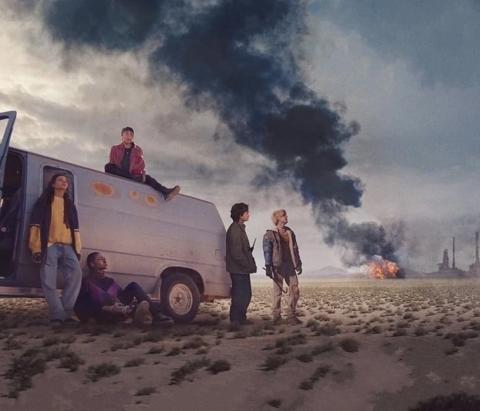
    (Top image: from the poster of the fiction film How To Blow Up A Pipeline, inspired by Andreas Malm’s non-fiction book)

  • 6 February 2024

    Ministry still riding the (heat) wave

    Ministry still riding the (heat) wave

    “Article 14 of the Paris Agreement Under the United Nations Framework Convention on Climate Change called for a periodic taking stock of all the signatory nations’ carbon emissions, which meant in effect the total global carbon burn for the year in question. The first “global stocktake” was scheduled for 2023, and then every five years after that. That first global stocktake didn’t go well.”

    Thus begins Chapter 3 of The Ministry for the Future. But it could very well be a headline of the coverage of COP28 in December 2023, in our very real world! 2023 was the hottest year of the Anthropocene, and the heat wave kicking off Ministry makes it a timely and obvious starting point for discussing these issues.

    Kim Stanley Robinson has been talking tirelessly about Ministry for the past three years now with no sign of slowing down! In November, he visited several countries in Europe.

    Dutch editor VPRO produced this nice short video that can serve as a layman’s introduction to KSR and to Ministry (some parts are in Dutch but they are short): “Voorbij de klimaatcrisis met Kim Stanley Robinson”

    While in Rotterdam, he was interviewed by the Financial Times (with a lot of detail about the menu!): “If the world fails, business fails“

    Robinson tells me he has been invited to meetings about the future with central bankers and defence department officials, as well as associations of hedge fund managers, although he can’t share their names. “They don’t want to shake the confidence of the world by telling [everyone] that they’ve been consulting with a crazy science-fiction writer . . . They thought it might shake the stock markets.”

    In Switzerland, Stan gave a talk at ETH Zürich (which has been featured in a few of his works): see a report with photos from that event.

    Also in Switzerland, he gave a talk at the World Trade Organization, together with WTO Director-General Ngozi Okonjo-Iweala: “Harnessing the Power of the International Trade System to Respond to the Climate Crisis” (panel on YouTube)

    In Germany, the German translation of Ministry was awarded the Carlowitz Sustainability Award (named after the “father” of sustainable forestry), see also publisher Heyne press release.

    Several of Stan’s interviews in French media are very interesting — going beyond just talking about the issues around Ministry but more in general about his influences, his view on literature and science fiction, looking back on his career… Material in English is noted below.

    Interview at Blast (alternative media): “Un ministère du futur face à l’urgence climatique” (in English):

    Interview at the podcast C’est plus que de la SF (“it’s more than science fiction”): “Le Ministère du Futur par Kim Stanley Robinson” (in English)

    Interviews for purely French speakers:

    • Podcast at Le Book Club of France Culture (public radio): “Kim Stanley Robinson et le monde de demain” (all-French)
    • Reporterre: “Chaque milliardaire est un échec politique” (“every billionaire is a political failure”)
    • Libération: “Ce roman fait de moi une sorte de ministre du futur” (“this novel makes me a sort of minister of the future”)
    • Usbek & Rica: “Chaque milliardaire est un échec politique” (“every billionaire is a political failure”) & “Le changement climatique s’est emparé de la science-fiction de futur proche” (“climate change has taken over near-future science fiction”)
    • La Croix: “L’utopie est l’espoir de notre temps” (“utopia is the hope of our time”)
    • Socialter: “La science-fiction est le réalisme de notre époque” (“science fiction is the realism of our times”)
    • Ouest-France: Kim Stanley Robinson, un maître de la science-fiction écologique réaliste (a master of ecological realist science fiction)
    • En attendant Nadeau: “Les romans doivent être un plaisir” (“novels must be a pleasure”)
    • Mediapart: “Nous vivons dans un monde de science-fiction” (“we live in a science fiction world”) (paywall)
    • Le Nouvel Observateur: “Je suis anticapitaliste, mais j’essaie d’être réaliste” (“I am an anticapitalist, but I try to be realist”) (paywall)
    • Philosophie Magazine: “Le ministère du Futur est une nouvelle utopie” (“the ministry for the future is a new utopia”) (paywall)
    • Plus, from French-speaking Switzerland, Le Temps: “C’est une fiction climatique où nous faisons de notre mieux et où ça marche” (“it’s a climate fiction where we do our best and where it works”) (paywall)
    • And from French-speaking Belgium, Le Soir: “Pour s’assurer un avenir, nous devons dépasser le capitalisme” (“to ensure ourselves a future, we must go beyond capitalism”) (paywall)

    And, last but not least, Stan’s panel at the Utopiales science fiction conference in Nantes, France (that he had also visited in 2006) (in English):

    I will catch up with more Ministry-related and High Sierra-related interviews in the next update.

    Meanwhile, here are some reviews for Ministry:

    • Penelope Prime for Global Atlanta
    • Jim Reed for Global Atlanta
    • Andy Pollak for Slugger O’Toole
    • M.T. Bennett for the Good Men Project
    • Dean Spade for In These Times
    • Lee Zimmerman for Tikkun
    • Steffen Vogel for Blätter (German)
    • Stefan Sasse for Deliberation Daily (German)
    • Hughes for Charybde 27 (French)
    • Le culte d’Apophis (French)
    • LAmiSelbon for Vive la SFFF! (French)
    • Thomas for Constellations (French)
    • Gromovar for Quoi de neuf sur ma pile? (French)
    • L’épaule d’Orion (French)
    • Nicolas Winter for Juste un mot (French)
    • Les lectures du Maki (French)
    • Erdorin / Blog à part (French)
    • Lorhkan (French)
    • Anthony Glinoer for Le Monde Diplomatique (French)
    • Marjorie Adelson for BFM TV (video) (French)
    • Pablo Maillé for Usbek & Rica (French)
    • Sylvie Molines for Courrier Picard (French)

    And some sightings of Ministry in book lists and other recommendations:

    • International Institute for Management Development: Winter’s tales to thrill and chill you
    • PLOS Early Career Research Community: A Christmas Climate Reading Booklist
    • Niskanen Center: Suzette Brooks Masters
    • Argus-Courier: Petaluma (CA) top selling titles
    • Portland Press Herald: readers recommendations
    • Digg: Five Underappreciated Sci-Fi Novels To Read This Summer
    • The Review Geek: Must-Read: 10 Best Books on Saving the Planet
    • The Spinoff (New Zealand): The book Raf Manji wishes he never read
    • The National: Eight climate fiction, or cli-fi, books to consider before Cop28
    • Forbes: 16 Must Have Books And Podcasts For Leaders In 2024
    • EnergieWinde: Kleiner Kanon der Klimaliteratur (German)
    • Freude der Zeit: Was Wir Lesen: Melika Forutan (German)
    • James Cameron has read it
    • Thomas Piketty has read it too (and he met KSR in Paris)

    In addition, Ministry found its way in this interesting art-meets-science project: A Future Manual For Future Models: An Artist’s Guide on How to do Integrated Assessment Modelling Differently

    And it inspired a short story challenge at the Spectator.

    Then, Ministry book clubs! Here’s one in Martha’s Vineyard and I’m sure there are others out there. With this book club by Wonkette, there were several articles discussing aspects of it:

    1. A (Climate) Change Is Gonna Come
    2. Hope To Do Some Good, No Matter How F*cked Up You Are
    3. Hot And Cold Running Crises
    4. Climate Dreams And Flying Machines
    5. The Everything Feeling And An Earthquake In The Head
    6. A Future Up In The Air

    Finally, as the world continues to wake up to the reality of climate change and mobilize resources to counter it, lots and lots of articles make reference to Ministry in more or less detail. Here is a selection, the list is long and I’m sure there are more out there!

    • Mint: Private geo-engineers are just winging it to shade the planet
    • News Track (India): Could a global “carbon currency” save the world from global warming?
    • Diálogo Chino: Geoengineering in Latin America may create more problems than it solves
    • OODA Loop: Another Daunting Dispatch from the Ministry of the Future: ConocoPhillips’ Project Willow Will Freeze Melting Artic
    • Reuters: Policy Watch: The IPCC has given us a roadmap to a safe future for humanity. But will we follow it?
    • Grist: Radical eco-activists have made it into mainstream fiction. Is reality next?
    • Campbell River Mirror: Look to science fiction to learn how to save the world
    • Reactor Mag: Mid-Apocalyptic Fiction: Writing Against a Climate Catharsis
    • BBC: Heatwave: Is India ready to deal with extreme temperatures?
    • Wonkette: Climate Crisis Well Into ‘Just Like Science Fiction’ Territory
    • Economic Times (India) Energy World: A clarion call – The urgency of a Bharat Heat Action & Adaption Plan
    • Pajiba: Corporations Are Incompatible With the Future of Humanity
    • The Conversation: Increasing heat is already a factor in human migration
    • ZeroHedge: Blocking Out The Sun
    • The Mary Sue: No, Ben Shapiro, Air Conditioning Won’t Save You From Climate Change
    • El País Mexico: The heat that is coming for us / in Spanish: El calor que viene por nosotros
    • IISD SDG Knowledge Hub: Climate Change Has a Hitman: Responding to Extreme Heat
    • Common Dreams: It Isn’t Nice, But Climate Activists Will Block the Doorways
    • The Michigan Daily: Consider the carbon coin
    • Literary Hub: On the False Promise of Climate Fiction
    • The Main Monitor: Why climate fiction matters
    • New York Daily News: Woodrow Wilson’s cautionary tale

    Long story short, Ministry is still being widely discussed. With this infodump out of the way, be on the lookout for a future update with more varied material!

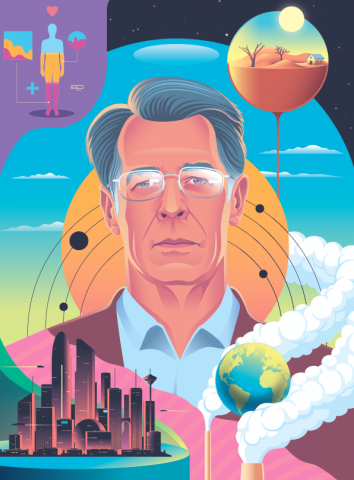
    (Illustration: Miguel Bucana for Socialter Magazine)

  • 20 October 2023

    Catching up with Robinson

    Catching up with Robinson

    It’s been a while, but I’m back with the usual list of links about everything KSR! On the program: MORE discussion of Ministry for the Future and some love for The High Sierra.


    KSR wrote an essay on Noema: Paying Ourselves To Decarbonize

    The people fighting to burn fossil fuels in this coming decade may be thinking they are doing their best to save their fellow citizens from ruin.

    The petro-states will have to be compensated, or they will become desperate and turn into such a force of disruption that efforts to avoid a mass extinction event will fail.

    We need to employ a kind of eco-realpolitik that refrains from too much righteous judgment, acknowledging that all nation-states are obliged to keep their citizens free from disruption, unemployment and starvation.


    Some KSR quotes in this Grist article: The summer that reality caught up to climate fiction


    KSR on Bloomberg CityLab Environment: Author Kim Stanley Robinson Has a Utopian Climate Solution: Cities

    California’s housing crisis right now is terrible. Suburbia is the culprit, cities are the solution.

    You need a space you can call your own. It needs to be functional. It doesn’t need to be a mini-mansion, as with the idea that a suburban house on a quarter-acre is like an English castle and you are a lord. It’s not just the carbon footprint. It’s the isolation of it into the nuclear family, the lack of collegiality and sociability.


    See also Bloomberg Green Climate Politics: How a Utopian Sci-Fi Author Writes Toward a Low-Carbon Future and Bloomberg Zero: A Sci-Fi Writer’s Guide to a Low-Carbon Future (podcast)


    KSR interview on Republik.ch: «Ich wollte schon immer erzählen, wie wir trotz Klimakrise eine bessere Welt erschaffen können» [in German; quote translated back into English, about Silicon Valley tech boys:]

    We would all like a simple solution to complex problems. But the world is not easy. I have met several of these people. These Silicon Valley types often come from engineering backgrounds and are poorly educated in history, political theory and economics. Almost all men. That alone is suspicious. The combination of patriarchal masculinity, wealth and arrogance makes such people believe that they can solve all the world’s problems themselves. But what’s actually more interesting than these guys is their idea that everything is technology. But that is only true and correct if you also view culture or laws as technology. Language, for example, is nothing more than software. Ultimately, these are the really powerful technologies.


    Some video interviews:

    A discussion for Grist’s Looking Forward Book Club: ‘At least zombies aren’t eating my face’ (vimeo)

    At a certain point, dystopia has run its course of what it can do usefully. So then you need the positive stories. I’ve been writing utopias since about 1987, so that’s adding up to a lot of years of just trying to do the positive because I think we need it more. And it’s harder, technically — it’s less dramatic. But it’s interesting because you get new stories that haven’t been told before.


    Into the Impossible With Brian Keating: on The High Sierra: A Love Story (YouTube) — also as a podcast

    UC San Diego TV: A Conversation with Author Kim Stanley Robinson

    About the Authors TV S04:E18 – Kim Stanley Robinson (also on Locus Mag and YouTube twice)

    Green Change: Hope Meetup (Facebook video)

    Planet: Critical: How Things Could Go Right (YouTube) — also available as a podcast

    A discussion for the SciFri Book Club: The Ministry for the Future: A Global (and Fictional) Response to Climate Change (book club announcement – Q&A livestream – YouTube link) + an excerpt from Ministry (Chapter 3)

    A classy video made for KSR’s visit in Denmark for Bloom 2022: Science Fiction is the Realism of Our Time (YouTube/vimeo)


    On to podcast interviews with KSR, of which there are many:

    • A recording of a 7/Dec/2022 event at San Francisco’s City Arts & Lectures: KSR in conversation with Eric Rodenbeck
    • Everyday Anarchism on the Three Californias trilogy: The Wild Shore, The Gold Coast and on Pacific Edge
    • Futureverse Part 1 (Unveiling Climate Denial and the Power of Community) and Part 2 (Surviving the 21st Century: Unraveling Utopia)
    • CarbonSmart: on Ministry for the Future
    • Book Club with Jeffrey Sachs : on Ministry for the Future
    • Seldon Crisis: Future Visions
    • A Skeptic’s Path to Enlightenment: Kim Stanley Robinson and Robert Thurman: Climate, Politics, and the Dalai Lama
    • Tales From The Bridge: A chat with Kim Stanley Robinson
    • An Ordinary Disaster: Wayfinding with Kim Stanley Robinson
    • Obvious Ideas: Kim Stanley Robinson On Our Climate Future
    • Pitchfork Economics: Sci-Fi Economics (including transcript)
    • The New Humanitarian: Rethinking Humanitarianism | What science fiction teaches us about imagining a better world
    • Unknown Worlds of the Merril Collection: Climate Fiction
    • Radio New Zealand: Imagining the future and finding hope
    • Create Tomorrow: Scenarios of the Future


    Some news about The High Sierra: A Love Story:

    • Alta’s recommendation list
    • Review: Tina Winstead for the Daily Star
    • The High Sierra won the Glenn Goldman Award: California Lifestyle, in the 2022 Golden Poppy Awards from the California Independent Booksellers Alliance


    How about some academic works about the novels of KSR?

    • 10,000 signs: Structures of Feeling, Technocratic Policy, and Violence: On the Nature of Historical Change in Kim Stanley Robinson’s Ministry for the Future (an extensive essay — part of that author’s dissertation on ecological SF!)
    • Mikes, A. and New, S. (2023). How to Create an Optopia? – Kim Stanley Robinson’s “Ministry for the Future” and the Politics of Hope. Journal of Management Inquiry.
    • Malm, A. (!) (2022/2023). The Future Is the Termination Shock: On the Antinomies and Psychopathologies of Geoengineering. Part One. Part Two. Historical Materialism.


    There’s still a lot of discussion going on about The Ministry for the Future:

    The Only Sky Humanist Book Club did a series of articles discussing Ministry for the Future:

    • How do we talk about impending doom so that people will listen?
    • Is real carbon sequestration possible under capitalism?
    • How do we make protests work for climate change reform?
    • Do we have the technology to ease our melting ice sheets?
    • Eco-friendly transportation? The good, the bad, and the pipe dreams
    • The struggle for a more global response to climate change
    • Can we ever truly combat climate change in a world at war?
    • How to spare billionaires from terrorist attack

    Some more Ministry reviews:

    • Amy Brady for Orion Magazine (includes an excerpt)
    • Tim Middleton for the William Temple Foundation
    • John Towner for the Ilkley Quakers
    • J.R. Burgmann for Climate Action Australia
    • Ministry in recommendation lists: Los Angeles Times
    • Ministry in the Science Friday Book Club
    • Ministry in Grist’s Looking Forward Book Club

    Articles inspired by or mentioning Ministry:

    • The Progressive Magazine: Triage and Transformation Strategies for the Climate Emergency
    • Los Angeles Times: California is working on solutions to worsening climate change. Will they be enough?
    • The Conversation: Telling stories of our climate futures is essential to thinking through the net-zero choices of today
    • The Spinoff: The secret reading history of James Shaw
    • New Scientist: The truth behind how to reduce your energy use and still live well
    • The Progressive Magazine: The Climate Catastrophe Is Already Here
    • OODA Loop: Macron’s Recent Paris Summit Remarks Read Like a Charter Statement for the Ministry of the Future
    • University of Oxford Said Business School: Our Ministry for the Future – Reshaping capitalism to help solve the climate crisis
    • Himal Southasian: Southasia’s place in contemporary climate fiction
    • Noema: ‘Burn Carbon, Get Taxed. Sequester Carbon, Get Paid.’
    • The Washington Post: A ‘climate solution’ that spies worry could trigger war
    • OODA Loop: Saudi Arabia and the Future of Money
    • Grist: From fiction to reality: Could airships be the key to greener travel?
    • BBC Future: To avert climate disaster, what if one rogue nation dimmed the Sun?


    And finally, some odds and ends:

    • Meanwhile! Marooned! on Mars, the podcast, is on to tackling Galileo’s Dream!
    • Three Californias recommendation on the Los Angeles Times
    • Tormod Johansen on psychogeology and an appreciation of KSR’s works
    • Red Moon review: Duncan Lunan for the Orkney News
    • Don’t Bank On It! KSR was a signatory in a letter to banks to stop fossil fuels expansion.

    Be sure to check out the events calendar — some European and US dates will appear!

    Until next time —

    (Top photo: by Carsten Snejbjerg, from Republik’s article)

  • 19 December 2022

    The Solstice Update

    The Solstice Update

    The world turns and I’m back with another impressively long list of links on everything KSR!

    Kim Stanley Robinson’s latest column in Bloomberg Green is on: “Kim Stanley Robinson Makes the Case for Counting Your Carbon“:

    Because not much is left in the budget, individual choices are worth thinking about and then changing.

    [..] There’s even danger that raising the question of how we live risks shifting the burden of change away from governments and corporations. That’s why the fossil fuel industry was the first to promote the individual “carbon footprint,” rather than face the poisonousness of its own product.

    It’s also true that individual action can do only so much to decrease the carbon burn of civilization, given its current infrastructure. An individual’s most powerful form of action remains politically supporting laws to curb emissions. It’s usually not very hard to figure out which politicians will do this. These are the real levers of effective action for individuals in our time: mobilization, solidarity, political mass action.

    […] So pay attention; feel your body; think it over. Be mindful of your carbon burn, and make what you burn really count. Don’t waste it. We’ve been cocooned in fossil fuels for too long, and busting out of that sheath of crap back into the wide world will be a liberation.


    Interviews

    KSR was interviewed by James Bradley for the collection Tomorrow’s Parties, edited by Jonathan Strahan, with “Twelve visions of living in a climate-changed world” consisting of short stories, artwork, and the KSR interview. The interview itself is available:

    So “2312” was written in 2010. In that novel, I provided a timeline of sorts, looking backward from 2312, that was notional and intended to shock, also to fill the many decades it takes to make three centuries, and in a way that got my story in place the way I wanted it. In other words, it was a literary device, not a prediction. But it’s interesting now to look back and see me describing “the Dithering” as lasting so long. These are all affect states, not chronological predictions; I think it’s very important to emphasize science fiction’s double action, as both prophecy and metaphor for our present. As prophecy, SF is always wrong; as metaphor, it is always right, being an expression of the feeling of the time of writing.

    So following that, “The Ministry for the Future” was written in 2019, before the pandemic. It expresses both fears and hopes specific to 2019 — and now, because of the shock of the pandemic, it can serve as an image of “how it felt before.” It’s already a historical artifact. That’s fine, and I think it might be possible that the book can be read better now than it could have been in January 2020 when I finished it.

    Now I don’t think there will be a period of “zombie years,” and certainly not the 2030s. The pandemic as a shock has sped up civilization’s awareness of the existential dangers of climate change. Now, post COVID, a fictional future history might speak of the “Trembling Twenties” as it’s described in “The Ministry for the Future,” but it also seems it will be a period of galvanized, spasmodic, intense struggle for control over history, starting right now. With that new feeling, the 2030s seem very far off and impossible to predict at all.


    KSR was, once more, interviewed by Jacobin: “We Need Democratic Socialism“


    That being the case, maybe now we can say this: we need to pressure our political representatives to do the right things for us and the biosphere. Mass demonstrations, either entirely peaceful or with a violent edge, seem to me appropriate now. The failure of the Biden administration’s Build Back Better act is not an indictment of that administration, but of the US electorate and political class; we should have elected a real working majority. Missing by one vote does not invalidate the goal or even the method; we need more votes in the Senate to get a true working majority. Then that majority has to legislate and pass the legislation. That’s one obvious tactic. I also think that breaking machinery in ways that don’t hurt humans may be appropriate.

    […] So, what I wanted to imagine in my novel is not any particular political formulation, but rather a messy and yet effective swerve away from a mass extinction event, which means, as a first step, away from neoliberal capitalism. One step at a time:  I think we need first a refusal of austerity and neoliberalism, by way of Keynesian stimulus; then social democracy; then democratic socialism; and then on from there.


    KSR appeared on the VERGE 22 event and spoke on a panel together with Delton Chen.

    NPR’s The Indicator from Planet Money podcast interviewed KSR and discussed the carbon coin idea

    KSR appeared on the Factually! podcast with Adam Conover to talk about The Science Fiction of Climate Change.

    KSR was interviewed by the Green Central Banking website: “Stabilising money requires stabilising the biosphere“:

    What was your rationale for putting central banks at the heart of a near-future novel about climate change?

    A couple of factors. One, the job of rapid decarbonisation of our civilisation, and all the other things we need to do to dodge the mass extinction event we have begun, is really immense. It will therefore take a huge amount of money, representing human time and effort.

    Also, a lot of this work isn’t necessarily profitable. Individuals are not clamouring to buy what is in effect a giant sewage system for the world, even if they like the idea of the result. Put these two factors together and we’re in big trouble, which we are. The central banks, being the creators and guarantors of money itself, need to be involved if we are to succeed.


    KSR spoke to North State Public Radio’s Blue Dot podcast about The High Sierra.

    KSR appeared on the The Laura Flanders Show (video).

    KSR was interviewed by the Between the Covers podcast special on “Crafting with Ursula [K. LeGuin]“.


    The Gold Coast

    Alta Journal‘s California Book Club organized discussions around KSR’s 1980s novel The Gold Coast.

    Essays and analyses:

    • Anita Feilicelli on the book’s influences and what it influenced in turn
    • Anita Felicelli: ‘The Gold Coast’ Pictures Orange County in 2027
    • Charles Finch: Past Meets Future
    • Ajay Orona: Vision As Moral Act
    • Stephanie Burt: The Simultaneity of Kim Stanley Robinson’s Past, Present, and Future Visions
    • John Freeman: The High Costs of Convenience
    • David Ulin: Why You Should Read

    Also included: an excerpt from The Gold Coast; and “Why I Write: An Acceptable Degree of Coherent Narrative“, a KSR piece directly adapted from his short story A Sensitive Dependence on Initial Conditions.

    The book club was capped by a conversation between KSR, Cory Doctorow and host John Freeman. A recap of the event is available, video on YouTube, as well as a full transcript.

    It turned into one of the most autobiographical novels that I ever wrote. And that’s usually dangerous ground for me. I wouldn’t recommend it. But this particular novel being the entirety of my 20s as written from my 30s, I was pleased with it that when I was done for one thing, the plot is a kind of a train wreck where the readers can see the train wreck coming, but none of the characters can.

    […] So there you have dystopia with ordinary people. 

    […] Yeah, Jim McPherson, Kim Robinson, I went to McPherson High School. It’s not particularly disguised that this is a novel about my earlier self and Jim is not a very good poet that was easy to imagine and becomes a kind of historian and doing prose poems, which is also something that maybe was speaking almost to my future self in the way that I was trying to do the rest of it. But Jim’s recovery of Orange County’s history, which is completely obscured and at first looks minor league indeed is really one of the things that pulls him out of the strange and shallow and kind of screwed up world that he’s in at the time. All that, along with his trip to the Sierras with his friend Tashi, all that happened, I can say that.


    Ministry for the Future

    Three chapters from MftF were included in “No More Fairy Tales: stories to save our planet“, “an anthology of 24 top climate solutions wrapped up in engaging stories” that was also distributed to the thousands of delegates and attendees of COP27. This is an initiative of The Green Stories Project, in association with Herculean Climate Solutions. (Note: these were chapters 42 on the carboni coin; 22 and 93 on slowing down glaciers melting.)


    Ministry for the Future reviews:

    • Caroline Underhill and Kevin Skinner for the Socialist Worker
    • Carly Madge for North Shore News
    • Case Muller

    Parade included MftF in its list of the 222 best books of all time (!).

    It was also in the Indie SciFi/Fantasy Bestseller List (US-wide independent bookstores).


    People who recommended MftF:

    • Business Day (South Africa)
    • European Council on Foreign Relations podcast
    • Climate Council (Austrlaia)
    • New York Times Events “How Can We Use Storytelling to Find a Way Out of the Climate Crisis?“, where KSR and Octavia Butler are discussed
    • Slate Future Tense Newsletter: Sci-Fi’s Lessons for Balancing Climate Hope and Despair
    • Photographer and author Grant Sheehan
    • Musician Brian Eno would like to do some MftF-inspired LARPing
    • Climate activist Bill McKibben recommends MftF and NY2140
    • Philosopher Bruno Latour on Twitter: “A good therapy for ecodepressed: place Graeber and Wengrow to open up the past & “The Ministry for the Future” by Robinson to open up the future. At once, you breathe a fresher air because you realize how poor in imagination are those who are stuck in between feeling powerless.”
    • Megan Koreman on Notre Dame Magazine
    • Business Insider: 10 fiction books worth reading that imagine what climate change could look like

    Articles related to or that make reference to MftF:

    • Breaking Travel News: OceanSky Plans Ambitious North Pole Airship Cruise
    • Nepali Times: Hotter summers in the Indo-Gangetic plains could lead to mass migration of people to cooler Himalayan climes
    • The Asset: No security without climate security
    • CNBC: White House Office of Science and Technology Policy (OSTP) Five-Year Plan for Research on Climate Intervention
    • The Engineer Scifi Eye: Engineering an extreme solution to climate catastrophe
    • Livemint: On market-based incentives for climate action in India
    • Business Standard: Geo-engineering and climate control in India
    • The New York Times “Debatable” newsletter: on full employment with an ageing population
    • University of Minnesota: Climate researcher Zeke Hausfather quotes KSR in his lecture on The Case for Cautious Climate Hope
    • OODA: The Water Wars in France Eerily Resemble Scenes from The Ministry of the Future
    • South China Morning Post: on climate change and a carbon currency
    • Propsect Magazine created an entire special report on the work of a real-life Minister for the Future (Introduction, full report pdf)


    The High Sierra

    There’s also news related to The High Sierra:

    • Alta Online book review
    • Book Riot recommends it
    • SF Chronicle recommends it
    • Mother Jones in its Best of 2022 list
    • Florida Times-Union recommends it


    Everything else

    KSR was included in Vox’s The Future Perfect: 50 scientists, thinkers, scholars, writers, and activists building a more perfect future.

    Richard Powers was awarded the 2022 Fitzgerald Award. Kim Stanley Robinson participated in a “Tribute to Richard Powers”, discussed with Powers in a “Conversation about the Art of Fiction” and introduced him to the award. The tribute recording is available online. File770 reported from the event.

    KSR spoke at the opening of the exhibition “Science Fiction: Voyage to the Edge of Imagination” at the London Science Museum. New York 2140 is featured in the exhibition.

    KSR recommends:

    • KSR wrote the Introduction to a new edition of George R. Stewart‘s “Earth Abides“, by Mariner Books.
    • Claire Nelson’s “SMART Futures for a Flourishing World“, A Paradigm Shift for Achieving Global Sustainability. KSR’s endoresement: “This visionary synthesis of our current global situation uses the tools of science fiction, prophecy, and policy analysis in combination to make a compelling description of where we are and where we could get to, in terms of making a good future for humanity.”
    • Gaia Vince’s “Nomad Century: How Climate Migration Will Reshape Our World“. KSR’s endorsement: “This book is a rather astounding addition to a growing body of thought that suggests the twenty-first century is going to include, and even require, lots of human migration–and that handled correctly, this could be part of a good adaptation to the climate and biosphere crisis we are now entering. What Vince gives us here is some cognitive mapping to understand the situation and see a way forward.”

    Mathias Thaler, from the University of Edinburgh, published “No Other Planet: Utopian Visions for a Climate-Changed World“, particularly focusing on works by N. K. Jemisin, Kim Stanley Robinson and Margaret Atwood.

    Finally, I’m no longer on Twitter, but there’s a new @KSRQuoteBot with “Daily quotes from the modern sci-fi author!”

    Happy winter solstice!

    (Photo: Powers and Robinson at the Fitzgerald Literary Festival)

←Previous Page
1 2 3 4 5 … 42
Next Page→

Upcoming Events

Notice
There are no upcoming events.
0 events found.

Events

Notice
There were no results found.
Notice
There were no results found.

Events Search and Views Navigation

Event Views Navigation

  • List
  • Month
Today
  • Today
  • Google Calendar
  • iCalendar
  • Outlook 365
  • Outlook Live
  • Export .ics file
  • Export Outlook .ics file

KimStanleyRobinson.info

The reference site for Kim Stanley Robinson

  • About KSR.info
  • Kim Stanley Robinson
  • Stan’s Favorites
  • Bibliography
  • Forum
  • Events

This is not an official website for Kim Stanley Robinson. To contact this website, send an e-mail to postmaster [at) kimstanleyrobinson.info – To contact Robinson or his publishers, visit the official Kim Stanley Robinson Facebook page – To inquire about a speaking engagement with Kim Stanley Robinson, contact the Hachette Speakers Bureau

Twenty Twenty-Five

Designed with WordPress