










Skip to content

KimStanleyRobinson.info

The reference site for Kim Stanley Robinson

  • Who is KSR?
  • Stan’s Favorites
  • About
  • Bibliography
  • Forum
  • 19 September 2022

    High Sierra and Ministry updates

    High Sierra and Ministry updates


    Now that summer heat is dying down, it’s time for the big infodump on what the prolific KSR has been doing of late. This is going to be a big one!

    First off, some interviews with KSR, out promoting his latest book The High Sierra, but also the ever-timely The Ministry for the Future.

    Bryan Alexander: Academia, climate change, and the future

    If a real revolution leading to a real post-capitalism comes into being by way of the public insisting on it, by demonstrations and votes, then how would that be bad? It wouldn’t be bad. So to hope for it is not naive or stupid.


    The New York Times: A Sci-Fi Writer Returns to Earth: ‘The Real Story Is the One Facing Us’

    “I decided that it was time to go directly at the topic of climate change,” Robinson said. “The real story is the one facing us in the next 30 years. It’s the most interesting story, but also the stakes are highest.”

    The Sierra Club (of course!): Minister for the Sierra

    “When I was younger, I didn’t notice interactions with wild animals as being transformative and important,” he admitted. “Now when I see wild animals up there, it’s like sticking my finger in a wall socket.”  

    The Orange County Register: The Book Pages: Kim Stanley Robinson shares the books he loves — and a story that improved with age

    I like the cover of my novel “New York 2140” very much. Otherwise, to tell the truth, I don’t much notice covers.

    Fatherly (Cory Doctorow): Growing Up Fast On Planet Earth

    I came home and I realized that it’s best to spend more time outdoors than we do. There’s a lot of people who know it’s fun to be outdoors because they’re carpenters and they’re outdoors all the time, and they like it. Farmers too. But writers, not so much. So a garden, working outdoors and then being an activist for environmentalist causes, greening everything in my life and my political aspirations of looking for what would be best for the biosphere.


    Book Forum: Mountain Song

    I start with a situation, usually. Say I want to write about terraforming Mars—then I need a terraformer, a person opposed to terraforming, a political radical, a Machiavel, a builder, a psychologist, etc. The French structuralists spoke of characters as actants, as the action-doers who make the plot happen. A single character could cover a couple of actants at once, or an actant could be split between a few characters. This I’ve found useful in clarifying things to myself as I get started. Therefore, characters are, at first, kind of just positions, or needed operators of the plot. But this is just the start.

    Another useful conceptual tool is protagonicity. Does a novel have high protagonicity or low protagonicity—meaning the story is maybe spread out among a lot of different characters, who might be considered minor characters, except there aren’t any major characters. The story I intend to tell determines or suggests how I might go about deciding this. 

    High County News: Seeing Mars on Earth

    I was surprised how many of my texts have some analogue to the High Sierra. Right from the start, I can see when Hjalmar Nederland is wandering around Mars in Icehenge, it was a Sierra wander. And that kept happening. It was true in my Mars Trilogy. To terraform Mars is really cheating. Mars is basalt rather than granite. It’s poisonous rather than healthy. So, turning Mars into the High Sierras required something like a 2,000-page novel to make it even slightly plausible. I like it when my novels find their way to get in a big walk 

    Sactown Magazine: Q&A with Sci-Fi Author Kim Stanley Robinson

    Once you got up there above the treeline in the Sierra, you were in a different space that was cognitive and emotional and spiritual as much as it was physical. And I think that has to do with the whole sense that humans are only visitors there, nobody lives there year-round. There’s something different about it. It really did take the whole book to try to capture what we were talking about with this single phrase, you know, “up into the God zone.” What the heck did that mean? We were young hippies, all very Buddhist, so it was simplistic hippie stuff, almost a joke, but a joke about a real feeling.


    The Times of India: Climate change is now the big story in world history

    I felt an obligation to stick with India, after deciding to put that first awful scene there, because it is in such a dangerous spot. I couldn’t just show the disaster and then walk away. Much of the novel is based in Zurich, Switzerland, the home base for my fictional Ministry for the Future, but the minister’s chief executive officer is an Indian (with a Nepali mother), and he and the minister and the story itself keep returning to India, to see what is going on there. This allowed me to show that positive developments in India, in agricultural practices and in governance, are world-class and could lead the rest of the world in positive ways.

    Entertainment Weekly: Why prolific sci-fi writer Kim Stanley Robinson’s latest book is about real-life mountains

    I had been wanting to write about the Sierras for decades, and The Ministry for the Future felt like the end of a sequence of novels, so that it was kind of a case of “now’s the time.” I was really ready for it.

    Literary Hub: Words of Hope, and a Defense of John Muir: Kim Stanley Robinson on His Love of the Sierra Nevadas

    I think this book is an anomaly in my career, a one-off. I’d prefer to return to novels and stay behind my characters and my stories, to get out of their way. But also, it’s as you’ve noted; I am a Californian writer, and have written about the state a lot, and of course The High Sierra is a major contribution to that part of my work.

    Extinction Rebellion: Q&A with KSR

    So on the one hand, I wanted to warn readers that bad things are going to happen; on the other hand, I wanted to describe humanity reacting to the climate crisis in an uncoordinated way that nevertheless dodges the mass extinction event we have started, and comes to a better moment in future history, where even more progress could be made.  So ultimately this was a kind of low-bar utopian novel, which presents a good future happening despite the lack of any strong plan imposed from above, or below or from the sides.  Instead it results from lots of people trying lots of different things. 

    Los Angeles Times: Sci-fi master Kim Stanley Robinson on the Sierra and why humans might just ‘squeak by’


    There are many places on this planet that are intensely beautiful and lovable. You don’t need to burn a lot of carbon to have a good time. The basics of paleolithic contentment remain the same in us and are available at any time.

    The New Institute: Capitalism is the Main Problem

    I think my Ministry for the Future says what i have to say about this issue, as a writer and novelist. I’ll let it stand for what I have to say for a few years and see how it goes. It’s making an impact— I don’t want to get in its way by adding bits or sequels or distractions of any kind. As a writer, I’ll pursue a few other projects and see what happens. 

    Farsight: “Mars is irrelevant to us now. we should of course concentrate on maintaining the habitability of the Earth”

    My Mars trilogy is a good novel but not a plan for this moment. If we were to create a sustainable civilisation here on Earth, with all Earth’s creatures prospering, then and only then would Mars become even the slightest bit interesting to us. It would be a kind of reward for our success

    Politico: Climate Catastrophe Is Coming. But It’s Not the End of the Story.

    I chose India because it’s the biggest democracy. It’s one of every eight people on Earth or even more. It’s a mess like any other democracy, but it has the potential to be a leader. Once I put the disaster there in Chapter 1, I made a promise to myself, to my mental India, that I would stick with India. It wouldn’t just be the place that the disaster happened and then everybody else solved the problem.

    Interview in Neue Zuercher Zeitung (in German): Ist Science-Fiction der Realismus unserer Zeit

    Die Leute waren unheimlich hungrig auf diese Geschichte. Eine Geschichte darüber, wie die nächsten dreissig Jahre gut ausgehen könnten: ohne Superhelden, ohne technologisches Wunder. «Ministerium für die Zukunft» füllte eine Nische. Das Buch scheint mir gelungen zu sein.


    Also, a couple of videos:

    KSR’s Keynote at Future in Review 2022 (with David Brin)

    Discussion “From science fiction to climate action” at Hertford College, Oxford


    Now for some podcast interviews:

    Storytelling Animals: Kim Stanley Robinson on Wildlife, the Martian Constitution, and Loving the High Sierra (podcast)

    Azeem Azhar’s Exponential View: Imagining Climate Futures with Kim Stanley Robinson

    Tin House Between the Covers Podcast: Crafting with Ursula : Kim Stanley Robinson on Ambiguous Utopias

    Everyday Anarchism: KSR on The High Sierra

    The Ezra Klein Show (The New York Times): A Weird, Wonderful Conversation With Kim Stanley Robinson

    Pricing Nature: Kim Stanley Robinson, Kate Raworth, and Delton Chen Discuss “Carbon Currency”

    Rick Kleffel’s Agony Column podcast on The High Sierra

    Planet A – Talks on climate change: Kim Stanley Robinson – On Climate Fiction and “The Ministry for the Future”

    Blue Dot: Kim Stanley Robinson and the High Sierra


    Plus, you can find more KSR writings in two recent publications:

    Tomorrow’s Parties: Life in the Anthropocene, edited by Jonathan Strahan, includes an interview with KSR by James Bradley: “It’s Science Over Capitalism: Kim Stanley Robinson and the Imperative of Hope” (MIT Press, Penguin Random House).

    In Noema magazine issue III: Rupture, Fall 2022.

    Kim Stanley Robinson contends that, in the vein of eco-realpolitik, the rest of the world needs to compensate petro-states for their lost income as they transition to a green economy — or they never will.


    So, the multi-media multi-mode book of Kim Stanley Robinson The High Sierra is available for nature lovers to enjoy.

    You can listen to KSR reading from the audiobook version – specifically the chapter Moments of Being (6): A Sierra Day: Under the Tarp. And read an excrept at Literary Hub.

    The High Sierra was in various recommendations lists and summer read articles: Redlands Daily Facts, Yale Climate Connections, The Christian Science Monitor, Adventure Journal, The San Francisco Chronicle, The Bend Source, Men’s Journal. Also in best sellers lists (in California): Alta Online, Daily News week 31, week 32.

    Book reviews:

    • Jon Christensen for Boom California
    • David L Ulin for Alta Online
    • Jeff VanderMeer for The Washington Post
    • Weighing a pig doesn’t fatten it
    • Michael Berry for The Christian Science Monitor
    • Marc Weingarten for The Wall Street Journal
    • Joe Mathews for The San Francisco Chronicle
    • Lima Public Library (Ohio)
    • Verlyn Klinkenborg for The Atlantic
    • Carlo Wolff for The Pittsburgh Post-Gazette
    • Joe Mathews for Zocalo Public Square
    • Cory Doctorow


    Meanwhile! The Ministry for the Future is continuing to make waves, which, given the abnormal summer the northern hemisphere has had, is not that surprising.

    Book reviews:

    • Bill Gates himself (+ in his summer books list + a whole little video on it!)
    • Lincoln Michel for Esquire
    • Michael Glitz for the Book & Film Globe
    • Walter G. Moss for the LA Progressive
    • Fred Phillips for Science 2.0
    • Alexander Wallace for Warped Factor
    • Space the Nation podcast

    As usual by now, plenty of articles are making reference to it or are using one aspect of it to build an opinion piece around current events. Here are the ones that I have found: The Economist on wet-bulb temperatures, Jayati Ghosh (Project Syndicate) on heat waves and Indian workers; Pete Golis (The Press Democrat) on California’s heat and water stress; David Wallace-Wells (The New York Times) on extreme heat waves, Stuff on New Zealand climate policy, the Bulletin of the Atomic Scientists on cities and extreme heat, Reuters on climate finance, Fareed Zakaria (The Washington Post) on climate policy options, New Jersey on heat waves and climate change reporting, Yale Climate Connections on imagining positive climate outcomes, The Guardian on climate and diet, Daily Kos on Goetterdaemmerung capitalism, The Fore on the carbon coin idea, The Story on climate fiction, The New Statesman on the importance of Utopian thinking

    Further recommendations of Ministry specifically and mini-reviews: Outlook India, Siouxland Public Media KWIT, Patheos, Conservation.org, Electronic Design, Rare Books, Institut Montainge (French).

    More Ministry mentions at Storytelling Animals book club, Rizolve, The Berkeley Daily Planet, Allison Stephenson Haus, Korean Quarterly, Slate podcast, Robert Reich, Lawfare, European Council on Foreign Relations, Illinois book club, The Carbon Almanac, Calgary Climate Hub book club.

    Ministry still finds itself in the American Booksellers Association bestsellers list.

    More translations of Ministry are out: in Italian, by Fanucci, and in Romanian, by Nemira/Armada.


    It looks like in 2023 thare will be a Slovenian theatre production, Bodočnost, that is inspired by Ministry!

    After this exhaustive list, it’s time for a break. More shortly.

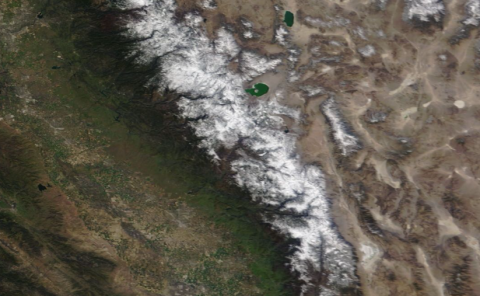
    (Top image: Sierra Nevada from NASA’s Worldview)
  • 10 May 2022

    The High Sierra published!

    The High Sierra published!

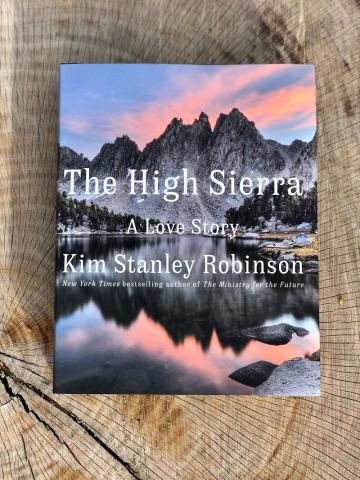
    Shortly after KSR celebrated his 70th birthday, today marks the publication date of KSR’s first non-fiction book (well, his thesis The Novels of Philip K Dick excepted), by Hachette/Little Brown and Company!

    It’s The High Sierra: A Love Story.

    Maps. Personal memoir. Aerial photos. Local history. Scientific diagrams. (Psycho)geology. Personal photos. Hiking gear advice. Numbered chapters alternating between different categories, à la 2312. And more. All about the Sierra Nevada of California.

    Robinson described it in this way, in an interview for Publishers Weekly:

    I hope that the book can inspire people to pay attention to simply being outdoors, the sky, the trees, walking—things that can be done anywhere. Some parts of the Sierra experience are very specific to the Sierras. Others are specific to simply being outdoors. I hope that people reading the book who will never get to the High Sierra will be thinking, “Well, that sounds like a good range. I wonder about my local hill—it’s got rocks, it’s got trees, it’s got sky and clouds, weather.” I hope it inspires them to find pleasure in outdoorness and the physical world, especially in this age of the internet and younger generations that are very often caught in their screen reality, to get out into that third dimension.

    In another interview for Sactown Magazine, Robinson discussed the new book, but also Mars and Ministry:

    But ordinary suburban neighborhoods could begin to think about less grass, less water, more native species and more wildlife corridors. There are things you can do as local landowners and as local citizens that begin to add up pretty quickly to a larger vision of the landscape.

    The Los Angeles Times include it in their May 2022 books and Esquire already recommends it as one of the Best Books of Spring 2022.

    KSR just presented The High Sierra at the Bay Area Book Festival.


    In other KSR news:

    KSR recently visited India to meet the Dalai Lama (!), in a Dialogue For Our Future event on Earth Day, during which time the Dalai Lama was given a symbolic bloc of melting Himalayan ice (report).

    Kim Stanley Robinson, who described himself as a science fiction writer, asked how Buddhism can help science. His Holiness told him that scientists have been interested to discuss ways to achieve peace of mind because they recognise that if the mind is disturbed people won’t be happy. He emphasised the benefits of discovering more about mental consciousness and learning to train it on the basis of reasoning.

    KSR also delivered the closing keynote for that, on Creating a Good Anthropocene (available on YouTube).

    KSR’s March column for Bloomberg Green was a Guide to Keeping the Doomsday Glacier Hanging On: “Send the navy—all of them—and the oil industry to Antarctica if we want save every beach on the planet”

    KSR wrote the introduction to The Dark Ride: The Best Short Fiction of John Kessel.

    In the newly published book/reader version of (re)programming – Strategies for Self-Renewal, Marta Peirano is in conversation with, among others, KSR.

    A very interesting discussion with KSR on buddhism, meditation and more on A Skeptic’s Path to Enlightnment.

    An interview with KSR by Andrew Majeske published as an article on the New American Studies Journal: Climate Crisis and Writing in the Anthropocene.

    KSR spoke to the podcast of the World Bank’s International Finance Corporation: the Ministry of the Speculative Carbon Market.


    Erzähler des Klimawandels (“narrator of climate change”), edited by author Fritz Heidorn, edited by Hirnkost, is a new KSR short stories collection has been published in Germany, together with interviews, discussions and guest contributions from Klimahaus Bremerhaven. With material from the 1970s to today, it is the first time these ten short stories appear translated in German. Review by Die Zukunft.

    KSR is also supporting the writers competition Klimazukünfte 2050 (“climate futures 2050”), organized by Hirnkost and Klimahaus Bremerhaven, to raise awareness about various climate futures.


    The paperback of Ministry found its way to the top sellers list of SF&F books! 

    More recommendations of The Ministry for the Future:

    • KlimaDAO cryptocurrency vision
    • Science Business article on solar geoengineering
    • Decatur Public Library book club discussed Ministry and New York 2140
    • Open Global Rights article on human rights and climate change
    • Columbia Public Library
    • Atlas Oscura founder
    • Falmouth Climate Action Network book club will discuss Ministry
    • Bradford/BWG Public Library
    • (United Arab) Emirates Literature Foundation
    • Nepali Times and The Indian Express and Worldcrunch and Planetizen mention Ministry in connection with the recent Inda/Nepal heat wave
    • Naperville Public Library recommends New York 2140
    • Ministry in Booktrib’s Solarpunk Futures list
    • Clean Technica and Climate & Capital articles on melting glaciers

    Ministry reviews:

    • Jo Lindsay Walton blog
    • Crispin B. Hollinshead for the Ukiah Daily Journal
    • Kundra Dixit for the Nepali Times
    • James Mumm blog
    • Solarpunk Life (video)


    Stay tuned as the interviews and reviews around the new book start coming through.

  • 8 March 2022

    The Ministry around the World

    The Ministry around the World

    The Ministry for the Future has generated quite some buzz in wide-ranging circles, not only in the science fiction circles but also in anything from environmental activists and current event commentators to international institutions and in anyone who is interested in imagining alternatives. It was helped by KSR’s appearance at the last COP but also by the current moment in public discourse, where it would appear we are at a turning point towards taking sustainability issues seriously, despite all odds.

    Some more KSR interviews and podcasts before and after COP26:

    At the 4th edition of the Paris Peace Forum: Engineered climate: The needed governance of Solar Radiation Modification (YouTube video)

    At the Climate Crisis Advisory Group public meetings of January 2022: What needs to be achieved in 2022 to ensure a manageable future for humanity? (YouTube video)

    At the Long Now talks: Climate Futures: Beyond 02022 (YouTube video) — a great long-ranging talk as the Long Now series tend to be, on Ministry and its reception, on what KSR learnt from COP26, and more.

    Of particular interest to Ministry and its focus on India, at the Jaipur Literature Festival (“the world’s largest book show”), in conversation with writer Raghu Karnad: The Urgency of Borrowed Time. The recording is available on YouTube. The event generated some buzz in India: a report on Mint Lounge, another report on News9Live.

    An Orbit Books discussion between KSR and science fiction writer Lincoln Michel about capitalism, climate change and the future of New York City.

    At TYT’s The Damage Report: A Climate Plan For A World In Flames (on YouTube).

    At the Your Undivided Attention podcast: How Science Fiction Can Shape Our Reality.

    At the Manchester Green New Deal podcast: Sci-Fi is a Metaphor for How Now Feels.

    A print interview in Spanish at Telos: El futuro inmediato será un desastre.

    Another one in Spanish at Contra el diluvio: Hay un nicho ecológico para las historias que cuentan cómo alcanzar un mundo mejor desde el presente.


    This website has existed for a while now — all the links above and the list of past events KSR has participated in can be found at the Archive of Events page.

    By the way, Ministry has been translated into Spanish (El ministerio del futuro, Minotauro) and German (Das Ministerium für die Zukunft, Heyne Verlag; includes a preview of the first 70 pages) — at least!

    Chapter 57 of Ministry was published on, quite fittingly, Anthropocene Magazine, and it is available to read.

    Ministry has inspired a whole new podcast: Climate Futures, by Annelisa Kingsbury Lee, has interviews with people researching the ideas mentioned in KSR’s novel.

    And meanwhile, Matt & Hilary’s podcast that is still called Marooned! on Mars has concluded 2312 and has begun its coverage of Green Earth!


    Ministry reviews, in no particular order:

    • Fritz Heidorn for Klimafakten (in German)
    • Thomas Hummitzsch in Die Freitag and in Intellectures (in German)
    • Maximilian Probst in Zeit (in German)
    • Frankfurter Allgemeine Zeitung (FAZ) (in German)
    • Marten Hahn in SWR2 (in German)
    • Borja Bilbao in Windumanoth (in Spanish)
    • Sean Estelle for Shred Magazine
    • A video discussion of Ministry with Sean Estelle, Jacobin‘s Daniel Aldana Cohen and the Marooned! on Mars podcast’s Hilary Strang and Matt Hauske
    • Elizabeth Anker for By My Solitary Hearth
    • Colin Steele for the Canberra Times
    • Gabriel (Gav) Sturm and Shannon O’Brien for Berkeley Science Review
    • Marc de Faoite for The Vibes
    • Tim Louis (Vancouver lawyer and former city councillor) for Straight and on his website
    • Danny Crichton for TechCrunch
    • David Fitzsimmons for Tucson/Arizona Daily Star (needs login)
    • Ted Glick for Dissident Voice
    • Gerry Canavan for the Los Angeles Review of Books
    • Cory Doctorow for Locus Mag and more on his blog and his other blog
    • Dave Gamrath for Real Change News
    • Steve Ghan for Tumbleweird
    • Ethan for Examined Worlds
    • Mike Sandler for the Foundation for the Economics of Sustainability
    • Gerard Madden for Rupture
    • Robert Christgau
    • David Oates for 3 Quarks Daily
    • Brendan Myers
    • Michael Kalm for Psychiatric News
    • Dave Gamrath for Green Valley News
    • Patrick Depret-Guillaume for the Garrett County Republican

    Book clubs! Ministry was selected by SciFiEconomics/Edgy Ryders, by Gaianism (where KSR also appeared, apparently), by the Albany Public Library and by Steamboat Pilot.

    Ministry was in The Economist‘s best books of 2020. It was in Grist’s reading list and New Scientist’s reading list for climate fiction. It was in Otago Daily News’ Top 10 of 2021 (New Zealand) and in Die Zukunft’s best of 2021. It was recommended by New Scientist’s Rowan Hooper, by Financial Times’ Pilita Clark, by Radio West and by the McGill Reporter. It was on international bestsellers lists as well as California bestsellers lists.

    Ministry also generated and inspired articles and thought pieces around the world. A non-exhaustive list and in no particular order:

    • A poem by Christyl Rivers inspired by Ministry!
    • An academic paper by Jeffrey Benjamin Meyers, Toward a Post-Apocalyptic Rule of Law, that quotes Ministry!
    • The Good Men Project podcast discussed climate science and Ministry
    • A Slate.com podcast on US politics mentioned Ministry
    • A Point Reyes Light article on discussing the future with younger generations refered to KSR
    • A Bloomberg article talked about research on heat waves risk in India and mentioned Ministry
    • A Washington Post article used the examples of KSR’s Ministry, Asimov’s Foundation and Herbert’s Dune in talking about long-term planning
    • An Irish Times article bases its argumentation regarding carbon trading around Ministry
    • A Lexology article on climate legal action (need login)
    • A Daily Maverick article on imagining the future
    • An Irish Times article on how popular culture can help address the climate crisis
    • A New Yorker comment by Raghu Karnad (who also interviewed KSR) on India’s climate action
    • A Bloomberg opinion discussing solar geoengineering
    • A Hankyoreh article (Korea) on Ministry and the Netflix series The Silent Sea
    • A Greenfield Recorder article on the importance of trees
    • A Fair Observer article on eco-terrorism
    • A Forbes article on “seven climate movies (and the one we need next)” (hint: Ministry is that last one!)
    • A CBC article on COP26
    • A Pebble Mag article on climate fiction
    • A CNN report from COP26 refers to KSR
    • A Caixin opinion on COP26 refers to KSR
    • An article by Andreas Malm for Verso Books (whom KSR has referred to repeatedly) refers to Ministry once again
    • A New York Magazine article on climate change reparation
    • A Hill article on carbonoffsets and cryptocurrency trade
    • A Discourse on Development article on the Half Earth concept and Aldo Leopold

    That’s “”just”” it from what I could gather on Ministry. Coming up in just two months in May: KSR’s non-fiction book on the Sierra Nevada, The High Sierra: A Love Story by Little Brown!

    (Top image from the latest IPCC report on climate change impacts)

  • 8 March 2022

    More things that happened

    More things that happened

    (Image by Anders Dunker for Rediscovering Earth)

    Continuing on The Ministry for the Future related news:

    Crooked Timber organized a full on-line seminar around Ministry, with some great content and great commentators. Links to all articles:

    • Henry Farrell: Technocracy and Empire
    • Maria Farrell: What is Ours is Only Ours to Give
    • Jessica Green: Can the World’s Bankers Really Save the Climate?
    • Oliver Morton: On Solar Geoengineering and Kim Stanley Robinson
    • Suresh Naidu: This Is How It Gets Better
    • John Quiggin: Half the Earth?
    • Olúfémi O. Táíwò: What’s In Our Way?
    • Todd Tucker: Ministry for Your Future Soul
    • Belle Waring: The Sudden Tempest of Ultimate Summer
    • Kim Stanley Robinson: Response

    Related to that, following a very successful book club on Ministry, Bryan Alexander interviewed KSR: Academia, climate change, and the future

    KSR gets a mention to set the context for an interview with Delton Chen, the man behind the carbon coin idea developed in Ministry, in the Wall Street Journal: Could a ‘Carbon Coin’ Save the Planet?


    More stuff that happened in 2021 that I didn’t previously cover:

    Interviews or events that have put their material online (I wonder what would happen to the world if YouTube were to go offline):

    • The mayor of Orlando and KSR delivered the opening keynote for the online event Higher Ground: Building the Cities We Need for Climate Change. Recording on YouTube.
    • At a webinar by the Institute for Carbon Removal Law and Policy, KSR spoke about The Global South in the Imagining of Climate Futures. Recording on YouTube. There’s even a transcript of the Q&A!
    • Fittingly enough for Ministry, KSR was interviewed by Zurich’s Tages Anzeiger: Wie die Welt gerettet werden könnte (in German, paywalled).
    • KSR also wrote a kind of a love letter to Zurich for Tages Anzeiger, remembering the year he spent there with his wife in the 1980s: In Zürich hatten wir zwei der schönsten Jahre unseres Lebens (“We had two of the best years of our lives in Zurich”; in German, paywalled, but there’s a nice photo!).
    • KSR spoke to the Libros Schmibros podcast, on his writing, Kenneth Rexroth, the Sierras, and more, see podcast services and on YouTube.
    • On the occasion of an exhibition on Mars at Barcelona’s CCCB, Mars. The Red Mirror, KSR spoke to CCCB: Mars: Utopia? Recording on YouTube.
    • KSR and Michael Mann talked at the Tucson Festival of Books: The Future Is Now for Climate Change, the recording is available on their site.
    • KSR talked at the Northern California Science Writers Association: The Future of Science and Society.​ The recording is on YouTube.
    • KSR participated to the Brazilian literary festival Relampeio: Eco-crítica na Ficção Científica. Recording available on YouTube.
    • At the University of Colorado Boulder’s 2021 Conference on World Affairs, KSR participated to an event on Fixing Spaceship Earth: Our Past, Present and Future. The recording is available on YouTube.
    • KSR and philosopher Roman Krznaric​ participated to an event organized by the British Library: Future Thinking. The recording is on YouTube.
    • KSR participated to an outreach event of the Intergovernmental Panel for Climate Change — more specifically, IPCC WGIII eLAM4 (!) — together with IPCC scientists and representatives of youth activist movements: Climate change and our future. Driving the transition. The recording is available  on YouTube.
    • KSR spoke to the French public radio/podcast, France Culture, on La méthode scientifique, about the whole of his career — nearly all of his work has been translated into French! His voice is dubbed over for the show.
    • KGB Bar’s Fantastic Fiction reading series had an event with KSR and Nancy Kress. The recording is on YouTube.
    • KSR joined Arizona State University/New America‘s Climate Imagination Fellows in a discussion on writing, also available on YouTube.

    Some short interviews:

    • In The Guardian, along with other SF&F writers: sci-fi writers on how they build their worlds. KSR’s bit starts with “I don’t like the term world-building”!
    • In The Atlantic, Don’t Cancel John Muir, KSR weighs in in favour of John Muir.
    • In The Mercury News, Dive into California’s science fiction scene — from LeGuin to Philip K. Dick, along with a short interview of KSR.
    • In The Washington Post, Climate change is the greatest threat to humanity. Here’s how filmmakers have tried to make sense of it all. — with a short quote by KSR.
    • In the Los Angeles Times, KSR gives his recommendation of fellow writer Jonathan Lethem and his latest nover The Arrest.
    • KSR recommeds and provided a blurb for Karl Schroeder‘s Stealing Worlds and Eliot Peper‘s Veil.


    Some things in print + Forewords:

    • A while ago, Arizona State University’s Center for Science and the Imagination published its digital anthology Visions, Ventures, Escape Velocities: A Collection of Space Futures. It includes an interview with KSR + quotes from Red Mars sprinkled throughout. It can be entirely downloaded on their site.
    • KSR’s 2015 essay, Our Generation Ships Will Sink, was included in the anthology What Future, edited by Torie Bosch & Roy Scranton, by Unnamed Press.
    • KSR wrote the foreword to Matthew J. Brown‘s Science and Moral Imagination: A New Ideal for Values in Science, by University of Pittsburg Press.
    • KSR wrote the foreword to the One Project book The New Possible: Visions of our world beyond crisis, by Cascade Books. Review.
    • An interview with KSR is part of Anders Dunker‘s book Rediscovering Earth by OR Books.
    • KSR wrote the introduction to a new edition of George R Stewart‘s 1949 Earth Abides, by HMH Books.
    • KSR provided the foreword to a collection of Stanislaw Lem‘s stories, The Truth and Other Stories, by MIT Press. Review.
    • KSR contributed to Liam Young‘s book Planet City, by Uro Publications. A visual book, “a vision of a future where 10 billion people converge in one hyperdense megalopolis, surrendering the rest of the planet to a global wilderness”! Article and visuals on this item. Another article.


    And, finally, something for the collectors! Thomas Gladysz gathered up the author trading cards from author events at the Booksmith bookshop in San Francisco, see his website with the complete details. Kim Stanley Robinson had two, #314 from 1999 celebrating the release of The Martians, and # 911 from 2008 celebrating the release of Sixty Days and Counting.

←Previous Page
1 2 3 4 5 6 … 42
Next Page→

Upcoming Events

Notice
There are no upcoming events.
0 events found.

Events

Notice
There were no results found.
Notice
There were no results found.

Events Search and Views Navigation

Event Views Navigation

  • List
  • Month
Today
  • Today
  • Google Calendar
  • iCalendar
  • Outlook 365
  • Outlook Live
  • Export .ics file
  • Export Outlook .ics file

KimStanleyRobinson.info

The reference site for Kim Stanley Robinson

  • About KSR.info
  • Kim Stanley Robinson
  • Stan’s Favorites
  • Bibliography
  • Forum
  • Events

This is not an official website for Kim Stanley Robinson. To contact this website, send an e-mail to postmaster [at) kimstanleyrobinson.info – To contact Robinson or his publishers, visit the official Kim Stanley Robinson Facebook page – To inquire about a speaking engagement with Kim Stanley Robinson, contact the Hachette Speakers Bureau

Twenty Twenty-Five

Designed with WordPress